Literarisches Events (in and around Lawrence KS)

  • JULIA TRECHAK & NATE BARBARICK. Lawrence. Thurs., May 23, 7:00 p.m. Raven Bookstore, 6 E. 7th St. FREE
  • ROBERT GLICK & KATHRYN NUERNBERGER. Lawrence. Sun., July 14, 5:00 p.m. (preceded by open mic). Eighth Street Taproom (x New Hampshire).
  • JOSEPH HARRINGTON, JONATHAN MAYHEW, & MARY KLAYDER read work by OTHER PEOPLE. Lawrence. Thurs., 25 July, 7:00 p.m. Raven Bookstore, 6 E. 7th St. FREE.
  • DENNIS ETZEL, JR. (et al.). Lawrence. Thurs., 26 Sept., 7:00 p.m. Raven Bookstore, 6 E. 7th St. FREE.
  • KIT ROBINSON (& al.). Lawrence. Sun., 6 October, 5:00 p.m. (preceded by open mic). Eighth Street Taproom (x New Hampshire).

Tuesday, May 21, 2013

Artist's Statement (?)

Last semester, I asked my workshop students to write an artist's statement or poetics statement, per their respective conceptions of either or both, in an idiom most everybody could understand. I did the exercise along with them, as I always do.

~~~~~~~~~~~~~~~~~~~~~~~~~~~~~~~~~~

I write (currently) in 2 modes. One is like collage: I take a lot of documents, photos, & found material, select certain parts or quotations, then weave them together w/my own words to form a narrative. About history. These are long poems - book-length. They're very much in the modernist tradition of Ezra Pound, early Louis Zukofsky, Charles Olson, Muriel Rukeyser. Hopefully they're entertaining as well.

The other mode is the serial poem: longish poems, made up of smaller segments - "poemlets," you might say. These are written over a period of time - maybe a month, maybe a year. They are the opposite of the collage poems, in that these are very voice-based - a persona - who speaks in complete sentences, but they don't always make good sense. Sometimes perverse sense. These tend toard satire. They are influenced by the essays and novels of Joy Williams, a lot of contemporary US poets, and Hannah-Barbera cartoons form the 60s.*

In general, what I like best about poetry in the US today is that it can mean anything. Once upon a time, novels were novel . . .

* I've been calling these "f*d-up nature poems," but I think maybe the polite term nowadays is "necropastoral"?

Tuesday, May 14, 2013

Joe's Marginalia: from C.S. Giscombe's _Prairie Style_

re: “Lazy Man's Load”

lazy -- pleasure -- erotic -- lazy

make a coherent? soul / statement

End w/a story at the beginning --> one that predicts the future (as usual)
    - story as argument aimed at closure
    - can openness be coherent?

lazy --> insouciant --> servantless (--> pleasure)

Shape - same-ness > “low point” > lowest common denominator

story vs. impulse --> or are they really different?

Then a real story (within a story)
    - “I” connects himself w/Ishmaelites wandering

Let the “Let be be finale of seem” be
The outsider/outcast defines location. Who says “be”?

Pleasure as authority --> normative, prescriptive

Facts: (geography &) trains --> of thought --> region

“In-d” = “In-land”
Movement as pleasure (range as opportunity, not thrust)

Crossing town, solve a (future) equation, voice to complete
    - articulation vs. actual closure, results (pleasure that’s over)

Wants juxtaposition to be self-evident.
BUT > it’s the connections that make the story

Close in w/story --> an inquiry, not a conclusion
    - a lot of vacancy in a vacant lot
    - would be remiss to leave it at that?

Pleasure > desire > implies absence of object

Mixed feelings > geography shapes thoughts, language, as well as vice versa
    - what’s a town w/o its monster?
    - range requires people who range upon it

Meanings achieved avoid others, cancel others

Friday, May 10, 2013

Joe's "Marginalia": _Humanimal_, by Bhanu Kapil

section 43

What is a companion text? A feral text? A companion animal, a companion dad. A memory of the past = a reanimation of the corpses. His legs smashed up in a beating, hers by the Reverend Doctor (or vice versa). His coarse, black hair didn’t fit the picture, so he put his seal skin back on and dove into the sea. Skin is always exposed - “where is that protection that I needed?” Why can’t everyone’s be the color of the sky? Wasn’t somebody’s, on Star Trek? Then there’s Blue Man Group, with their faux-feral minstrel show. But a monster hybrid cyborg leg has silver chunks. Diving in makes one invisible > the jungle as womb, the sea as mother (again), the photo as frame. O to be a geometrical figure, a punctual self. A white dot wouldn’t even show up against the sand. I don’t need you to count my legs, Sethe said.

section 56

Planting a child in roots and pray for rain - abandon her in a room or a root. Sounds of people, sounds of seagulls. All these abandoned kids: Moses, Rom ‘n’ Rem, fairy tale princesses’ mistaken identities. Or a standing question, a standing wave. “She” is immortal, silver cyborg, invincibly rising up from the earth of which she is also part. Going into the woods, away from the people, is the safe way, pace Hansel and Gretel. The writer is her own fairy godmother. Her father’s mother at the end. The invisibility of it all - in the jungles, the waves. Don’t blink or you’ll miss her.

section 58

Rewrite her. Make it all tropically and then it will come out, make a nest of rough black hair. Lumbering like a selkie on dry land, slow. She is watching herself, her psyche, in a muse-ment. Something there is about an orphan girl. When you write her name, she will appear.

Thursday, May 2, 2013

Joe's Marginalia: _The Lust of Unsentimental Waters_, by Rosa Alcalá

Re: "Safe Distance":

Safe from what or whom?
What we think we know . . .
We are split - distant from
ourselves?

History shapes our bodies (ask someone who was whipped or branded). And our bodies are a history (ask someone who is old).

Is the body a museum - of bad habits, shrapnel, treasures?
Who's the looter then?
"You will destroy an empire," the oracle said - He thought it meant someone else's --

I dunno - an empire as pawn-shop does pretty well . . .

No love is safe, period.
Lack of imagination = pawned ideas?
a heap of secondhand broken images

We're "working out patterns" wreading this poem

war and translation often go together --> & the former can be metaphor for the latter

the sensitivities are lost in translations, as "I don't know but what . . .": the stranger will never use the same words

As if war is war; the body, physical and not a trope.
Who wants to hear that in a poem??
But we suspect it might be true - that 1400 people can die in a factory collapse. Due to negligence and intimidation.

Just not here.

If you really felt that, how stay sane?
At best, a mere conversation.

"Cancer is my default horror" --> the body's history splitting it apart

(sex is always news)

the body politic as real thing

people are relationships, singly or in groups

can't we hide in metaphor, please?

Go away, Myself!
call me up or out --
carry me over into
a place I've never seen.

~~~~~~~~~~~~~~~~~~

Re: "Sea Body":

Those are pearls that were his eyes and wouldn't he have wanted to move the harbor at will, rather than be rich and strange five leagues under?

"This" can only refer to what's already here - so is it my internal compass? My faulty "moral compass" wiggling its point?

"North is whatever direction is in front of me"

This poem is going south - slip-slidin away, maybe

Experiment often takes you where you didn't think you'd go --> dangerous for the single-minded, the Ahab who will get sucked under into the drink from his own rigid steps

My what bright fish you are - finding the goodies of the deeps (unconscious?)

The water is waiting and wants you > "wreck" suggests "ship" (and vice versa?)

Davy Jones' Locker is another dog's kitchen cabinet
The gods made their victims into stars

Is "this" wreading "coming home"?
Or is home coming to me?

This is a poem about love
This is a poem about getting old
This is a poem about love getting old
growing


Friday, April 5, 2013

In Which I Travesty a Canonical Roman Poem

 
1

Sweet cheap wine, taste
with woodruff and berries and fingers

blood-red tulpen    snow-white, too
not snow-white snow –
woo-hoo     woo-hoo

Tantalizing green sets off
redbud seams in draws –

(It’s only natural to love the new
(those who get old r creepy

So black or fair me laddie-o
the ladies all come courtin’
Corinna fair and Paddy-o
with Lycidas are sportin’ –

(woo-hoo, &c.)

Birdy-snake / birdy-snake / birdy-snake
over-under-over-under-over-und
fluttering parti-colored spokes
All that happens tomorrow &
tomorrow,
woo-hoo.

When we play the poem down again,
half-empty or half-full,
then half nothing,
the maypole ribbons, guy-wires

of th’universal antenna, the dick,            
wind down, alas, as well. 
All’s well            ah well,
Woo-hoo.


2

Finally, a toasty breeze!  instead of
freezing my ass off in a fricking gale –
Flowery foresters are out, I’m out,
everyone’s out to each other,
fast in a bass boat or walkin the dog

Cytherean Venus and the Nymphs,
decked out as hippie chicks, play
an outdoor gig – or some Ultimate –
while her sucker husband
has the day shift in the boiler room

nobody wears lilac, myrtle –
none of that sissy stuff 'round here –
but if they did, they’d do it now.
Jesus, stop sacrificing for once
in your life!  It’s nice – play ball!

Soon enough the ump of all
will call you out at home    hence
delayed gratification means an ox-eye,
moron.     So: retire immediately, Joe –
before you retire for good,

a weirdo ghost, to a flickering home
from whose bourn you don’t get back
your winnings, winings, whinings,
or self.  Nothin but sixes and tens
then – and no randy dallying, sure.

Monday, March 25, 2013

Sheesh - that was fast!

My review of The First Flag, by Sarah Fox, is already "up" at Tarpaulin Sky. Shazam!

Hadara Bar-Nadav is my "Pick of the Week" at KWH

The fabulous folks at Knox Writers House asked me to choose the "Pick of the Week" from amongst their voluminous archive of poets' reading their work. So many possibilities! I ended up choosing Hadara Bar-Nadav's poem "Lullaby (with Exit Sign)," which is also the title of her new collection. See what you think!

Sunday, March 24, 2013

Joe's Marginalia: in THE FIRST FLAG, by Sarah Fox


So these are the symbols?
Dictated poetry?

ergo political

mother as danger

male parthenogenesis

fecundity

the transformation

into mother

a monster?

hierarchical differences

human / earth
body replaces
bone cage

“A Vision in a Dream”

wedding

like Plath
(how she wrote not
how you think she wrote)

one must handle words as neonates

“essay”

dispersion indeed

WhyTM?

How pronounce “Pwah!”?

combines two strains

i.e., would

I-Ching hexagrams

Fuck-u poem

This one more Antin [David] than Antler?

pleasantly chatty a la O’Hara

Is this transitional?

Footnote Numbers in Body Text

“after completion”

Kristeva, Irigaray / Klein, Jung

reader

relation of history to myth?

Paradoxes and Oxymorons

great!

SP;QR

of poems?

hopeful vision –
but not “beyond gender”

image+text

from “I cut”

like anatomy drawings

womb
tomb

C-section

resists further marking

D.E.S.

* father

re-wombing

electrical – cyborg

horses

Return of Patriarchy

Herr Doktor-Vater

shades of Iatrogenic --> spec-po

All one dream?

Aftermath

Ursula > devouring mother

shadow(s)

crows

Future

“medicine” & “poison”

coma – real?
comma – yes

re-birthing
+ dead babies

rein-
carnation

Alchemical cycle

centered

Object Relations – Projective Identification
                Tower – Cauldron
[chiasmus across the Comma (cut)?]

tower/well --> penis as inside-out vagina

story

yikes!

Brenda-Coultasy direct address

what is it w/horses?
Do they exist outside
human gender-codes?
Yes and no.

& bears

not nec. good
for the soul – or body

Lets things be overdetermined
(in the original (psychoanalytic) sense.
Jung was a science-making daddy.

like the deer carcass

dream + waking intermingled

once upon a

lots of Rome here

ha!

what’s time got to do with it?

Mr. Honey is creeping me out, here

mortality

that sounds like time

ref. to “Comma”

back to the tone of parts 1 & 2

satire

Dante’s big rosebud

Epona + Sequanna

D.E.S.

yikes

Vicuñesque

the glowing teeth earlier

Father with a Thousand Faces

found deer parts

turning point

present tense

buck to her doe

conclude & contain

ends w/real placenta
as it must

Wednesday, February 27, 2013

It's . . . The NEXT BIG WHATEVER!

Many thanks to poet, critic, teacher, podcaster and Kennedy-assassination historian Tony Trigilio for tagging me for this undertaking.

What is the working title of your book?

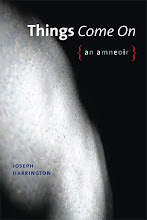
Hmm. That’s a tough one. I had one out a couple of years ago called Things Come On (an amneoir). But we’re talking Next Big Thing, not Last Big Thing, so . . . Well, I’ve got a chapbook forthcoming (from Bedouin Press) called Of Some Sky. But that’s a chapbook, not a bookbook. I do have a completed manuscript called No Soap, which is under consideration by a publisher (and has been for some time now, in fact). Let’s talk about that one, how ’bout.  Is that OK?

I’m not allowed to give answers. I am merely a pre-written list of questions.

Ah. OK. Carry on.

Where did the idea come from for the book?

It’s part of a series of books about my mother’s life and times. No Soap is kind of a prequel to Things Come On. That book dealt with the end of my mother’s life. No Soap deals with the beginning of her life - before the beginning, in fact. I’m writing her biography, but writing about a lot of other things in the process – the south in the Great Depression, women artists, Capitol Hill during the Cold War, memory, aporias, the archive – but I’m getting ahead of myself. In answer to your question, actually, my mother died when I was 12, and I wanted to know more about her than I did. That – and a compulsive desire to research, think, and write – got me started.

What genre does the book fall under?

“Fall under” is a great choice of terms. I’ve been filling out an NEA fellowship application, and you have to choose nonfiction or fiction, poetry or drama, but no combination of these, let alone some new genre that hasn’t been invented yet (like the NOVEL was, in the early 18th century). In other words, generic boundaries are part of official US government policy. So we all fall under, in a way.

But I have a hard time answering this question. My book is a mixture of prose and verse, dialogue and photographs. One page might be laid out like the Soncino Talmud, the next like a medieval manuscript, the next like a braided narrative poem. I guess I was thinking of the scrapbook as a model, more than anything – the post-WWI scrapbook, when American families started to use it as a memento and record of the family and immediate community. Those scrapbooks not only contain newspaper articles, like the older ones, but also artifacts: concert programs, coasters, bits of wood, whatever. So it’s a sort of wunderkammer.

??

You know . . . those curiosity cabinets they used to do in the 19th c. – where a platypus skull would be next to a rock from the Parthenon or whatever, next to an African mask, etc. etc.

Which actors would you choose to play your characters in a movie rendition?

Nobody you’ve ever heard of. Just: NO FAKE SOUTHERN ACCENTS. You think we can’t tell, but believe me, we can. I wouldn’t mind having Ken Russell direct it, but he’s not available, apparently. Wes Anderson could bring the right sensibility, but I think our storytelling styles are rather different.

What is the one-sentence synopsis of your book?

In No Soap, an adult son, who as a child lost his mother, tries to speak with his mother when she was a child through a scrapbook-like montage, and ends up taking an unforeseen tour of the early twentieth century. Does that make sense?

I can’t . . .

Oh – right. Sorry. Never mind. It sounds cheesy as hell, but it’s the best I can do.

What else about your book might pique the reader’s interest?

Well, the term “no soap” is 1930s slang for “no luck” and a term my mother, Lib Peoples, used frequently as a teen. Her grandfather, a timber baron, went bust; her father died; her house burned down; she grew up in a race- and class-divided South during the Depression and the Great Flood of ’37; she studied at the Chicago Art Institute but had few creative outlets in her small town. This is by far the most exciting story-line I’ve ever worked with. But, like the traditional romance plot, the story has a somewhat happier ending, as the heroine discovers how to gain a little power, escape her hometown, and open up new possibilities for herself.

Throughout No Soap, I try to ask Lib questions, to talk back, to (literally) write between the lines. What results is sometimes sober, sometimes wacky. A lot of it has to do w/displacements – of past/present, memory/document, self/other.

Will your book be self-published or represented by an agency?

Are those my only choices?  “An agency”? . . . Uh, I write experimental nonfiction and poetry. . . . But like I say, it is . . . currently looking for a home. Like the boll weevil.

How long did it take you to write the first draft of your manuscript?

Jeez – I don’t remember. The whole multi-part project blurs together. I think I got the idea for the whole thing in around 2002, and it has grown alarmingly. I’ve been writing while I researched, and revising one part as I put together the next. And I’m now composing the last part. I try not to think about things like this, actually.

Who or what inspired you to write this book?

My mom, first of all. And innate curiosity and epistephilia. As to models – I can’t imagine having written any of this project without the example of Theresa Hak Kyung Cha’s book Dictee. Michael Ondaatje’s early mixed-genre work; Susan Howe’s “historical” works (esp. The Midnight); Eleni Sikelianos’ The Book of Jon; Lyn Hejinian’s My Life – all these went into the mix, in different ways. I’m also inspired by the tradition of American “documentary poetry,” from Muriel Rukeyser’s “Book of the Dead” to Olson’s Maximus Poems to the many practitioners today – as well as mixed-genre work, from William Carlos Williams’ Spring and All down to recent titles from places like Coffee House Press and Ugly Duckling Presse’s Dossier Series.

(For a whole slew of influences and “further reading,” see the “Reader’s Guide” to Things Come On at Wesleyan University Press’ web site.)

So . . . is that it? . . . Can I go now? . . . Wait – don’t answer that – 

But, hemm. Whom to "tag"? Everyone I asked is either too busy, has already been asked, or considers it beneath their dignity.

Cheryl Pallant, perhaps? Aby and Matthew Cooperman? Lea Graham? Rachel Loden? Grant Jenkins? Jonathan Stalling?

Wednesday, February 20, 2013

"No layoff from this condensary" (NOT!)

--> So, I wrote a curmudgeonly Facebook post: “Sometimes I think that most poems are just too damn long.” This ostensibly harmless superannuated harrumph garnered an impressive string of comments whose implications ranged from Bronze-Age Greece to neoliberal globalization.

I guess what I had in mind is the recent proliferation of “lyric” poems that go on for two, three, or more pages (often as part of books that go on for 100+ pages), but don’t go anywhere, do anything, or say anything new within those pages. Even some famous poets. I mean, I like a bowl of oatmeal every now and then, but not a vat. You’re going to have to at least throw in some damn raisins or brown sugar or whatever, somewhere in there.

Or, to switch the metaphor: Frank O'Hara said "only Whitman and Crane and Williams, of the American poets, are better than the movies." And Spicer went him one better and said should be more entertaining than TV. But much contemporary “experimental” lyric is like watching a TV test pattern for an hour, instead of a show. It’s a damn good test pattern, mind you. If you enjoy that sort of thing.

There are concise long poems. Read late Niedecker, for some great examples. Or Homer. But then, he’s got narrative to carry you along (what today we might call “blow-up action”). True, there’s the catalogs (esp. the “catalog of ships problem,” as Ed Sanders calls it). But the function of those is to immortalize the warriors, so that current and future warriors would want to keep serving the “gore-goons” in order to assure their own poetic immortality, too.

However, it is exceedingly hard to write a long lyric poem of any sort, IMO.

Ashbery does it. In fact, I don’t care for his shorter poems, because his poetry works by process of accretion. And it thematizes meandering. You can’t meander much in 14 lines. You can’t forget where you were going, or set down in a completely different place than you had intended, which I take to be his point. The Language Poets wrote some very long texts with a high degree of formal internal similarity; but I finally realized that, if you reject closure, you can’t stop writing!

But how many poems make long-ness a topic? Or are even aware that their readers experience them as long – TOO long? Maybe Berryman’s mother was right about boredom evincing a lack of inner resources, but I have to sympathize with the guy. (Notice how short the segments of Dream Songs are, btw. This is why I like the serial poem – you can keep going, but any given segment doesn’t put you to sleep).

Part of the problem may be the poetic-industrial establishment. People who write poems want to get jobs teaching poetry – jobs that might even reward them for writing and publishing poetry. But they have to publish poetry in order to get those jobs. And like all things within neoliberal capitalism, size matters. Production, baby – that’s the name of the game. “My book is 30 pages longer than your book. And those 30 pages are a lyric poem that doesn’t use the vowel ‘o.’ So there!” Number of degrees, number of pages, number of books. An arms race.

[And of course, all this is happening as the economy is imploding, the climate is going haywire, an increasing percentage of an exploding population is in increasing misery, and the entire world is sinking into high-tech neo-feudalism. But whatever – back to our rant:]

The “Slow Poetry” movement (don’t blink or you missed it) emphasized production: handmade, letterpress editions rather than print-on-demand, mass produced verse. That’s fine. But the bigger issue, it seems to me, is consumption. In the accelerating world of po-biz (and every other biz), everybody has to read (or pretend to read) more and more, just to keep up. Given that the SIZE of poems seems to be increasing, this situation makes for some pretty shallow speed-reading of poems. Which is, of course, fucking ridiculous. Speed read economics textbooks, how-to books, engineering manuals even – but poetry?? What’s the point?

If you’re telling the story of a twenty-year war and sea voyage, then, sure, you’re going to need some space. But Paradise Lost?? I’m sorry – Dr. Johnson was right. And Ronald Johnson was right, too. Have you read any of Keats’ odes? OK. Have you read “Endymion”? More than once?

There are poems I like that are too long. There are long poems that contain passages that are to die for (when the rest is dross). There are books that contain many long poems, where the shorter poems shine like diamonds in the - well, oatmeal. Any time I’ve written a poem longer than a page, I compulsively grab my wallet. And then start cutting. I’m notorious – ask my students. I’m the psycho poet text-slasher.

And I like word-play as much as the next guy, up to a point. But look: if you’re clever, we’ll realize it after half a page. You don’t have to go on and on to convince us. Too many younger poets engage in endless verbal acrobatics that seem as desperate as a group of 4th-year MFA students at the AWP book fair.

And you know what? If you send a short poem into the slush pile – it might just get read, for a change.

Now – got to get back to writing my epic.