Literarisches Events (in and around Lawrence KS)

  • PATRICIA LOCKWOOD. Lawrence. Thursday, September 11, 7:00 p.m., Spooner Hall, KU Campus.
  • PATRICIA LOCKWOOD. Lawrence. Friday, September 19, 7:00 p.m. Lawrence Public Library. Sponsored by Raven Bookstore.
  • DENNIS ETZEL, JR. & RACHEL CROSS. Lawrence. Thursday, September 25, 7:00 p.m., Raven Bookstore, 6 E. 7th St.
  • TONY TRIGILIO. Lawrence. Thursday, Oct. 2, 4:00 p.m., English Room, Kansas Union, KU Campus. FREE.
  • CALEB PUCKETT & JUSTIN RUNGE. Lawrence. Thursday, October 16, 7:00 p.m., Raven Bookstore, 6 E. 7th St.
  • BEN LERNER. Kansas City, MO. Thursday, October 23, 7:00 p.m., Epperson Auditorium, Vanderslice Hall on the KCAI campus, 4415 Warwick Blvd.
  • KRISTIN LOCKRIDGE & ROBERT DAY. Lawrence. Thursday, December 4, 7:00 p.m., Raven Bookstore, 6 E. 7th St.

Thursday, June 18, 2009

Craig Perez Read, and YOU MISSED IT . . .

Well, son-of-a-gun. Craig Perez comes all the way from California, but nobody could drive 45 minutes from Lawrence to hear him read. O Kansas! O Humanity!

You missed a great reading. Craig is a terrific reader of his own work. If you've read his stuff, you know he likes using the entire space of the page - the archipelagoes of words and the oceanic blanknesses and so on. For me, reading his book the first time, it was a very visual experience. So it was good to experience the music of it by hearing him read. Robert Duncan and Charles Olson had complex systems of inflections and pauses based on their spacing and placement of lines. I didn't hear that, but I did get the narrative flow better - and the way Craig interrupts it or impedes it with a counter-narrative. The first poem he read, for instance, "from Achiote," I really heard the way that the Chomorro words threaten to scuttle the story of indigenous rebellion and Spanish conquest.

He read a para from a recent review of his book (positive overall) which took him to task for interspersing the longer historical narratives with "de rigueur lyrics," or some damn thing - b/c of course politics and lyric poetry don't mesh, n'est pas? Well, I wish he'd read some more of those lyric poems, esp. in context - as reflections on and interpolations into the narrative material.

He also read some new pieces in the voice of "Juan Malo" - a trickster figure who reminded me of the John of the "John and Ol' Massa" stories.

The reading was in the "Missouri Valley Room" (the local collection), which has a wood-panelled, clubby feel - and there was a fairly good crowd - and Craig was funny and charming - so it didn't have quite the cavernous, distant vibe of the CD Wright reading in KC. But still an older crowd than for Lawrence readings (naturally). I was pleased that the Q&A turned to questions of Guam sovereignty (or lack thereof) - a real case-study in how poetry can lead to a political-historical education.

My first time at the new KC main branch public library. A veritable palace.

Wednesday, June 17, 2009

Craig Santos Perez in KC Tonite

If you are in the Heart(o'darkness)land, be sure to come to the reading tonight with Craig Santos Perez, author of from unincorporated territory, at the Kansas City Public Library, main (downtown) branch, at 6:30 this evening.

Tuesday, June 16, 2009

Fact-Simile 2:1

OK - so I'm going to write a description (as opposed to a "review" - see previous post, below) of Fact-Simile 2:1 (summer 2009). Well, as with previous issues, much of it is in the open form/field tradition - lots of white space, structural/sculptural lines. But there are other experiments with spatial form, e.g., Michael Leong's "Elementary Morality," which makes use of columns (I'm not even going to try to reproduce it on Blogger). I like this mag b/c the poems aren't in code. For instance, Andrew Peterson writes:

George Washington died of a colonist's disease.
Him and his high horse.
Distasteful as money in the mouth is.
(I still play for quarters, occasionally.)
Wound open late nights.

So OK, the slide from lines two to three and three to four are only very vaguely topical, and the "wound" could mean "wrapped around" or an open gash. But the diction is pretty straightforward. That's the combination I'm drawn to, here. One poem even comes with helpful instructions for reading.

There's prose, too - prose poems, and Sara Nolan's wonderfully generically ambiguous "Because Everyone Is Going To":

"My second grade teacher told us EVERYONE IS GOING TO DIE EVENTUALLY and MEDITATE ON YOUR POO. Then she stood there and LOOKED at us. We were supposed to be having math - we already had our Workbooks out. . . .

"DON'T LET ANYONE LOOK AT YOU IN A WAY THAT IS NOT OK WITH YOU. Said my mother. Who was accidentally a feminist the way our goldfish was accidentally dead: CIRCUMSTANCES.

"I don't want to look at Poo, cried Betsey. We were in the principal's office. . . .

"But at home, my mother said SHE MEANT WELL."

If you've read Anise' (Anna Louise Strong) poems . . . well, you ought to, if this appeals to you at all. Anyway, why can't "creative" nonfiction read more like this? Isn't this more fun than some deadly-serious self-important sleeper that isn't supposed to be fiction but reads like the most conventional fiction ever told? Which is what this isn't.

There are some people here whose work I know (Rosemarie Waldrop, Leong, Marie Larson, Donald Illich), and a lot of people I'm glad to make the acquaintance of.

Last but not least (and first, in pagination) is a wonderful interview w/Kristin Prevallet re: mourning, ethics, and aesthetics, that is required reading. Again: no sketchy, high-fallutin diction for its own sake, but some disarmingly direct declarations and connections.

So, there - not a review, but a description. More like a revue, perhaps.

Monday, June 15, 2009

no negative reviews? no problem. call them what they are.

Many a critic has complained about critics – you know, the way we never write bad reviews except of books by people we loathe and fear. It’s mutually-assured destruction out there: you pan my book, I pan yours (hold fingers together and move hand back and forth). And, of course, we tend to review books and journals by people we like.

This all seems perfectly natural to me. I mean, what are ya, Alexander Pope or something? And then there’s Wilde’s dictum about not prejudicing oneself. (In How to Talk About Books You Haven’t Read, Pierre Bayard has an hilarious riff along these lines, vis-à-vis Paul Valéry – indeed, the whole book is hilarious – & also more serious than it sounds).

Anyway, how about this: how about instead of calling them “book reviews,” we call them “book descriptions.” I’m not talking Cliff Notes or Cartoon Classics here – no siree. But more detail than a mere blurb. I mean people who are good readers giving an overall impression of a book or journal that you’re probably not going to read anyway. Or – if it’s something that’s up your alley, maybe you will, if the description is detailed and vivid.

So, shazam – I just invented a new genre. Isn’t that wonderful? The world doesn’t have enough genres, does it? And we better make sure that no writing goes un-genred. You’re welcome!

Tomorrow: Joe describes journals that publish his stuff . . .

Sunday, June 7, 2009

Loden v. (or qua?) Nixon

OK, I’m a little intimidated talking about Rachel Loden’s new book, Dick of the Dead (Ahsahta Press, 2009). I could say it’s bigger and (even) better than Hotel Imperium, but that’s pretty shallow, so I won’t. But I do want to let you all know that you should get it and read it.

As in H.I., Loden [OK - Rachel - hi, Rachel!] lets her inner formalist come out to play. A lot of these poems are almost already on the verge of rhyming – or they are rhyming, but you can’t figure out how – which is the mark of a fine musician. But often the playground seems like the political unconscious. Or cultural shadowland. Or something. (She’s a lot more eloquent than I am, anyway).

Anyway, the Dick of the title is the dead Dick Nixon, of course; he is the (oh shitse! there is some latin or French term for this) you know, - well, Nixon is to this book what Tiresias is to the Waste Land, let’s just leave it at that. But I get the impression that “Nixon” isn’t always the biographical disaster who was president from 1969-1974. Rather, that name is a composite persona – a very dark shade – a kind of Henry Bones or shadow Maximus. And, of course, there’s Dick Cheney, too, and Belial (fine distinction, I know). And Betsey Ross, I think. Et alia.

Now, if this were a real review, this would be the place where I quote sections of poems. And this is deerintheheadlights time – how does one choose. Granted, I like some more than others, but really. Well, some of these poems are rewritings (redactions? travesties?) of other poems. For instance, Wallace Stevens’ “Rabbit as King of the Ghosts” ends with:

You become a self that fills the four corners of night.
The red cat hides away in the fur-light
And there you are humped high, humped up,

You are humped higher and higher, black as stone—
You sit with your head like a carving in space
And the little green cat is a bug in the grass.

In Loden’s “Milhous as King of the Ghosts,” the creepy bunny becomes the CREeP-y president:

I become an empire that fills the oleaginous pipelines
Of the earth. The bitch is still yapping
By gravestone-light and I am whipped high, whipped

Up, sculpted higher and higher, cool as a sphinx –
I sit with my head like a Rushmore in space
And the scrofulous hound smelling blood on my wings.

[google “Nixon AND Checkers,” kids] So, likewise, “I Knew a Man” becomes “I Knew a Brand” (the Jaguar XKR, as it turns out).

But there’s a lot more right-brain stuff going on in this book: that is, there are poems that may or may not be polished to a lapidary sheen, but that seem straight from the Martians (or the psychic Plumbers). Like that “Belial” poem:

Have you tasted me yet with the black hairs of your feet?

You lay your tiny, lilliput eggs in a basket: Easter fungi. . . .

Shall I compare your intentions to a giant cod which when split open, reveals a severed head?

They say your smegma is a delicacy in some countries, so give us a wet kiss –

Your fruiting body with its lacy gills, your stinger with its sweet paralysis.

Yeow. Or the “Richard Nixon Snow Globe” (which, apparently doesn’t really exist anywhere in the wide world’s web, despite an exhaustive search) made by a man who had to, “So he could see Dick’s head inside a dome/ While hoodoo snow is falling/ On the baby bush tricked out with lights/ In his rancho home sweet ovum.” Further deponent sayeth not.

Loden is one of the few poets around who can pull off addressing “big” issues in the res publica in a serious way – deftly, making traditional forms her own, at that – without sounding sententious. I think that’s b/c it’s too weird. Her stuff seems at least as close to Andre Breton as to “public poetry” in the US of the late 40s. And that’s the reason to read, not for me but for yourselves, o daughters of Sargon!

Saturday, June 6, 2009

"Music Listened to So Far Today": A Classic Blog Post

Isn't that what blogs are for? At least, they used to be. That is, conveying every boring detail of life to all your friends, and then hectoring them for not wanting to read about it. Oh, sure, people started using blogs to report from Iraq, and shit like that. But that's a revisionist application. The true purists will still write about washing their cars.

So - a friend of mine (huh!) recently went on an all-night whiskey bender, followed (predictably) by an all-day hangover. Nonetheless, she said, she could still see having "one mint julep" (a concoction I sometimes make, this time of year).

She claimed she had never heard "One Mint Julep" by the Clovers, so I played it for her - on Napster, from an Atlantic Records R&B compilation album.

Which made me want to hear Prof. Longhair doing "Tipatina," which I did.

Earlier, I listened to my current favorite e.p., the eponymous The Happy Problem. Their FB page recently reported that they were introduced by some LA dj as "The Happy People" - which, in LA, is a fine distinction. But still a problem.

Of course, not all Classic Blog Posts are this short. Maybe there should be a compilation album.

Friday, June 5, 2009

Myself, in _Hotel Amerika_ and _Fact-Simile_

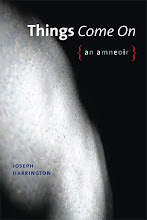
I just got my copy of the "TransGenre" issue of Hotel Amerika, 7:2 (spring 2009), that contains an excerpt from my book, Things Come On (an amneoir). H.A. is big and glossy, like the magazines in the art library. I like it. I am looking forward to reading it, as it looks like there are a lot of innovative texts that make use of all the options for layout, typeface, pictures, etc. that god has given us. And all the literary and non-literary genres.

The most recent issue of Fact-Simile, 2:1 (spring/summer 2009), has a "diptych" ("What did you call me?!") that I wrote. But more importantly, it has a superb interview with Kristen Prevallet, on mourning and literature, that I highly commend to your attention. In fact, like her book I, Afterlife, the interview helps me to make sense of what I'm doing in Things Come On. Thanks, Kristen and JenMarie.

All of this, and the fact that Craig Santos Perez is reading in KC on the 17th (see above) makes me lit-happy.

Tuesday, June 2, 2009

On the Long (Boring) Poem

Does anybody else think a lot of contemporary poems are too damn long? I'm not talking about the book-length poem - I'm talking about the overlong lyric. It seems like there are a lot of poems that are a densely-packed page or two of long lines (or prose) that basically keeps doing the same thing. It may be doing interesting things with language, even. At first. Like the poet is just so inherently fascinating that s/he can't think of depriving you of more cleverness? As in: OK, I GET IT! hahaha, already.

Lyn Hejinian, in the intro to her Best American Poetry volume, spoke of a "sustained engagement with negativity." I'd like to think that Adorno in heaven is smiling on me as I read one of these poems. But that doesn't keep me from getting bored, helas. I have the same problem with an avant-garde poem that is too long to sustain my interest that I did with E. Alexander's inaugural poem, which also bored me to tears. Frank O'Hara said poetry should be as good as the movies, and Jack Spicer upped the ante by saying it should be as fun as TV. Let's hear it for short attention spans.

And God bless Uche Nduka! [if you don't know his stuff, google him] He says something, and then stops. That's a poem. They're kind of "poemlets," a lot of them - not haiku or anything, just v. short lyric poems, often untitled. I can keep reading a lot of these for a very long time, when I'd have given up on a more prolix (and self-indulgent) writer.

Thursday, May 28, 2009

So, if "What's good for General Motors is good for the country," then . . .

Wednesday, May 27, 2009

Chris Joss

Also: check out Chris Joss' instrumental psychedelia. He's what the Grateful Dead might have been, had they not gone all flaccid and quaaludey after their first album.