Literarisches Events (in and around Lawrence KS)

  • PATRICIA LOCKWOOD. Lawrence. Thursday, September 11, 7:00 p.m., Spooner Hall, KU Campus.
  • PATRICIA LOCKWOOD. Lawrence. Friday, September 19, 7:00 p.m. Lawrence Public Library. Sponsored by Raven Bookstore.
  • DENNIS ETZEL, JR. & RACHEL CROSS. Lawrence. Thursday, September 25, 7:00 p.m., Raven Bookstore, 6 E. 7th St.
  • TONY TRIGILIO. Lawrence. Thursday, Oct. 2, 4:00 p.m., English Room, Kansas Union, KU Campus. FREE.
  • CALEB PUCKETT & JUSTIN RUNGE. Lawrence. Thursday, October 16, 7:00 p.m., Raven Bookstore, 6 E. 7th St.
  • BEN LERNER. Kansas City, MO. Thursday, October 23, 7:00 p.m., Epperson Auditorium, Vanderslice Hall on the KCAI campus, 4415 Warwick Blvd.
  • KRISTIN LOCKRIDGE & ROBERT DAY. Lawrence. Thursday, December 4, 7:00 p.m., Raven Bookstore, 6 E. 7th St.

Saturday, December 14, 2013

After the future, a lot of things don’t signify:

-->
grades, literature, publishing, networking, money, an individual’s inaccurate opinion of himself, another’s accurate opinion of me, politics, careers (remember those?), price-points, extinction of non-food species, credit ratings, deadlines, immaterial definitions of success and failure, deadlines, software compatibility issues, 401k’s (boy do those really not signify), trying to impress people, weather events that don’t knock the power out, “people with influence,” blogs, predictions, deferred gratification, losing sleep, prevention, resistance, engagement, participation, energy, the “news.”

Replacing the car’s wiper blades still signifies.

Friday, December 6, 2013

The Dying Elephant in the Middle of the Room

The one that no one really talks about: namely, that it's over. Democracy is over - has been for some time, in fact. The middle class is over, as is economic stability of any sort. Nature isn't over by a long shot, but it's changing a whole lot, very quickly, in ways that will disrupt everyone's life. People acknowledge that things are bad; but we keep behaving as though the future were going to be just a slightly worse version of the past. So people take on another job, looking forward to the day when things will start looking up; or they put money in their retirement accounts; they try to advance their careers; they try to raise their kids with essentially the same values and expectations they have. It's going to be more competitive to get a good job, but you will still be able to get a good job. A college degree will help you get there. If the Democrats can regain the House, then things will change in a big way!

But what if all that is self-delusion.

I recently read a couple of texts that take that premise seriously. The first, by Roy Scranton, "Learning How to Die in the Anthropocene," takes a rather philosophical approach - Stoic, even. He takes as a given that self-delusion is a bad thing; for him, there seems to be a certain nobility (or beauty?) in facing up to the facts.

The other, After the Future, by Autonomist theorist and activist Franco Berardi, posits that the future, understood as the possibility of progress, is at an end. There has been a "mutation," produced by finance capital, neoliberal politics, necroculture, and permanent natural changes, that prevents people from forming links of solidarity ("subjectivation") with one another. This is particularly true, according to Berardi, of the "cognitariat," those knowledge-workers in Palo Alto or Bangalore, who are ostensibly instantly and integrally interconnected. Instead, digital connections reinforce the culture of the cubicle.

Berardi does not end on a totally hopeless note. Rather, he believes that economic collapse will necessitate subjectivation, in the interests of survival. Moreover, the powerlessness of the individual may encourage the withdrawal of individuals from active participation in the economic and political systems that have led to this mess. The task now is to (a.) forget about the future as deferred gratification; pay attention to the present, and see what possibilities arise. Be willing to be surprised by new and unanticipated possibilities; and (b.) imagine what he (after Marx) calls the "general intellect" - that is, a self-consciousness of the collective intelligence of humanity.

There used to be these bumper stickers that said "I feel much better ever since I gave up hope," or something to that effect. Maybe hope is the problem, in fact.

Saturday, November 23, 2013

Don't Nobody With a Good Car NEED Redemption

From an e-mail exchange:

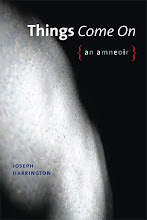
Q: I recently came across your interview with Kathleen Ossip online, and I really appreciated your comment that it is not necessary "to attach redemptive endings to stories that resist it" in talking about your writing and amneoir but I was curious as to why you referred to redemptive endings as an American desire?

A: Obviously, there are stories in all cultures that have redemptive endings (the Christian New Testament, for example). But not every culture insists on them all the time. There's something about US culture that values the story about victory despite the odds, recovery from serious _____, rags to riches, etc. Look at the memoirs on the New York Times Bestseller list, and you'll see what I mean. "I once was lost, but now am found" - the conversion narrative was the first American success story.

This is, of course, why a lot of modern writers write about the other side of things – the tragedies, the injustices, the more complicated and ambiguous stories. Some of them see the "American success story" as being ideology. That's why Theodore Dreiser titled his novel An American Tragedy. That's why Richard Wright wrote Native Son.

Saturday, October 12, 2013

If it has to be a pitcher's duel, best to have it end in 8 1/2 innings, rather than 13. As long as the Cards win.

Thursday, September 26, 2013

Criquettes

name-sayers
vainly hold
out for
summer's
coming again

when plants
exactly
keep time

Thursday, September 19, 2013

Poem for today (seemed appropriate)


The flags drop to half-mast
anytime anyone dies:
for the shooting in DC,
the one in Florida, the one
in Colorado, or any other state?
Or the ones 10 yrs ago today. Or
the ones that haven’t happened yet.

Not for the ones in Iraq,
I’m guessing.

The flags stay at half-mast
Half the whirlygigs shut
down at the wind farm

how now brown corn
cows browsing water
all along an irrigation arm:
mamma’s little animals
wanna live too.

there, there

where, where

Pappa’s little critters
say sauve qui peut

Monday, September 2, 2013

On _Occasional Desire: Essays_, by David Lazar

Reading David Lazar’s new book, Occasional Desire (U of Nebraska Press), is like eating the richest, most decadent and delicious flourless chocolate torte with raspberry coulis that you have ever had in your life, except it’s essays. This sensation is caused, in all likelihood, by the epigrammatic density and detectability of the writing. To wit:
Men in run-down, anachronistic businesses in New York in the 1960s always seemed to have the air of a Borscht Belt comedian who had gotten tired of telling jokes. They always seemed on the verge of saying something, before saying nothing.
For Lazar, the terms of my analogy (torte and retorte?) are not so far removed. For him (and his readers) the essay is a pleasure; it may or may not have nutritional value, but it will remind you that you are alive. Of course, by the same token, this particular torte may contain more than the allowable p.p.m. of gall. There’s a lot of rather unpleasant topics (like, uh, death, divorce, decay, dating). The thing is, his discussion of them transforms them into something - not necessarily palatable by themselves, but undeniable, when this writer serves them up.

Lazar’s guiding lights are Montaigne and Lamb, and one could do worse for guiding lights. He is an unrelenting proponent of the Essay - not “creative nonfiction,” i.e., the realist short story that happens to be derived from “real-life” material (though you wouldn’t know it if you were not told, so similar is the form to mainstream fiction). The essay is different from “autobiographical excursions that insist on epiphany” (too common in poetry, as well - in 2013 even - one might add). This is a crucial distinction, and you should buy the book simply to encourage someone who is willing to make it publicly and vociferously:
The best essay’s sheets are rumpled, askew; it sits on the corner of the bed with one eyebrow raised. Memoir, too often, stands at the window in white linen; it gazes out wistfully, not admitting it wants a large greasy breakfast.
Ouch. And right on. And funny, even to the point of near-Wildean zingers: “She had the laugh of someone who has had too much therapy, and needs much more.” “Meeting the dog” has already become a cross between a punch-line and a come-on in my home. Or more sober, but no less memorable: “A good run of bad luck strains our sense of the probable, turning it into the absurd. At such moments we see ourselves as fictional.” Narrative in the essay is OK - “Anecdotes are like essay candy” - but a whole book of candy? No thanks. Lazar deploys anecdotes, memoiristic or not, judiciously, as a saucy saucier should do.

The essay “Queering the Essay” makes a strong case that it is that genre (not, say, “Poetry”) that is the true and proper medium of trans-genre or genre queer (not unrelated to gender queer for Lazar) literature. Sure, he uses the materia poetica of his life - a lot of it, in fact. But it’s always in service to something that you can care about even if you don’t happen to be David Lazar: the frisson of a ringing pay phone (remember them?); taking a taxi in one’s (former) home town; death; mentorship; sex; the presentation of the self; death.

But the biggest pleasure (for this reader) of Lazar’s essays are his sentences:
But the fluid, indefinable masculinity of Astaire, the otherworldly trances of the great dances with Rogers (I clung tenaciously to the tow of them as the necessary pair) had been important to me ever since I started watching them on four o’clock movies - my gateway to so much ideological twaddle and necessity, so many images of charming impossibility, tuxes and gowns, beauty and wit, bandstands and banter, art deco and décolletage.
(this in an essay about death, mind you) For instance again: the sentence on page 12, beginning with “after” and ending with “tongue” would not be as funny as it is were not the penultimate and antepenultimate clauses as long as they are, in comparison to the last. (Really, you don’t have to think this way to enjoy the book - you can enjoy a boat ride w/o thinking about displacement and buoyancy. But civil engineers are different; you’ll still get to the other side, even if you aren’t one). Those of us who love the sentence as a unit of composition, its deepening level of clause subordination, even to the point of intricacy (not to mention those of us who cannot, even in the simplest sentence, resist the parenthetical aside), its workings, both mechanistic and organic, will be delighted by Lazar’s.

For him, the essay is not about linearity. Sure, you want the papers in freshman comp to be coherent; you want your instruction manual to stay on topic. Those are not essays in the Lazarian sense. “[I]n its classic form, the essay doesn’t quite know where the hell it’s going to go from the outset.” Lazar’s essays, like Emerson’s or Montaigne’s, are like listening to a particularly intelligent, sensitive, and creative friend captivate a dinner party after the plates are taken away; only in Lazar’s case, he has foregone the cognac for a triple espresso. To switch metaphors: his sentences are meandering paths into the woods: at first lovely, green, and sylvan, then darker and rather unsettling, and there may be a witch or mama grizzly (or MFK Fisher) at the end. But that’s what you get if you walk in the woods, and Lazar is the pied piper or sylph or whoever it is that draws you deeper in, until you realize your soul and body are where they really are anyway: lost. In addition to being formally inventive and delightful, the essays in Occasional Desire use humor and brio to get at the rather dark and tacky recesses of life. Here is his reading of the iconic airplane/cornfield scene in “North By Northwest”:
It’s a dream so large it could fill a childhood. The dreamer in this scene is a man on the ground, a man with a camera, a man watching the screen from the safety of his chair. But anyone awake in the dark or asleep in the day senses that the dreamer has an X on his back; he can only run hard in that timeless space and flat time, when the dark wings pick up speed and descend at midday, zeroing in on us, like a toy holocaust whose remote control is shattered.
Or overhearing a couple on a train and ruthlessly dissecting the moment:
SHE: What are you thinking about? 
HE:  I was wondering what you were thinking about.
SHE: Me too.
Understood by the eavesdropper: The couple is on a cusp, being prodded to jump onto the tracks of metalove by the little amourvore on their shoulders, the grim reaper who tells them their emerging self-consciousness is charming and knows, to boot, that no one will risk saying what’s really on his or her mind. The safest response can lead to romantic carnage.
I should say that my upscale culinary metaphor is chosen advisedly. As you might imagine, there is more of Freud than of Marx in this book: this essayist sees the world in terms of individuals and their relationships. If you’re looking for political critique that is just as incisive in its sphere, we should talk. But it has been my experience that political movements are composed of individuals and their (dysfunctional) relationships, and this book provides quite a bit of insight in that department. Indeed, much of Lazar’s charm comes from “a kind of adaptable interest in the world and seeing [him]self in it” - "himself" being a character as fallible and self-protective as any of us. Knowing your Freud doesn’t mean you can cure thyself, any more than knowing your Marx makes you a political organizer. But in both cases, auto-critique can go a long way.

But it’s the pleasure principle that keeps one engaged in Occasional Desire - even when reading about a preternaturally awkward date or about Francis Bacon’s sometimes ghoulish portraiture. No wonder I devoured it as fast as I’ve devoured any collection of essays. And it didn’t spoil my appetite for more!

Monday, August 19, 2013

Please Write One of Each of the Following . . .

A “motion” poem
A spoiler poem
A giddyup poem
A natal poem
A stereo poem
A theriomorphic poem
An orthoscopic poem
A steroidal poem
An e-motion poem
A contested poem
A pledged poem
A poem in thyrsids
A poem in crenelated stanzas
A poem in frosted couplets
A poem in a namby-pamby register
A wombly poem
A poem containing empids
A poem in “stacked” stanzas
A septiva
An ocharina
A “peasant” mandalay
A choirette
A bivouaced poem
A lost poem
A “boomerang” poem
A cavernous poem
A poem generated via a Madurzial operation
A baronial snivella
A shackled sonnet
A list poem
A stop poem

Saturday, August 10, 2013

Note on Notes on Notes on Conceptualisms

The central tenet of conceptual art is that the concept - the idea behind the art work - is more important than the work itself. If you have the idea that gave rise to the work, you don't need to see or read the result to "get" it.

Ergo, now that I know the concept behind conceptual art and writing pet se, it means that I don't have to read or see any conceptual art, or think about any conceptual writers or artists, or their critics, ever.

QED. . . . And what a relief!

Tuesday, May 21, 2013

Artist's Statement (?)

Last semester, I asked my workshop students to write an artist's statement or poetics statement, per their respective conceptions of either or both, in an idiom most everybody could understand. I did the exercise along with them, as I always do.

~~~~~~~~~~~~~~~~~~~~~~~~~~~~~~~~~~

I write (currently) in 2 modes. One is like collage: I take a lot of documents, photos, & found material, select certain parts or quotations, then weave them together w/my own words to form a narrative. About history. These are long poems - book-length. They're very much in the modernist tradition of Ezra Pound, early Louis Zukofsky, Charles Olson, Muriel Rukeyser. Hopefully they're entertaining as well.

The other mode is the serial poem: longish poems, made up of smaller segments - "poemlets," you might say. These are written over a period of time - maybe a month, maybe a year. They are the opposite of the collage poems, in that these are very voice-based - a persona - who speaks in complete sentences, but they don't always make good sense. Sometimes perverse sense. These tend toard satire. They are influenced by the essays and novels of Joy Williams, a lot of contemporary US poets, and Hannah-Barbera cartoons form the 60s.*

In general, what I like best about poetry in the US today is that it can mean anything. Once upon a time, novels were novel . . .

* I've been calling these "f*d-up nature poems," but I think maybe the polite term nowadays is "necropastoral"?