Literarisches Events (in and around Lawrence KS)

  • PATRICIA LOCKWOOD. Lawrence. Thursday, September 11, 7:00 p.m., Spooner Hall, KU Campus.
  • PATRICIA LOCKWOOD. Lawrence. Friday, September 19, 7:00 p.m. Lawrence Public Library. Sponsored by Raven Bookstore.
  • DENNIS ETZEL, JR. & RACHEL CROSS. Lawrence. Thursday, September 25, 7:00 p.m., Raven Bookstore, 6 E. 7th St.
  • TONY TRIGILIO. Lawrence. Thursday, Oct. 2, 4:00 p.m., English Room, Kansas Union, KU Campus. FREE.
  • CALEB PUCKETT & JUSTIN RUNGE. Lawrence. Thursday, October 16, 7:00 p.m., Raven Bookstore, 6 E. 7th St.
  • BEN LERNER. Kansas City, MO. Thursday, October 23, 7:00 p.m., Epperson Auditorium, Vanderslice Hall on the KCAI campus, 4415 Warwick Blvd.
  • KRISTIN LOCKRIDGE & ROBERT DAY. Lawrence. Thursday, December 4, 7:00 p.m., Raven Bookstore, 6 E. 7th St.

Saturday, August 28, 2010

More Narrative Issues

I’m not going to stuff the story of Lib's life into a meta-narrative or over-arching trope (that would be both cynical and flat, since I don’t believe in such things). In fact, I have an ambivalent relationship to narrative in general; in the US narrative is typically conceived of as the "other" of poetry, and I'm fond of poetry. But I do want this work to have a framework – an angle.

I think it has something to do with the time warp that any kind of creative life-writing or memoir involves. It has to do with a dialogue of the past and present – “hello from the future!” And the past people who can’t shut up – whom we are joining – who are as dead as our own childhoods. Since my mother died when I was barely 12 years old, most of my life I’ve imagined her as a rather static image – and part of the appeal of this project was to discover (i.e., assemble) her narrative self. But since I did know her (and her family) some, and since there is some documentary evidence as well as memory, it’s really as much a dialogue with past-me and present-me – or 1930s Lib with 1960s Lib.

Roland Barthes comment, re: the photo of the condemned anarchist assassin, from the 1880s: “He is dead and he is going to die.”

We know the ending, but only of the past.

Thursday, August 26, 2010

My Narrative "Issues"

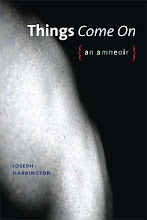
I have a book coming out early next year, called Things Come On. It covers the period from autumn of 1972 to summer of 1974, during which (a.) the Watergate scandal was “unfolding” and (b.) my mother was dying. That concurance provided a ready-made structure.

Now I’m writing the rest of my mother’s life and times – and there is no obvious narrative structure waiting for me. Instead, I have to pull one out of my – brain.

In part, this is because I’m dealing with 50 + years instead of 2. Also, I’m working on the part that covers her childhood and teens, during which not much extraordinary happened. I’m hoping that once I get her to Washington and onto Capitol Hill, the content will buoy me up and carry me along.

This is not to say that her childhood and teen years (1920-1939) are not interesting. I find them very interesting – not just b/c they involve people I knew later in life, but because, well, I’m a sucker for particularity. I can get immersed in the minutiae of anyone’s life, esp. if it’s new to me, esp. if it’s from a bygone era. And I think that the minutiae, the seemingly random and haphazard memories, quotations, and factoids, form a lot of what we take to be life.

But not everyone feels that way, alas. So, how to make it interesting to others? Isn’t that always the question?

Thursday, August 12, 2010

2 By Rachel Zolf

I’ve been meaning for some time to write something about Rachel Zolf’s book Masque (Mercury Press 2004), and now she’s come out with another one, Neighbour Procedure (Coach House 2010). The first is a “masked” memoir in the form of verse dialogue. The second deals with the Palestinian-Israeli conflict; it was occasioned by a trip to “Israel-Palestine” and contains “some of the journey’s mad affects.”

Masque is large – 10x8” pages – and the verse is spread out over the pages. It is “spoken” by various characters – The Media Man (who is also The Father, the egomaniacal reporter/TV personality, Benny Z-d); The Daughter; The Philosopher (who is mostly Marshall McLuhan); The Censor (who “redacts” certain words); The Whisper (which says things like “you fucking screaming idiot”), and so on. At first some of the voices occur on separate pages, then in consecutive dialogue. But finally, they mostly are all talking at the same time, by way of interlined stanzas; the names in the right and left margins alert the reader to the first line of the character’s speech, but the parts are written in alternating lines. Sometimes there are just a few short lines crouching in the upper left-hand corner of the page; sometimes there is one column of text that is left-justified, one that is right-justified, and one coming down the center. There are even drawings and extended etymologies. I’m not going to try to reproduce this method on Blogger. Suffice it to say that Zolf depicts a very complex set of relationships within and beyond a family in a few (colloquial) words. Much of the material is taken from Canadian Broadcasting Corporation footage, as well as newspapers which her father – who just happens to be a Media Man, too – wrote for.

Neighbour Procedure is rather different. The title refers to the practice by the Israeli army of using residents of Palestinian neighborhoods as de facto human shields. Again, much of the material comes from “found” sources: newscasts, web sites, commercials, the Qur’an, Judith Butler, etc. The first section reminds me of the ghazal form – that is, the juxtaposing of lines of verse that do not follow one from the other, but which have a lot to do with each other. (In this respect, it reminds me of Susan Tichy’s Gallowglass, except that there it is the American-Iraqui conflict that is the source). Other poems are lists of numbers and names, or a mosaic of the words “car [mule, belt, bike] bomb” with musical notations added. The middle section is composed of white-out poems from Ibn Barun’s 11th c. “Book of Comparisons” of Arabic and Hebrew words, as a method of glossing the Torah (mixed in with the poet-speaker’s own stutterings). The rest are various mash-ups and docupoems – one section is composed of “word maps.” And the notes at the end are well worth reading.

The barber

One soldier danced into the shop, 'Nice, nice'

Whose faces were painted certain images don't appear

Cutting in random lines the machine touched my scalp

Can you be gentle I'm not an expert open your mouth

A group of children stones his weapon on my shoulder

Intolerable eruption patting his chest, 'Now I'll tell you my name'

Sometimes staccato sometimes continuous

The soldier left the barbershop with the scissors

The soldier left the hair on my lips

Tuesday, August 3, 2010

Memory, History, Poetry, and the Nature of Nature

A couple of weeks ago, I heard Lawrence Buell, ecocritc extraordinaire, give a talk on what he calls “environmental memory” in literature. The argument is still developing (unlike some “big names,” he didn’t just read from an already-published book), and is sort of perspectival and descriptive, rather than anaylitical and critical. In any event, it seemed to me that “memory” was being used as a kind of ahistorical, psychologized category – an individualized version of history.

That’s a consummately American approach. Europeans can see history for the succession of tragedies that it is (b/c it has been more so, over there). Americans need to boil history down for their own personal use. If Europeans philosophize, Americans psychologize. This tendency is especially problematic for environmental discourse, as there is already a penchant for organicist tropes (and essentialist thinking).

I asked what to me was the obvious question: What is history? He was obviously quite tired (halfway through a two-week intensive graduate seminar), and the response kind of rambled, but I think he understood what I was getting at. I do hope that he thinks some more re: the relation of history to memory (and how each gets represented). That’s crucial.

I also hope that he branches out generically. “Literature” meant “novels.” This conflation is typical, esp. amongst Americanists. Moreover, he did not talk about the form or structure of novels – that is, how the shape and texture of the text might interact with the way it represents memory or the environment.

The grand theories of American literature from the 50s and 60s dealt with motifs in novels. Those were the days of structuralism and psychologistic readings. Nowadays, not many people presume to account for all of American lit – and increasingly, monographs limit themselves to one or two genres (in the titles, even). But Buell is the generation just after the Theories of American Literature (Novel) crowd, and while he has branched out in dramatically new directions, this basic assumption – and approach – remains in place. It is a criticism that takes “content” for granted.

It is a pivotal assumption, since, it seems to me, the nature of representations of nature is what is at stake – not simply the semantic, hypotactic meanings, but the syntactic, material nature of the text as well.

I recommend that Prof. Buell read poets who deal with memory and history: Susan Howe, Adrienne Rich, Charles Olson, Nathaniel Mackey, et al. They may or may not deal with the environment as well. But one needs to think about the medium in order to understand the message. And to do that, one cannot accept genres as natural phenomena. To do so means to misunderstand “nature.”

Thursday, July 29, 2010

Lost at Midnight

I still don't quite get what Susan Howe was doing in The Midnight. I mean, it hits on a lot of her major themes - legibility, lostness and discovery, textual mediation, margins v. center, etc. And there are the small, double-spaced poems in the middle of the page. But this book seems very different.

In many (most?) of Howe's books, we get a short prose introduction/explanation/narrative detailing what motivates the poems - and where some of the lines come from. This is a very useful and clever method, insofar as it preremps the "What's it about?" question. The prose bit gives you some notion of what the poems are alluding to, what the tone is to be, and what's prompting the feeling (and leaps of thought). In The Midnight by contrast, we get a series of poems, then a section of prose snippets, poems, prose, poems. The final set of poems, "Kidnapped," clearly pick up on themes and even texts that the prose parts introduce. But the relation between the other poems, "Bedhangings," which were originally collected as a chapbook of that name, and the prose sections that divide them, is rather cryptic.

Moreover, the relation of the prose pieces (each titled) to one another is often a bit mystifying. How does the early life of Frederic Law Olmstead relate to the origin of starching in fabrics relate to Howe's aunt and uncle? These sections are rendered in prose that is more-or-less linear and representational: it's clear how one person relates to another, or one object relates to those persons, and usually how one sentence relates to the next - which maybe leads me to expect more connections between the titled sections. One of the themes of the book is relationality - what's created when one thing is set next to another. That's OK until the relationality looks like that between the strands of spaghetti stuck to the wall. I mean, if I sent this to a publisher - even your friendly neighborhood avant publisher - they'd tell me to get lost. Granted, the writing wouldn't be as good, or the family stories as interesting. But even if they were, the form of the text offers so little purchase for the reader, that the reader has to be motivated already. You keep reading b/c it's by Susan Howe. 

So, I read Marjorie Perloff's article, which gave excellent close readings of individual sections, but not much sense of why all of these disparate elements are in the same book. Then I read John Palattella's review, which told me that "Howe catalogues details in an almost forensic way" and does so by "cracking the looking glass and making the incongruous appear even more so." Moreover, "The prose sections . . . . present a collage of brief narratives, with coincidence and synchronicity being the only means offered for aligning and organizing them." Reading these lines made me feel like I wasn't losing my mind after all. But in other books by Howe I always had a sense of how each section w/in a book hung together (loosely, anyway), and I saw the thematic filaments that led me from one to another and back.

Then I read Stephen Collis' review, and that helped. The "Bedhangings" poems relate text and textile, and the obssession w/the interleaves of books deals with another kind of "curtain," which in turn "is also the false front we present to the world," which Howe's actress-mother certainly did (when the curtain went up). "The curtain protects . . . but it also excludes." All of which rhymes with the account of trying to get into the Houghton Library at Harvard, and then trying to "get at" the books behind the "locked glass." Or how "while one voice excludes ('Go away') another includes."

That's really the issue: why these fragments? Why not that one - the one that was left out?

In any case, I had been suspecting what Collis says in as many words: that The Midnight is not so much about Howe's mother (as Palattella holds) as about Howe herself - or at least her work. It's almost like reading a "greatest hits," at least in terms of her intellectual concerns, tropes, forms: "she notes how 'you must turn Uncle John's books around and upside down to read the clippings and other insertions pasted and carerfully folded inside.' Again one is struck by the similarity between this and Howe's own books, where upside-down and off-kilter lines cause one to constantly turn her books about inthe midst of reading."

So, yes, noone but Howe could have published a book like this, but noone but Howe would have written it. And perhaps noone but Howe fans would be interested in reading it. If this were the first book of hers you read, it would be a disaster. But if you read it in the context of the rest of her oeuvre, you can see how one part of the book might "rhyme" with another. The family history/memoir is in a sense just another path into the woods - albeit a particularly treacherous and overgrown one.

All of which makes me wonder if one should read each of Howe's books as a chapter of a larger, yet-to-be-collected work.

All of which is, of course, my own anxieties about my writing projected onto Howe's book.

Tuesday, July 27, 2010

Blogger v. Facebook

It's old hat to say that Facebook has replaced Blogger and Twitter has replaced Facebook. The latter replacement surely has to do with the prevalence of mobile devices (and the difficulty of "typing" on them), esp. among young people. But what about the former? Both blogs and FB are mostly old farts like me.

If Twitter is also about reduced attention spans, perhaps FB is about reduced patience and time. People post and respond to posts more frequently, because it doesn't take as long - or at least you're not expected to be as smart and eloquent (or prolix). By the same token, one can "keep up with" more people in less time; if Blogger is like a virtual public sphere, FB is a virtual cocktail party (emphasis on "virtual," in both cases).

There are some folks who have done good things with "microblogging" on FB. Ben Friedlander is the first person who comes to mind - pithy posts arising directly from his research and thinking about poetics; the responses tend to be equally good. Sure, it's like overhearing snippets of conversation, but a really good conversation.

The rest of us just make wise-cracks.

In one respect, FB is head-and-shoulders above Blogger: you can SEE the comments to the original post (well, several, anyway). It's like a digest of bulletin boards delivered to your computer. So the dialogic aspect is always in front of your face - unlike Blogger, which seems to think the Comments are the Footnotes. (In Word Press, you can make the comments part of the "main page" of the blog - but the print is so damn tiny!).

Please comment!

Sunday, July 18, 2010

What Would Walter Benjamin Have Said About the Voice Synthesizer?

Reading the Arcades Project, I have to wonder what would have caught Benjamin's eye (and other senses) had he been working on the 21st c. US instead of 19th c. Paris. I have to think that the ubiquitous voice synthesizer would be one item on his list. Why is it so pervasive in pop music? Is it the desire to have the natural fed back in distorted form? In order to denature the voice (and, by implication, the body), or to hear the natural distorted by the machine, so that it corresponds to the experience of everyday life in capitalist society, blah blah blah? I have to think it would be more original than all that. Or maybe that's the problem - the New, the desire for novelty, which relapses into spleen afterwards.

What are some other things WB might fix upon? Vitual reality of all sorts, surely. Environmental bumper stickers. The NBA playoffs in the summer. Facebook, of course.

Sunday, July 4, 2010

Jeez, I'm behind!

. . . my last post was JUNE 30! And here it's the Fourth of July. You have to WORK to PRODUCE, Joe.

Actually, I have been blogging on Dale Smith's blog Possum Ego - responding to his and Boyd Nelson's posts - and responding to their responses.

Oh and happy 4th. I guess.

Wednesday, June 30, 2010

Rethinking (Reality-checking) Poetics

I have been reading (w/some degree of amusement, I admit) the reports from last month’s “Rethinking Poetics” conference at Columbia University in NYC. All of the (first) name dropping and who-said-what makes it more entertaining than Rolling Stone and the E! network rolled into one. Ditto for the anti-academism coming from tenured academics (are we not supposed to notice? . . . ).

I especially liked John Keene’s fast-forward time-lapse quasi-versified précis of the whole thing – well worth reading through to the end. Frankly, it sounded like it was another (above-average) professional academic conference that went onto a lot of c.v.’s. Which is fine.

As I commented after that post, it also sounds to me like there was a lot of liberal hand-wringing going on – over the state of the world, and over poets’ inability to effect change qua poets (or qua academics). This is, of course, a very old sport, as any student of Anglophone poetry in the 1930s knows. The difference now, of course, is that there is not an over-arching, semi-numinous ideology to redeem it all – and no Uncle Joe to tell us we’re doing our part and it will all work out in the end. In fact, it’s looking less and less likely that it will all work out (has the bottom of the ocean dropped out yet?).

Those of us still clinging to (or dreaming of squeezing into) the comforts of lower-middle-class existence don’t want to do anything to jeopardize it and are overwhelmed by the magnitude of the challenges. We want to fight the Man, but we want to do so by doing things that will also advance our careers (which involve working for the Man). One can retreat into the belief that cultural change will lead to political and economic change (“it may take a very long time, of course” . . . the problem is that there isn’t a long time. Read The Iron Heel, by Jack London, to see how discomfiting this time-scale can be).

Unfortunately, social movements require leadership, leadership requires enormous amounts of time and energy, and if one is leading a movement against People with Money, they don’t pay you for it (which, in the era of neoliberalism, means you don’t get paid) – until you get coopted or sell out, which requires you to work at it long enough and successfully enough (w/o money) to have something to sell. You have to eke out a living doing something tedious and exhausting, and then, “after hours,” do your organizing work (and there actually are people who do this). This is why poets generally aren’t organizers. They spend “after hours” writing poems and arguing with one another. Academics have to grade papers, prep class, do committee work, get published, etc.; we call this "burrowing from within."

It’s no wonder social movements are often composed of mostly young people w/o kids – they have the energy, resilience, lack of other commitments, and naivite necessary to achieve goals that are far short of what they had desired.

Rebecca Wolff wrote a pretty good piece on the relation of poetry to “social change.” She ends up sounding a bit like John Crowe Ransom (“Poetry butters no parsnips and delays the eating of them,” or something to that effect), with one big difference – Ransom thinks one shouldn’t write poetry that touches on political and social issues at all – which is true of some (unlikely) poet-critics today, as well. But Wolff doesn’t care about that, one way or the other. She does care about being dictated to, especially on the authority of grandiose and unfair claims for poetry. She gets exercised where I get amused.

Monday, June 28, 2010

how did I get mixed up in this? . . .

. . . or rather, mashed up. It's Mad Bashers, a joint issue of the neo-dadaish Mad Hatters Review and the humor magazine Bunk. I "mashed" Lyn Lifshin and Patricia Carragon (b/c her piece contained the word "dwarf") - 20 ways til Sunday (or at least 4).

Did anyone at the "Rethinking Poetics" conference mention fun?