Literarisches Events (in and around Lawrence KS)

  • PATRICIA LOCKWOOD. Lawrence. Thursday, September 11, 7:00 p.m., Spooner Hall, KU Campus.
  • PATRICIA LOCKWOOD. Lawrence. Friday, September 19, 7:00 p.m. Lawrence Public Library. Sponsored by Raven Bookstore.
  • DENNIS ETZEL, JR. & RACHEL CROSS. Lawrence. Thursday, September 25, 7:00 p.m., Raven Bookstore, 6 E. 7th St.
  • TONY TRIGILIO. Lawrence. Thursday, Oct. 2, 4:00 p.m., English Room, Kansas Union, KU Campus. FREE.
  • CALEB PUCKETT & JUSTIN RUNGE. Lawrence. Thursday, October 16, 7:00 p.m., Raven Bookstore, 6 E. 7th St.
  • BEN LERNER. Kansas City, MO. Thursday, October 23, 7:00 p.m., Epperson Auditorium, Vanderslice Hall on the KCAI campus, 4415 Warwick Blvd.
  • KRISTIN LOCKRIDGE & ROBERT DAY. Lawrence. Thursday, December 4, 7:00 p.m., Raven Bookstore, 6 E. 7th St.

Monday, February 7, 2011

Meshugas Av. and "Z"

I'm sure I will post something about the AWP in the coming days, but now I'm just playing catch-up. Pretty much the craziest, most chaotic (and one of the more expensive) conferences I've ever been to. Got to read with some really cool people whose work I already knew (Elizabeth Willis, Evie Shockley, Rae Armantrout, Mark McMorris, Grant Jenkins, Cheryl Pallant), and was introduced to some really swell poets (Lea Graham, Melody Curtis, et al.).

Just before the Wesleyan reading, I watched in horror from the podium as Susan Howe, Rae A., Rosmarie Waldrop, Anne Waldman, and C.S. Giscombe came through the doors. But it went fine - I think they liked it.

And found my mom's 1950s apartment building yesterday - with screaming jungle birds in the background, just as my dad had said.

More anon.

Sunday, January 30, 2011

You Said It, CD!

Click on the comments for the January 20 post - "CD" (CDW?) wrote an amazing little essay re: mixed-genre work, why it is scary, and why there is more of it nowadays. It is far more eloquent and engaging than anything I would put up here. Dig it.

Sunday, January 23, 2011

Poetry's Death by a Thousand Twits

I recently read an article in The Australian by one Christopher Bantick, complaining that the internet has destroyed poetry. Good Poetry. The problem? That "just about anyone can be a poet, published at least online." Because Anyone by definiton cannot be a poet (only Good Poets recognize Good Poetry - after all, they write it), "the Muse has been kidnapped and abused."

It is undoubtedly true that never has more hackneyed and boring poetry been produced than now. But then, never has more poetry been produced before now. Some of it is fresh and interesting. There is more of that, too. If more of on-line poetry is experimental than conservative, it is b/c not so many conservative poets have availed themselves of this particular publishing technology. After all, conservatives want to conserve the old and resist the new.

But Bantick points out the flaw in his own reasoning when he writes, "Even Horace back in 65 BC was on the money when he dryly observed: 'Skilled or unskilled, we all scribble poems.' The point is that much digital poetry is just electronic scribble."

Clearly, much hand-written poetry in 65 BC was analog scribble, according to Horace. And that newfangled invention, the printing press, only made matters worse. Anyone with a printing press could produce bad mass-circulation literature - from broadside ballads to penny dreadfuls. If you have any doubt about this, I invite you to thumb through an 18th c. anthology of English verse. Page after page after page of derivative, formulaic heroic couplets. Clearly, the printing press was killing poetry (or at least its former readers). And Alex Pope was on hand to document it.

Then it was mimeographs, then photocopies, and now - ugh! - desktop publishing!

There's no way an on-line journal can have the same stringent quality controls as print journals, b/c it is on the INTERNET! And of course, all print journals publish poetry of the highest order, as we know.

The bottom line: more people are publishing poetry and reading poetry b/c of the internet. If you define poetry by its production and consumption by a cultural elite, then of course the internet is the villain.

I like print. I prefer it to reading a screen b/c it has higher image resolution. So I think it's a shame that it is falling victim to snob appeal.

Of course, the joke may be on me. The only Australian poetry I read is on-line. For all I know, "Christopher Bantick" is the satirical persona of some snikering 20-something avant-gardiste in Brooklyn.

Thursday, January 20, 2011

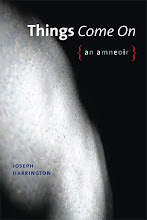
THINGS COME ON done come in.


Not the most photogenic person in the world am I, but you get the idea. Things Come On: (an amneoir) is now available from Wesleyan University Press. Order from the University Press of New England web site using the discount code W301, and you get 30% off - which brings the price more in line with a regular poetry book. While you are there, check out the terrific recent books by Rae Armantrout, Kamau Brathwaite, Ed Roberson, Elizabeth Willis, and Evie Shockley - all of which are available at the same discount, if I'm not mistaken.

Between being sick and having to read 150+ graduate applications, I have neglected the bloggo. I apologize to my thousands of fans. Ha ha.

Really, what I was going to say about mixed-genre work and elegy isn't very profound, and inadvertently got way more build-up than it's worth, simply b/c I haven't been blogging.

It's just this: that there seems to be a lot of it. Or rather, that a lot of work that mixes, defies, or invents genres seems to be in an elegiac or eulogistic vein. The book above being an example, but also:
- Kristin Prevallet, I, Afterlife: An Essay in Mourning Time
- Eleni Sikelianos, The Book of Jon
- Anne Carson, Vox
- Susan Howe, The Midnight
- Michael Lesy, Wisconsin Death Trip
- Mark Nowak, Coal Mountain Elementary
- Susan M. Schultz, Dementia Blog (arguably)
- Parts of Theresa Hak Kyung Cha's Dictee
- Mahmoud Darwish, Memory for Forgetfulness
- Michael Ondaatje, Running in the Family
And I'm sure there are lots of other ones you could name that are not occurring to me.

Why is this? Part of it may be that contemporary writing generally is in an elegiac mode, in the broadest sense: it conveys a sense of lostness, belatedness, etc. When I read a longer Ashbery poem, I always feel like I'm reading an elegy.

But the best specific explanation I've encountered is a sentence from Prevallet's book (which I quote in the notes to mine): "If the body of the text has suffering at its root, then language will take a fragmented, torn-apart form, as if it too is suffering" (p. 50). There does seem to be something about the physicality of the text that connects with the physicality of loss - the feeling of being held together with chewing gum and baling wire. The mixed-genre text presents itself as something not-whole. This feature is certainly in keeping with Prevallet's principled refusal to impose "closure" on mourning.

Then there are scrapbooks (in the English-speaking world, esp.)- an ad hoc memorialization via physical artefacts collected in a book. The keeping of relics.

Half-baked hypotheses on somebody's blog. What do you think?

Friday, December 31, 2010

_Earth Day Suite_ is ready for your downloading pleasure!

My (e)chap, Earth Day Suite, is now availble for download (free) from Beard of Bees press.

I got yer nature poetry - RIGHT HERE!

While you're at the site, check out some of the other fine chaps on display - including those by that lovable poetry-bot Gnoetry - whose poems are, to this pre-post-human author, scarily good.

Tuesday, December 28, 2010

Why Multi-Genre?

I applied for a fellowship to work on a series of books I’m doing about my mother’s life and times (the first of which, Things Come On, is scheduled to be “out” next month). I was told that I didn’t get it because I hadn’t provided adequate reasons for my writing in multiple genres (verse, prose, dramatic dialogue) within a single book. I thought I'd addressed that issue – but then I’m not the one handing out the fellowships.

So I started thinking more systematically about it. The most obvious and general reason is that I’m a believer in trying not to separate form and content – i.e., that it’s a false dichotomy. So, rather than trying to make a welter of heterogeneous materials fit into a pre-determined form (e.g., the linear narrative of standard prose autobiography – or Spencerian stanzas – or five acts), I am attempting to let the materials of the books – diaries, scrapbooks, conversations, photographs, hand-written documents, letters, etc. – and combinations of materials from a given time period – suggest the shape of the text into which I am integrating them. As the nature or tone of the materials change, so does that of the narrative, and therefore, its shape.

The bigger issue here, one which I’ve addressed before, is the generality/particularity or deductive/inductive issue. Writing a biography of any kind (maybe a non-fiction book of any kind – maybe a book of any kind) is the experience of being confronted with lots of materials, voices, ideas. The author must somehow select from amongst that mass of Stuff and compose the selected materials, along with his or her own words, in such a way that the reader gets, at the very least, patterns of images, themes, feelings, that add up to something more than any single one (whether or not that something is "greater than the sum of the parts" – the assumption behind that expression is precisely the problem, seems to me).

One way to go about that, of course, is to select for a certain type of story, or a certain genre of story, and then to force any recalcitrant materials to conform to that type. The default type is the absorptive “page-turner” that sews everything together into one central storyline – like a realist novel, whether or not the nonfiction book includes dialogue, point-of-view, composite characters, etc.

But to my mind, part of the thing that makes life stories interesting is precisely that welter of particulars – either because I recognize some of the places and personality types instantly (e.g., Memphis Afternoons, by James Conaway) or because I’m confronted with a set of people and details that are radically different from those in my own life (e.g., The Immortal Life of Henrietta Lacks, by Rebecca Skloot). The Skloot book, for instance, makes no bones about switching from a journalistic to novelistic to memoiristic telling of events, as the events themselves seem to demand it. And I think one reason is that she took seriously this question of fitting the structure of the narrative to the narrative that needed telling - in part as a way to try to honor the particularity of the lives she is writing about (including her own).

So, the multi-genre non-fiction book is less like a novel than a scrapbook – that hybrid, connect-the-dots story book formed by the relations between its elements – which are very diverse elements indeed. As Susan Howe puts it, “The relational space is the thing that’s alive with something from somewhere else.”

Now to try to condense all this into a single paragraph for the application!

Tomorrow (well, OK – soon, anyway): Multi-genre writing and the elegiac mode.

Friday, December 10, 2010

She Ain't from Around Here, Is She?

The admission by a local poet to being "incapable of confrontation" led me to reflect upon why Kansas is the reddest of red states. "Power concedes nothing without a demand," as a famous person once said (and he oughta know!); it's precisely demands - esp. of people in power - that midwesterners (and maybe Americans generally) seem incapable of. Demanding and confronting are not "polite" (i.e., quietist) activities, and therefore are cardinal sins in these parts - even for political liberals. Accordingly, that which has happened happens again - which is a good definition of conservatism. And this state of affairs makes it easy for an unscrupulous person bent on political power to get it and keep it. One doesn't talk back to one's betters, around here. Consequently, nobody fights, so nothing changes.

In the state capitol in Topeka, there is (or was) a photograph from 1893 of the Populist Party legislators who were elected (as a majority) in 1892. They pose, brandishing rifles, some, next to their desks. The Republicans ended up stealing the election and ejecting the Populists from the capitol w/the help of the National Guard. But the incident shows that Kansans were not always as cowed and timid as they are now (a point Thomas Frank has tried to emphasize); perhaps they were more desperate, perhaps they were more ornery. All that is certain is that they are very different today.

Then I came across the following, from the book Parenthood in a Free Nation (1963):

"Perhaps the whole thing is that she isn't afraid to be afraid, when there's real danger. She's not afraid to show anger when a situation calls for anger. She isn't afraid to take a chance on being disappointed if her plans go wrong. She meets hostility on the part of a classmate with a certain amount of - well, almost composure. As a matter of fact, she actually seems, somehow, to have a very good understanding of what the world is like. She's learning to take things in stride. She seems to know - and really feel it - that when she gets thrown off balance she is capable of regaining her footing."

This passage describes a fourth grader, but I devoutly wish the same could be said of University of Kansas students - graduate and undergraduate alike - today. Not to mention everyone else in the state, the midwest, and the nation.

Tuesday, December 7, 2010

I'm Officially "Hot"! (and anti-papist, apparently)

I googled my forthcoming book - as one can, I think, be forgiven for doing in the nervous weeks leading up to its publication. Here's what I saw at Library Journal.com, under the headline "What Else Is Hot?: More Spring Poetry," by Barbara Hoffert, dated Dec. 1:

"This time, I’ve organized the 22 titles by category—a dangerous venture as the best poetry can’t easily be contained by labels. Joseph Harrington’s Things Come On: an amneoir ('Storytelling') might just as easily be classed under 'Political Edge,' for instance, given how it parallels the story of a death with the story of Watergate. And Harrington’s work could have as easily been classed with Alice Notley’s Culture of One and Tom Waits and Michael O’Brien’s Hard Ground in another category called 'Multimedia,' given their blending of material beyond verse."

OK - so I've never seen my name in print alongside Alice Notley's, let alone Tom Waits', so that got me interested. Here's what she says about my book:

"In Things Come On: an amneoir (Wesleyan Univ. Apr. 2011. ISBN 9780819571359. $22.95 eISBN 9780819571366. $11.99), Joseph Harrington blends poetry, prose, documentation, and images to narrate his mother’s death from breast cancer around the time of Watergate. Both the public and the private event involved denial and a struggle to get at the truth (hence amneoir, which combines memoir and amnesia)."

She goes on to present the following teasers re: forthcoming books by two of my fellow (?) Wesleyan poets:

"Evie Shockley’s the new black (Wesleyan Univ. Mar. 2011. ISBN 9780819571403. $22.95) considers various concepts of 'blackness,' past and present, while Elizabeth Willis’s Address (Wesleyan Univ. Mar. 2011. ISBN 9780819570982. $22.95. eISBN 9780819570994. $11.99) considers how civic structures shape the way we think."

Personally, I can't wait to read those. And, since all three of us are reading at the AWP on Feb. 4, I probably won't have to wait as long as these pre-pub notices indicate (in fact, you can pre-order all three from University Press of New England, amazon, etc. now).

In other news, I found my book listed on Boomerang.com, Australia's answer to Amazon. My name was listed as "Professor Joseph Harrington" - which I certainly have been called before (and worse!), but never as a by-line. I clicked on Professor Joe's name. I did not find Poetry and the Public: The Social Form of Modern U.S. Poetics (for instance), but I did find this title:

Popery and Treason Inseparable. in a Discourse Upon the 5th of November, Not Forgetting the 4th. Wherein Is Also Some Remarkable Memoirs Discovering the Arts of the Papists in the Death of King Charles the First, by Professor Joseph Harrington (1714)

Faith and begorrah - 'tis not me! On me honor, I don't think the man is even kin.

Sunday, December 5, 2010

"They show many different reactions . . . when faced with failure.

Some grow angry and fly into a rage; some try to evade the issue by distracting attention from the unpleasant situation. . . . Some try to bluff their way through, refusing to admit their inadequacy. Others blame persons or objects instead of admitting their own limitations, like the one who, when she could not fit wooden forms into the holes of a board from which they had been cut, exclaimed, 'You just ought to have bigger holes! These aren't right at all!'"

(from Parenthood in a Free Nation, by Ethel Kawin, 1963)

Wednesday, December 1, 2010

More on oldness (and me)

I should say, in re: my post in re: Old Women Look Like This, by Susan M. Schultz that my remarks are colored by these factors:

- I've been visiting our next door neighbor, who is dying of cancer, in a nursing home recently, and I haven't been in one for a while;

- I have a father who is 83 and - knock wood - lucid, healthy, and mobile (for now);

- I am not getting any younger and have yet to fully come to terms with that fact.

I think that, if I see the chapbook as being tragic, rather than - what? - a romance? - then it probably has as much to do with me as with it. It also has to do with the fact that the chapbook asks us to take in a lot of people at a glance - so the full force of dementia in its many permutations hits one all at once. In this respect, the work is different than the same author's Dementia Blog (Singing Horse Press, 2008), which chronicles her mother's decline into Alzheimer's (and her own responses, in historical context) - backwards, in good blog (and dementia) fashion. The upshot is that the change, while already an accomplished fact, is revealed more gradually - and we focus on one sufferer in greater detail. Moreover, the loss only becomes fully apparent at the end.

But I still think that the power of Old Women comes from its unwillingness to try to give a happy ending to a process that resists it - a rare resistance to the forced optimism of American culture.