Literarisches Events (in and around Lawrence KS)

  • PATRICIA LOCKWOOD. Lawrence. Thursday, September 11, 7:00 p.m., Spooner Hall, KU Campus.
  • PATRICIA LOCKWOOD. Lawrence. Friday, September 19, 7:00 p.m. Lawrence Public Library. Sponsored by Raven Bookstore.
  • DENNIS ETZEL, JR. & RACHEL CROSS. Lawrence. Thursday, September 25, 7:00 p.m., Raven Bookstore, 6 E. 7th St.
  • TONY TRIGILIO. Lawrence. Thursday, Oct. 2, 4:00 p.m., English Room, Kansas Union, KU Campus. FREE.
  • CALEB PUCKETT & JUSTIN RUNGE. Lawrence. Thursday, October 16, 7:00 p.m., Raven Bookstore, 6 E. 7th St.
  • BEN LERNER. Kansas City, MO. Thursday, October 23, 7:00 p.m., Epperson Auditorium, Vanderslice Hall on the KCAI campus, 4415 Warwick Blvd.
  • KRISTIN LOCKRIDGE & ROBERT DAY. Lawrence. Thursday, December 4, 7:00 p.m., Raven Bookstore, 6 E. 7th St.
Showing posts with label poetics. Show all posts

Thursday, July 21, 2011

Ronald Johnson 'n' Me

One of my colleagues compares the academic summer to the weekend: up til Labor Day, it's Friday night. Then it's Saturday up til July 4 (say). Then it's Sunday, and August is Sunday Night. Time's up!

I've been trying to get people to read a book that just came out; and for the first part of the summer, was revising a manuscript I'd like to come out, too. A couple of other writing projects, a little administration, a few grad students to work with, and before you know it, your blog has languished for three weeks.

Well, it's about time I at least wrote about JUNE! One of the things occupying my time during that month was a reading group I organized to discuss the works of the American poet Ronald Johnson. RJ was born in Ashland, Kansas, and grew up there and in Topeka, where he also spent his final years. So we claim him as One of Ours - even tho he lived most of the rest of his life in New York, Colorado, and San Francisco, with interegna in other spots.

The occasion was the visit of the Canadian poet Sonnet L'Abbé, who is also a doctoral candidate in the English Dept. at the Univ. of British Columbia in Vancouver. If you don't know her poems, you should. Her recent stuff, in particular, is concerned with some of the same issues that brought her from her delightfully temperate home to the global-warming capital of North America (viz., aquí). Those issues have to do with the nature and implication of metaphors involving plant life.

Sonnet w/Ronald Johnson plaque at Ward-Meade Park, Topeka, where he used to work. 


Clearly, RJ was obsessed by our foliate friends, the plants. From Book of the Green Man to Shrubberies, they're all over the place (literally):

What the Earth Told Me

No surface is allowed to be bare,
& nothing to stand still. A man could forever study a pebble

& at last see dilations & expansions of the hills -
to pull the most slender stalk, is to jostle the stars,
& between the bearded grass
& man 'looking in the vegetable glass
of Nature', is a network of roots & suckers
fine as hairs.
I threw a stone upon a pond
& it bounded the surface, its circles interlacing

& radiating out to the most ephemeral edge.

Flint & Mica, Lichened Limestone, Shale & Sarcens, Sandstone, Soil.

I saw the wind moving on a meadow
& the meadows moving under wind
lifeting, & settling & accumulating.

Flint & Mica, Lichened Limestone,

Shale & Sarcens, Sandstone, Soil.

[from The Book of the Green Man, 1967]

If you hear Whitmanesque echoes here, you're meant to ("Letters to Walt Whitman" is well worth a read, too); this is a pastoral poem written in the English countryside - by an American.

Another occasion for the group was my desire to - finally - read Ron Johnson's work. I'd lived in his home state for 15 years w/o doing so. My net-net: Green Man is amazing. Radi Os was necessary, and it is what it is. The concrete poetry is extremely interesting. The middle section of ARK is amazing. Much of Shrubberies is extremely moving and well-wrought. Not bad, Ron.

[To Be Continued - it's late . . .]

Monday, March 21, 2011

Hello from the Parallel Poetry Universe

I never ceased to be amazed by the way that American poets, even now, seem to live in parallel universes. This tendency is nowhere more evident than among younger poets, who bear strongly the stamp of their tutelage and who have perahps not ventured very far from it.

That's the sense I get from Weston Cutter's "Thoughts on Structure" at Plougshares blog. He bemoans (understandably, and eloquently) how many poems take the form of the "block-o-poem: left justified, without stanzas," and written in free verse. If you added "memoirsitic," "representational," and "about a page in length," this description could still go for most poems mass produced in The [Insert Place Name Here] Review.

But it also made me realize how few poems that I read are like that. Not that they're all sestinas and villanelles, but they either use stanzas (at least) or some kind of patterned form (often aleatory), are serial poems, or make use of the field of the page in some interesting way. Indeed, if Cutter were to read the poetry books (or the journal) from BlazeVOX, which just published his book of short stories, he would encounter a variety of poetic forms that do not conform to the norm he's described.

Aside from reading (immediately) the Language book and The Politics of Poetic Form, and maybe Anthony Easthope's Poetry as Discourse, I'd recommend that Weston ditch the print journals and the big-name outfits for a while and browse some of the on-line mags that Spencer Selby lists here. Look through the Small Press Distribution catalogue, which is chock full of formally inventive (as well as formally traditional) poetry. Read up on Oulipo and New Formalism both. Read books from Fence, Coffee House, TinFish, Wesleyan, Ahsahta, Coach House, or any of the many non-commercial indy presses publishing writing in innovative forms. There's a whole 'nother world out there - and your teachers may not have told you - may not have known - about it.

I know a number of younger poets who are in a kind of indeterminate, exploratory, and probably scary space - between the conventional quasi-confessional poetry they were reared on and the "post-avant" poetry that they've heard is hip. Maybe they're biding their time, like uncommitted troops waiting to see which side is likely to win a civil war. But I hope they're learning - both by trying out new forms and also by learning a little about the history, theory, and motivations behind them.

Then there is the third parallel universe, the one that Aaron Belz lives in:

Dear New York Times “Week in Review” editors, whose gesture toward our dying art (soliciting “Twitter poems” from famous poets) has not gone unnoticed,

The results of your solicitation are most emphatically not“Twitter poems” because they do not conform to Twitter’s lack of line breaks. I want you to know how careless and silly I think your solicitation of “Twitter poems” therefore is! It makes me really, really mad. One of the reasons poetry is so hard is because it requires recognition, then possibly even mastery, of formal rules. Line breaks are one of our primary means of achieving rhythm, and otherwise an essential element of poetic form. With/without them is an enormous difference. You, a big publishing empire, toy with our art this way. Have you not heard of the poor man’s lamb? Thou art the man!

Yours somewhat dramatically!

Aaron Belz

Tuesday, March 8, 2011

Rachel Blau DuPlessis Reading (and Lecture)

The reading last night was excellent - Rachel is not only a good reader of her own work, she is a good interpreter of her own work - both on the page and in performance. I urge you to check out her PennSound page and listen to some of the recordings. Ben Cartwright, mastermind of the Kansas Blotter Project, recorded her (and me - ! - co-performing the latest Draft, #105). Hopefully, this recording will soon be up on PennSound, along with Ben's recording of Univ. of Kansas readings by Fred Moten and Ken Irby.

I had the pleasure of introducing her - and I'll paste the text below, for the heck of it. And, as the text below indicates, there are (as of this writing) a couple more events w/Rachel in Lawrence before we bid her au revoir. Hope you can make one or both!

~~~~~~~~~~~~~~~~~~~~~~~~~~
I would like to thank the KU Department of English for sponsoring this event, as well as the John F. Eberhardt Memorial Lecture by Prof. DuPlessis tomorrow night at 7:30 in Alderson Auditorium in the Kansas Union on the KU campus. The title of that lecture is “Reflections on the Long Poem: Autobiography of a Practice.” I would invite you to that lecture, as well as to a Q &A at 11 am tomorrow in the “Parlors,” 5th floor of the KS Union. I would like to thank the Eberhardt family for allowing us to bring Rachel to Lawrence.

Tonight we will hear some of the long poem in question, namely the multi-volume work Drafts. However, I should say that I knew Rachel Blau DuPlessis’ work as a critic a good ten years before I knew that she was writing one of the most important long poems of the post-World War II era. Like most of my grad school chums, I knew her work on H.D. and George Oppen, her articles, and her foundational study The Pink Guitar: Writing as Feminist Practice (1990), but I didn’t realize that her first book, published ten years previously, was a book of poems, Wells. DuPlessis had been working on Drafts since 1986, but it wasn’t until Wesleyan University Press published Drafts 1-38, subtitled Toll, in 2001, that I began to read the poem(s) in earnest and become aware of the scope of the project. The subsequent three volumes, subtitled Pledge, Torques, and Pitch, all published by Salt Publishing, have made it clear that Drafts rivals Ezra Pound’s Cantos, H.D.’s Trilogy, and the Maximus Poems of Charles Olson in breadth, skill, and moxie.

But the content of Drafts is very different than those other poems. As my students have pointed out, it lacks the Authoritative Recounting – and persona – of Maximus. It rejects the mythic machinery of Trilogy. And it is nothing short of a left-feminist answer to the macho fascist Explaining of the Cantos. While Drafts deals with the whole of life, from the cosmological to the daily news in Philadelphia, DuPlessis’ poem is not afraid to express un-knowing, doubt, and to acknowledge the other within her poem. Indeed, despite – or maybe because of – the ethical demands that pressure every Draft, they are still drafts – provisional investigations or internal dialogues of a person who is often just as confused and terrified as any of us, but whose powers of perception and sensitivity to the nuances and phantoms of language are shared by few.

The result has been an inspiration and a permission to expand the notion of what a poem is and can do, to challenge the received boundaries between critical and creative writing, between lyric, epic, and meditative poetries. We are very fortunate to have her in our midst. Please welcome Rachel Blau DuPlessis.

Sunday, January 30, 2011

You Said It, CD!

Click on the comments for the January 20 post - "CD" (CDW?) wrote an amazing little essay re: mixed-genre work, why it is scary, and why there is more of it nowadays. It is far more eloquent and engaging than anything I would put up here. Dig it.

Sunday, January 23, 2011

Poetry's Death by a Thousand Twits

I recently read an article in The Australian by one Christopher Bantick, complaining that the internet has destroyed poetry. Good Poetry. The problem? That "just about anyone can be a poet, published at least online." Because Anyone by definiton cannot be a poet (only Good Poets recognize Good Poetry - after all, they write it), "the Muse has been kidnapped and abused."

It is undoubtedly true that never has more hackneyed and boring poetry been produced than now. But then, never has more poetry been produced before now. Some of it is fresh and interesting. There is more of that, too. If more of on-line poetry is experimental than conservative, it is b/c not so many conservative poets have availed themselves of this particular publishing technology. After all, conservatives want to conserve the old and resist the new.

But Bantick points out the flaw in his own reasoning when he writes, "Even Horace back in 65 BC was on the money when he dryly observed: 'Skilled or unskilled, we all scribble poems.' The point is that much digital poetry is just electronic scribble."

Clearly, much hand-written poetry in 65 BC was analog scribble, according to Horace. And that newfangled invention, the printing press, only made matters worse. Anyone with a printing press could produce bad mass-circulation literature - from broadside ballads to penny dreadfuls. If you have any doubt about this, I invite you to thumb through an 18th c. anthology of English verse. Page after page after page of derivative, formulaic heroic couplets. Clearly, the printing press was killing poetry (or at least its former readers). And Alex Pope was on hand to document it.

Then it was mimeographs, then photocopies, and now - ugh! - desktop publishing!

There's no way an on-line journal can have the same stringent quality controls as print journals, b/c it is on the INTERNET! And of course, all print journals publish poetry of the highest order, as we know.

The bottom line: more people are publishing poetry and reading poetry b/c of the internet. If you define poetry by its production and consumption by a cultural elite, then of course the internet is the villain.

I like print. I prefer it to reading a screen b/c it has higher image resolution. So I think it's a shame that it is falling victim to snob appeal.

Of course, the joke may be on me. The only Australian poetry I read is on-line. For all I know, "Christopher Bantick" is the satirical persona of some snikering 20-something avant-gardiste in Brooklyn.

Thursday, January 20, 2011

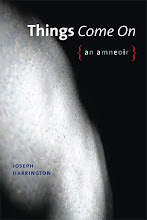
THINGS COME ON done come in.


Not the most photogenic person in the world am I, but you get the idea. Things Come On: (an amneoir) is now available from Wesleyan University Press. Order from the University Press of New England web site using the discount code W301, and you get 30% off - which brings the price more in line with a regular poetry book. While you are there, check out the terrific recent books by Rae Armantrout, Kamau Brathwaite, Ed Roberson, Elizabeth Willis, and Evie Shockley - all of which are available at the same discount, if I'm not mistaken.

Between being sick and having to read 150+ graduate applications, I have neglected the bloggo. I apologize to my thousands of fans. Ha ha.

Really, what I was going to say about mixed-genre work and elegy isn't very profound, and inadvertently got way more build-up than it's worth, simply b/c I haven't been blogging.

It's just this: that there seems to be a lot of it. Or rather, that a lot of work that mixes, defies, or invents genres seems to be in an elegiac or eulogistic vein. The book above being an example, but also:
- Kristin Prevallet, I, Afterlife: An Essay in Mourning Time
- Eleni Sikelianos, The Book of Jon
- Anne Carson, Vox
- Susan Howe, The Midnight
- Michael Lesy, Wisconsin Death Trip
- Mark Nowak, Coal Mountain Elementary
- Susan M. Schultz, Dementia Blog (arguably)
- Parts of Theresa Hak Kyung Cha's Dictee
- Mahmoud Darwish, Memory for Forgetfulness
- Michael Ondaatje, Running in the Family
And I'm sure there are lots of other ones you could name that are not occurring to me.

Why is this? Part of it may be that contemporary writing generally is in an elegiac mode, in the broadest sense: it conveys a sense of lostness, belatedness, etc. When I read a longer Ashbery poem, I always feel like I'm reading an elegy.

But the best specific explanation I've encountered is a sentence from Prevallet's book (which I quote in the notes to mine): "If the body of the text has suffering at its root, then language will take a fragmented, torn-apart form, as if it too is suffering" (p. 50). There does seem to be something about the physicality of the text that connects with the physicality of loss - the feeling of being held together with chewing gum and baling wire. The mixed-genre text presents itself as something not-whole. This feature is certainly in keeping with Prevallet's principled refusal to impose "closure" on mourning.

Then there are scrapbooks (in the English-speaking world, esp.)- an ad hoc memorialization via physical artefacts collected in a book. The keeping of relics.

Half-baked hypotheses on somebody's blog. What do you think?

Tuesday, December 28, 2010

Why Multi-Genre?

I applied for a fellowship to work on a series of books I’m doing about my mother’s life and times (the first of which, Things Come On, is scheduled to be “out” next month). I was told that I didn’t get it because I hadn’t provided adequate reasons for my writing in multiple genres (verse, prose, dramatic dialogue) within a single book. I thought I'd addressed that issue – but then I’m not the one handing out the fellowships.

So I started thinking more systematically about it. The most obvious and general reason is that I’m a believer in trying not to separate form and content – i.e., that it’s a false dichotomy. So, rather than trying to make a welter of heterogeneous materials fit into a pre-determined form (e.g., the linear narrative of standard prose autobiography – or Spencerian stanzas – or five acts), I am attempting to let the materials of the books – diaries, scrapbooks, conversations, photographs, hand-written documents, letters, etc. – and combinations of materials from a given time period – suggest the shape of the text into which I am integrating them. As the nature or tone of the materials change, so does that of the narrative, and therefore, its shape.

The bigger issue here, one which I’ve addressed before, is the generality/particularity or deductive/inductive issue. Writing a biography of any kind (maybe a non-fiction book of any kind – maybe a book of any kind) is the experience of being confronted with lots of materials, voices, ideas. The author must somehow select from amongst that mass of Stuff and compose the selected materials, along with his or her own words, in such a way that the reader gets, at the very least, patterns of images, themes, feelings, that add up to something more than any single one (whether or not that something is "greater than the sum of the parts" – the assumption behind that expression is precisely the problem, seems to me).

One way to go about that, of course, is to select for a certain type of story, or a certain genre of story, and then to force any recalcitrant materials to conform to that type. The default type is the absorptive “page-turner” that sews everything together into one central storyline – like a realist novel, whether or not the nonfiction book includes dialogue, point-of-view, composite characters, etc.

But to my mind, part of the thing that makes life stories interesting is precisely that welter of particulars – either because I recognize some of the places and personality types instantly (e.g., Memphis Afternoons, by James Conaway) or because I’m confronted with a set of people and details that are radically different from those in my own life (e.g., The Immortal Life of Henrietta Lacks, by Rebecca Skloot). The Skloot book, for instance, makes no bones about switching from a journalistic to novelistic to memoiristic telling of events, as the events themselves seem to demand it. And I think one reason is that she took seriously this question of fitting the structure of the narrative to the narrative that needed telling - in part as a way to try to honor the particularity of the lives she is writing about (including her own).

So, the multi-genre non-fiction book is less like a novel than a scrapbook – that hybrid, connect-the-dots story book formed by the relations between its elements – which are very diverse elements indeed. As Susan Howe puts it, “The relational space is the thing that’s alive with something from somewhere else.”

Now to try to condense all this into a single paragraph for the application!

Tomorrow (well, OK – soon, anyway): Multi-genre writing and the elegiac mode.

Monday, September 27, 2010

Middletown Lit.

"And so, as in primitive story-telling, the social function of these forays into the realm of fancy demands that the experiences thus vicariously shared be happy or valorous ones. 'There's enough trouble in the world all about one, so why should people have to put it in books?' is an opinion frequently heard in connection with the prevailing demand for happy endings - or at least endings that if not exactly happy still exalt you and 'make you feel that the world is coming out all right.' Many people in Middletown would agree with their favorite poet, Edgar Guest,* in condemning people who condone 'sin or unhappiness' in fiction by saying, 'The book is sordid, but it's art!'"

* "'Eddie' Guest is more widely read in Middletown than any other poet, with Riley as runner-up in popularity. Rotary has tried to secure him as a speaker, as has the Men's Club in a leading church. In a group of college-trained men prominent in local life, one said that 'Eddie' Guest and Riley were his favorite poets, 'That man Guest certainly gets to my heart'; one liked Kipling, 'never could get Burns, and Byron always seemed a dirty fellow dressed up in poetic form'; while a third prefers Kipling and 'never could get Browning. Why didn't he say it in prose instead of the awful way he did?'"

- Robert and Helen Lynd, Middletown: A Study in American Culture (1929)

Tuesday, August 3, 2010

Memory, History, Poetry, and the Nature of Nature

A couple of weeks ago, I heard Lawrence Buell, ecocritc extraordinaire, give a talk on what he calls “environmental memory” in literature. The argument is still developing (unlike some “big names,” he didn’t just read from an already-published book), and is sort of perspectival and descriptive, rather than anaylitical and critical. In any event, it seemed to me that “memory” was being used as a kind of ahistorical, psychologized category – an individualized version of history.

That’s a consummately American approach. Europeans can see history for the succession of tragedies that it is (b/c it has been more so, over there). Americans need to boil history down for their own personal use. If Europeans philosophize, Americans psychologize. This tendency is especially problematic for environmental discourse, as there is already a penchant for organicist tropes (and essentialist thinking).

I asked what to me was the obvious question: What is history? He was obviously quite tired (halfway through a two-week intensive graduate seminar), and the response kind of rambled, but I think he understood what I was getting at. I do hope that he thinks some more re: the relation of history to memory (and how each gets represented). That’s crucial.

I also hope that he branches out generically. “Literature” meant “novels.” This conflation is typical, esp. amongst Americanists. Moreover, he did not talk about the form or structure of novels – that is, how the shape and texture of the text might interact with the way it represents memory or the environment.

The grand theories of American literature from the 50s and 60s dealt with motifs in novels. Those were the days of structuralism and psychologistic readings. Nowadays, not many people presume to account for all of American lit – and increasingly, monographs limit themselves to one or two genres (in the titles, even). But Buell is the generation just after the Theories of American Literature (Novel) crowd, and while he has branched out in dramatically new directions, this basic assumption – and approach – remains in place. It is a criticism that takes “content” for granted.

It is a pivotal assumption, since, it seems to me, the nature of representations of nature is what is at stake – not simply the semantic, hypotactic meanings, but the syntactic, material nature of the text as well.

I recommend that Prof. Buell read poets who deal with memory and history: Susan Howe, Adrienne Rich, Charles Olson, Nathaniel Mackey, et al. They may or may not deal with the environment as well. But one needs to think about the medium in order to understand the message. And to do that, one cannot accept genres as natural phenomena. To do so means to misunderstand “nature.”

Thursday, July 29, 2010

Lost at Midnight

I still don't quite get what Susan Howe was doing in The Midnight. I mean, it hits on a lot of her major themes - legibility, lostness and discovery, textual mediation, margins v. center, etc. And there are the small, double-spaced poems in the middle of the page. But this book seems very different.

In many (most?) of Howe's books, we get a short prose introduction/explanation/narrative detailing what motivates the poems - and where some of the lines come from. This is a very useful and clever method, insofar as it preremps the "What's it about?" question. The prose bit gives you some notion of what the poems are alluding to, what the tone is to be, and what's prompting the feeling (and leaps of thought). In The Midnight by contrast, we get a series of poems, then a section of prose snippets, poems, prose, poems. The final set of poems, "Kidnapped," clearly pick up on themes and even texts that the prose parts introduce. But the relation between the other poems, "Bedhangings," which were originally collected as a chapbook of that name, and the prose sections that divide them, is rather cryptic.

Moreover, the relation of the prose pieces (each titled) to one another is often a bit mystifying. How does the early life of Frederic Law Olmstead relate to the origin of starching in fabrics relate to Howe's aunt and uncle? These sections are rendered in prose that is more-or-less linear and representational: it's clear how one person relates to another, or one object relates to those persons, and usually how one sentence relates to the next - which maybe leads me to expect more connections between the titled sections. One of the themes of the book is relationality - what's created when one thing is set next to another. That's OK until the relationality looks like that between the strands of spaghetti stuck to the wall. I mean, if I sent this to a publisher - even your friendly neighborhood avant publisher - they'd tell me to get lost. Granted, the writing wouldn't be as good, or the family stories as interesting. But even if they were, the form of the text offers so little purchase for the reader, that the reader has to be motivated already. You keep reading b/c it's by Susan Howe. 

So, I read Marjorie Perloff's article, which gave excellent close readings of individual sections, but not much sense of why all of these disparate elements are in the same book. Then I read John Palattella's review, which told me that "Howe catalogues details in an almost forensic way" and does so by "cracking the looking glass and making the incongruous appear even more so." Moreover, "The prose sections . . . . present a collage of brief narratives, with coincidence and synchronicity being the only means offered for aligning and organizing them." Reading these lines made me feel like I wasn't losing my mind after all. But in other books by Howe I always had a sense of how each section w/in a book hung together (loosely, anyway), and I saw the thematic filaments that led me from one to another and back.

Then I read Stephen Collis' review, and that helped. The "Bedhangings" poems relate text and textile, and the obssession w/the interleaves of books deals with another kind of "curtain," which in turn "is also the false front we present to the world," which Howe's actress-mother certainly did (when the curtain went up). "The curtain protects . . . but it also excludes." All of which rhymes with the account of trying to get into the Houghton Library at Harvard, and then trying to "get at" the books behind the "locked glass." Or how "while one voice excludes ('Go away') another includes."

That's really the issue: why these fragments? Why not that one - the one that was left out?

In any case, I had been suspecting what Collis says in as many words: that The Midnight is not so much about Howe's mother (as Palattella holds) as about Howe herself - or at least her work. It's almost like reading a "greatest hits," at least in terms of her intellectual concerns, tropes, forms: "she notes how 'you must turn Uncle John's books around and upside down to read the clippings and other insertions pasted and carerfully folded inside.' Again one is struck by the similarity between this and Howe's own books, where upside-down and off-kilter lines cause one to constantly turn her books about inthe midst of reading."

So, yes, noone but Howe could have published a book like this, but noone but Howe would have written it. And perhaps noone but Howe fans would be interested in reading it. If this were the first book of hers you read, it would be a disaster. But if you read it in the context of the rest of her oeuvre, you can see how one part of the book might "rhyme" with another. The family history/memoir is in a sense just another path into the woods - albeit a particularly treacherous and overgrown one.

All of which makes me wonder if one should read each of Howe's books as a chapter of a larger, yet-to-be-collected work.

All of which is, of course, my own anxieties about my writing projected onto Howe's book.

Wednesday, November 25, 2009

Please choose the work of art from the following: Level Two (this one is harder than yesterday's)

The following are recent excerpts from various blogs. Can you spot the art/literature?

[A.] “Or maybe all blogs are art. Maybe we should send out a mass-mailing with MFA diplomas as PDF attachments, and see who clicks on the link. Or maybe we [the Experts] should have an MFA Patrol, like the Publishers Clearinghouse, only you’ve already published yourself. And guess what? We've decided your blog . . . is art!”

[B.]

“I'm running out of listservs to join.
Hey, where are the chinks and niggers?
They're inside already? You don't say!
You mean we're outside? That's all right.
I've always liked to eat and fuck al fresco.”

[C.] “I'm pretty sure I was always the same person, the compass needle just needed proper adjusting. Looking at this photo of the buggy outside the record store now perfectly sums me up. The only difference being my Fell pony cart will certainly have that Ramones sticker on the back, and I'll trot him back to the farm, ipod blaring. Hey ho, let's go.”

[D.]


[E.]

“Billy Tea & Nerada
Coles Supermarket bread mix in a box
Wett-X
licorice from Darrell Lea Shop
TimTams
lolly aisle
violet crumble bar
veet (hair wax)
Elastoplast”

[F.]

“Rye Rye Rye Rye Rye Rye Rye Rye Rye Rye
Rye Rye Rye Rye Rye Rye Rye Rye Rye Rye Rye”

[G.] “I offered his virus to the mechanized virus reader. It had many functions, among these the one that translated ‘virus’ into ‘sick room architectures.’ Thus the design specs for his recovery: a 15 x15 outdoor room with a perimeter of medium height pines, inside of these pines a hospital bed and an eight foot flat screen tv.”

[H.] “Som god Ytrebykven er eg glad i finsk folkemusikk, og fann stor fagnad i ein farsott som har herja dutuba i ujamne bølgjer dei siste åra. Det byrja, så vidt eg har kunna bringa på det reine, her, med vokalgruppa Loituma si a capella versjon av den ubegripeleg catchy "Ievan polkka" ("Evas polka"):” [the post, not the song – which is by a f*in’ great band, IMO]

[I.] “Know your meat source. Grassfed beef biggie Tallgrass Beef of Sedan, Kansas, is the latest client of IdentiGEN North America Inc., subsidiary of the Irish IdentiGEN Ltd. The company’s DNA TraceBack technology allows meat to be traced to the farm where it was raised (unlike, say, the tainted hamburger recounted recently in the NY Times). IdentiGEN Inc. is based here in Lawrence, Kansas. (IdentiGEN press release; Lawrence Journal-World).”

[J.] “’A strong desire seized me of visiting remote regions. My first impulse was to go and see Paris. It was a trivial objection to my aspiring mind that I did not understand a word of the language, since I certainly intend some time in my life to see Paris, and equally certainly never intend to learn the language; therefore that could be no objection.’”

[K.] “I really miss writing the blog regularly but a couple of deadlines have kept me totally busy. One of them is the preparation of the performance with Pierre Joris & Miles Joris-Peyrafitte that will happen this coming Thursday in Angoulême (France). No Thanksgiving for us! We are off tomorrow and below is the info about the show in case you are around this area. This is my first trip to the Poitou-Charente region and I am looking forward to discover their food specialties and have some of the delicious Pineau des Charentes — a mix of wine and cognac. It will be my pleasure to report if I have any time to do so. But right after, I am off to the Pyrenees for more work on Augustus Saint Gaudens. I am leaving you with a few posts from last year, and please do dig into the archives and the categories.”

[L.] “One of the aspects I appreciate about our market is the festive, celebratory air. It’s an event. People bring friends or company from out of town. They use it as a social venue and run into their neighbors. They get to know the farmers, bakers, soap-makers and even the musicians busking on Saturday mornings.”

[M.] “The door is located on the right side of the store and I guess you just habitually wander in the same direction that you arrive. Very quickly my sister spotted Hallmark ornaments on sale 50% off. I didn't think there were any she didn't have, but obviously there are a few. As she pawed her way through the basket, I meandered around, glancing here and there, seeing some lovely bric-a-brac that I knew I didn't have room for. I was making my way around the room and was now facing the wall on our left.”

[N.] “The water people have a little window and a dog. The cigarette people have a stool and an empty shop. The fishing people have buckets and folding stools and rim the canal. The fishing people are rarely women but there is a shop for lures and casters in a hidden neighborhood and this is run by a woman who knows everything. The fishing people go to her finally when their buckets are empty and she is smoking double-happinesses when she tells them which wriggle startles a bottom-feeder and which arouses its interest. The massage people have an entrance that is always occupied in neon. I don’t know what they do. I have suspicions.”

[O.] “These dreams have no portent: I don’t seek their omens or believe such things presage future events. Some other transport—some intimate communion—takes place. Even now the memory of myself in bed, the hall light flooding one side of my room, arrives in dreamlike waves that can only be partially grasped. And yet, those years of going to bed composed an eternity, too.”

Wednesday, November 18, 2009

What Blog Is Art?

Many blogs (including this one) present themselves as commentaries upon. Upon books, farming, culture, what the kids are doing, etc. They use words to convey information or ideas.

But where are the blogs that are art? Or, said another way, are there blogs that are composed of art-writing (whether or not the author intends it)? And what is your criterion? How do you know?

I ask this question b/c I'm trying to advise an MFA thesis that is a blog. Can you tell which blog it is? Can you pick out the work of art from amongst the "blog[s] about x"?

Or maybe all blogs are art. Maybe we should send out a mass-mailing with MFA diplomas as PDF attachments, and see who clicks on the link. Or maybe we [the Experts] should have an MFA Patrol, like the Publishers Clearinghouse, only you don't get published. Surprise! We've decided your blog . . . is art!

Or one could do blog-sculpting - a mash-up of various elements of mere content-based blogs - a blog in which the blog form would itself be the content.

What if a web log were really a log? I mean a real, damn log!!! What do you think of that, Bucko?! I got yer art form - RIGHT HERE! Organic enough for you? Well, there's a lot more where this came from . . .


Saturday, November 14, 2009

The Case for Including Flarf and Conceptual Poetry in the Next Economic Stimulus Package

“Originality today has become the diminished function of lessening production costs (‘content scraping’) i.e. there is less and less incentive today to produce original works, especially in the arts, because everyone, particularly those outside the arts, are doing so. And this creates a considerable incentive, especially among artists, to plagiarize works by others, works that already exist and were produced by those formerly considered to be non-artists. Or to put it more simply, as the price of originality has gone way down (everyone an artist), the price of plagiarism has skyrocketed – even if, in the end, plagiarism has costs that are nominal, illusory, and often gratuitous when stacked against the no-less illusory concept of ‘originality.’ . . . Such activity [uncited circulation patterns, syndication across networks] should probably be regarded as value-adding rather than either theft (removal of value) or fraud (deception), the two crimes most closely associated with plagiarism.”

- Tan Lin (plagiarism/Notes/Heath, etc.)

Friday, November 13, 2009

_plagiarism/outsource, Notes Towards the Definition of Culture, Untitled Heath Ledger Project, a history of the search engine, disco OS_, by Tan Lin, et al.

I seem to be drawn to generically ambiguous, uncut, reflexive, abecederian works. I've been reading Anatomy of Melancholy, for chrissakes.

But it was hard for me to get started on Tan Lin’s book plagiarism/outsource, &c.(zasterle) – I re-read the first few pages a few times before I had my sea-legs – but the farther I got into it, the smarter it seemed. Call it conceptual poetry or performance art, verily, it enacts the problems with “intellectual property” and the culture it creates. For starters, it’s really authored by Lin and eight other people (seven workshop participants and a graphic designer). Secondly, it’s copylefted, not copyrighted. Thirdly, it takes the liberty of reproducing large chunks of (theoretically) open-source text (about Samuel Pepys), along with chunks of (theoretically) copyrighted text and images (about Heath Ledger, amongst others).

Hey, take it to the Supreme Court . . .

There is also a fair amount of source code/html mark-up – and google search results, etc.

“As Pepys and Heath and Helena and Mike and Jean, and Ina, and Soo-Young and Jennifer, and Tamiko noted, because ‘anything that can be entered into a computer can be reproduced indefinitely

“each morning at the Pickwick was narrowly descriptive and ‘as inert as possible,’ subject to erasure or re-distribution

“i.e. her feelings like his were hand-written or like everything else approximate or obstreperous and narrow like an itinerary post(ed) opposite the reception desk

"i.e. their (their) writing (writing) was like (like) an elevator opening

"as a result

"Heath: or Samuel: was not ‘ something inserted into the video: they were watching on You Tube ‘ ‘ (i.e. storage) but something taken away or outsourced (dissemination), i.e. the process was more like erasing each other (plagiarism) rather than viewing.”

This from section (?) 1, “unread novel.” The “Notes Towards the Definition of Culture” part of the title of the book, is a sho-nuff treatise:

“likewise, with a book she was carrying around all that week Heath died,

“you shouldn’t have to read it because everything in it has already been read by her,

“in this sense, the death is what intellectual property lawyers term ‘derivative;’ [sic] it encourages no detrimental reliance i.e. it would not render or caused you not to read something else since it is, technically, ‘something else’ subject to non-writers who are readers and any future non-readers who are writers working in a domain of what relaxed copyright advocates call @copyleft and so they decided because everything is plainly beautiful and

“indiscriminately ugly in unlimited distribution,

“the non-logocentric, non-literary project shares much with what George C. Williams, the evolutionary biologist, describes as the principal functioning of the gene: ‘that which segregates and recombines with appreciable frequency’ . . .”

And the blocks of project Gutenberg text (not least the “small print” copyright instructions and disclaimers). And the “Entertainment Story” is a damn good imitation of an entertainment RSS feed, if it isn’t really one.

they or the texts they are writing can be [mythical] like a [tourist] destination

they can be [programmatic] without being confined to a single practice,

< XTRA GREEN Green Tea Beverage Mix >

notice the lack of quotation marks

This is a heady blurring of authorial authority and ownership. So when I say:

genre = brands,

you don’t know if Tan said it or Michael or Ina or Sooyoung or Jennifer or Helena or Tamiko or Jean or Danielle or Heath or Samuel or Joe. Or all or none.

[“I,” for one, definitely believe it to be true]

"In this system, creating content is less useful than passing on existing content or re-creating a context for re-use. Plagiarism, despite its 'contested normative significance' is one parameter to define this recontextualizing mode. Ditto with outsourcing or image defamiliarization. Having sex changes the group dynamic."

– “Emily,” from Historia de mi Vida Triste

I’m glad I wrote that in my blog, b/c what better place for matter of uncertain authorship. Yo, originality is the last remaining waste product of creative practices and remains to be eliminated within aesthetic production and/or distribution systems.

What he said.

Saturday, October 17, 2009

Anthology or Notlogy?

As I prepare to order books for my poetry workshop next semester, I’m confronted by the perennial issue of whether or not to order an anthology. Marianne Moore argues in favor of anthologies thusly: “Academic feeling, or prejudice possibly, in favor of continuity and completeness is opposed to miscellany – to music programs, composite picture exhibitions, newspapers, magazines, and anthologies. Any zoo, aquarium, library, garden, or volume of letters, however, is an anthology and certain of these selected findings are highly satisfactory.” Just so. But likewise, “However expressive the content of an anthology, one notes that a yet more distinct unity is afforded in the unintentional portrait given, of the mind which brought the assembled integers together.” And, one might add, the historical moment in which that mind operated. The auteur and his/her times.

So, should I order an anthology? And if so, which? I’m seriously asking – that’s what the comments box is for.

To my mind, the contenders:
- American Poets of the 21st Century (Claudia Rankine and Lisa Sewell, eds.)
- American Hybrid (Cole Swenson and David St. John, eds.).
- Lyric Postmodernism (Reginald Shepherd, ed.)
- Postmodern American Poetry (Paul Hoover, ed.)

Each has its flaws, as has been pointed out in the BlogPoSphere. The first only covers 7 poets (but does so in gratifying detail – poems, poetic statement, essay by another poet/critic). American Hybrid – only 7 pages per poet – and lots of them – and lots of them are boring – and some less-good poems by the poets that aren’t. But it’s cheaper than the late R. Shepherd’s anthology – which had the misfortune to come out from an independent press the year before the A.H./W.W. Norton juggernaut appeared. And it does largely the same thing, in a little more detail – something between the previous two. It’s about 2/3 the size of A.H., but costs a couple of bucks more. Pomo Am. Poetry is great, but pretty dated at this point.

I also want to order books by individual authors. Here the problem is to avoid foisting my current reading habits (experimental multi-genre narratives, mostly; often large) on my students, who will be intermediate-level. But that’s another issue . . .

Saturday, October 3, 2009

Why I Like Marianne Moore

- I like lists, esp. lists of stuff and of species

- I am an inductive, rather than deductive, thinker

- Whoever says Moore’s stuff is not musical has a tin ear. I like the sound, shape, pacing, connotations of her words and lines more than the “message.” It’s complex music – which is so much better than the metronome.

- There is something about seeing nature as art and art as nature that appeals to me

- And the ethos of resilience

- Grammatically Correct sentences that leave one off-balance. Parataxis within and between them. Precursor of the “new sentence”??

- Bits of found material - citational - a research-based poetry

- Bits of found material sutured together into the same sentence. (Precursor of flarf??)

- She purposely evaded the either/or, "er ye fer it or agin it," coke/pepsi configuration of US poetic politics (despite Pound's best efforts)

- The rarely unbrilliant Ben Friedlander: "[M]ediation becomes at once more complex and more pervasive: more complex because, as Moore's work shows, one can be aware of mediations while negotiating them with ease; more pervasive, because their introduction into a poem can be coordinated with the sharing of meaning rather than treated as antagonistic to it. . . . Indeed, Moore's most precise and informative descriptions are often those places where the mediation of representational language is highlighted." What he said.

- Part of this phenomenon is due to the way she makes her syntax do Advanced Yoga.

- In fact, the topic of mimesis comes up in a lot of her poems - never unproblematically. We're always aware of looking at language describing looking at a representation. The poem is an object about objects.

- her "collage textures of poetry and discursive slides by which I definitely feel influenced." (Rachel Blau DuPlessis)

- I reserve the right to add to this list at any time.

Wednesday, September 16, 2009

Gertrude Stein; Blogging; &c.

I post a lot in the summer, less in the fall, and hardly at all in the spring. I am a seasonal worker.

But this is a pure existential activity, this blogging, this posting. Have you ever sent a letter to an address you knew didn't exist - and with no return address? That is purity.

If I wrote about my personal life, it would be so fucking fascinating, your head would explode.

Not really. Don't worry. It doesn't matter.

Soon this planet will be like all the others.

* * *

Is Gertrude Stein for real when she talks about "exactitude"? As in "exactitude in the description of inner and outer reality"? That begs the question, no? Like Pound directly treating "the 'thing,' whether subjective or objective." Like, I'm going to be able to verify your subjective reality, Ez. . . . Pls.

I once asked Walter Benn Michaels if it was possible to have an intention that one was unaware of. He responded that it was possible to have unconscious intentions. OK. And maybe the martians are channeling their intentions through me.

Now that I think of it, I think the martians are in fact channeling their intentions through me. And I haven't been taking notes!

Virgil Thomson, in his note on "Patriarchal Poetry," claims that the poem is all about emotion - that it is a neo-romantic text. "It is hermetic writing; direct communication of ideas is not its purpose. Its purpose is the description of emotion . . . " And "'Patriarchal Poetry' is not cubistic at all . . . It is rounded, romantic viscreal . . ." Hmm. Well, neither I nor my students got that. But maybe we're all fools - entirely possible. Or maybe Virg is pulling our leg.

Monday, August 24, 2009

Image + Text

a propos the last post (below):

"Many . . . literary journals [of the early 20th c.] . . . printed photographs of paintings and sculpture, thereby invoking a general revolution in the arts and urging us to mark similarities and difference between the literary and visual avant-garde. It is, however, very difficult for academics [and apparently non-academic poets, too, one could add] to read this way, since it works against the way they are trained in traditional disciplines. The counter-reaction is also apparent. The Fugitive aimed to have almost no physical presence; anticipating the aesthetic that would dominate conservative magazines in the 1950s, its neutral typography and layout was designed to project the poetry it printed directly into the imagination. Poetry, for The Fugitive, was a spiritual not a material phenomenon.

"The cumulative evidence of the illustrations in this book should demonstrate that the material presentation of texts can significantly increase the kinds of meaning they can be used to produce."

- Cary Nelson, Repression and Recovery, p. 218.

I would only add that in some of the poems he presents, it is difficult to distinguish between "the literary and the visual" - for instance, the collaborations between Marius De Zayas and Agnes Ernst Meyer - or Walter Steinhilber collaboration with Langston Hughes in "Advertisement for the Waldorf Astoria."

I guess if The Fugitive wanted to be disembodied, the web would be a good place for them today - tho since they were conservatives, they'd probably be fetishizing print. There certainly is a lot of "neutral typography and layout" amongst literary web journals. And sure, things have progressed - many journals include visual art. And literature. But rarely mixed.

Bob Brown, Stevie Smith, Robert Grenier, Kenneth Patchen, Eleni Sikelianos, Cecilia Vicuna, Anne Waldman, Anne Tardos, Stephanie Strickland, Roberto Tejada, Theresa Hak Kyung Cha, Jenny Gough, Jena Osman, Debra DiBlasi, Mark Nowak, Tan Lin - et alia - you can add to the list. So it's not such a weird thing anymore. And it's not that image-text writing/composing is being suppressed. It's that not many people are doing it. I would like to encourage it.

Friday, August 14, 2009

On Literary (and Political) Consensus

“I have written of a cult of ‘American consensus’ that rose up among the punditocracy [in the 1940s and 50s] . . . their fervent imagining . . . that America was united and at peace and would forever be, if only ‘extremists’ stopped stirring up the pot. And I have written about the kind of intellectual self-repression it took to believe this . . . America is divided and will always be. It is not too much to suggest that the rages that accompanied the crumbling of this myth of consensus, as the furies of the 1960s advanced, would not have been so rageful – would not have been so literally murderous – had the false rhetoric of American unity not been so glibly enforced in the years that preceded it: that some of the 1960s anger and violence was a return of what America had repressed.”

- Perlstein, Rick. Nixonland. NY: Scribner, 2008. 747.


“What does it mean to break down the traditional-experimental split [in poetics]? What are the implications of a traditional and experimental hybrid that claims to overcome division and speak with one voice?

“. . . If, as Filreis writes, ‘rhetoric about poetic form was often unacknowledged Cold War politics,’ then what sort of unacknowledged politics is the rhetoric of the hybrid?”

- Ehlers, Sarah. “US Poetry and the Politics of Form” [rev. of Counter-revolution of the Word, by Alan Filreis]. Against the Current, May/June 2009, p. 40.

Sunday, August 9, 2009

Mark Nowak on KKFI in KCMO

Just wanted to call your attention to the interview with poet-organizer Mark Nowak on this week's Heartland Labor Forum, Thursday, August 13, on KKFI-FM, 90.1. His segment runs at 6:30 pm apparently (the show is 6-7) - it's a show on new labor lit (esp. related to coal mining, such as Mark's new book of poetry/mixed-genre writing and photos, Coal Mountain Elementary, Coffee House Press - which you should check out, if you haven't already). You can also listen on your computer - and apparently, they rebroadcast the show on Friday.