Literarisches Events (in and around Lawrence KS)

  • PATRICIA LOCKWOOD. Lawrence. Thursday, September 11, 7:00 p.m., Spooner Hall, KU Campus.
  • PATRICIA LOCKWOOD. Lawrence. Friday, September 19, 7:00 p.m. Lawrence Public Library. Sponsored by Raven Bookstore.
  • DENNIS ETZEL, JR. & RACHEL CROSS. Lawrence. Thursday, September 25, 7:00 p.m., Raven Bookstore, 6 E. 7th St.
  • TONY TRIGILIO. Lawrence. Thursday, Oct. 2, 4:00 p.m., English Room, Kansas Union, KU Campus. FREE.
  • CALEB PUCKETT & JUSTIN RUNGE. Lawrence. Thursday, October 16, 7:00 p.m., Raven Bookstore, 6 E. 7th St.
  • BEN LERNER. Kansas City, MO. Thursday, October 23, 7:00 p.m., Epperson Auditorium, Vanderslice Hall on the KCAI campus, 4415 Warwick Blvd.
  • KRISTIN LOCKRIDGE & ROBERT DAY. Lawrence. Thursday, December 4, 7:00 p.m., Raven Bookstore, 6 E. 7th St.

Monday, September 20, 2010

You Said It, Brother!

"I called the upshot of the events soulless. I called the upshot of the events history-less. I equated lack of history with lack of soul. I turned a deaf ear to the chain of news items. I thought of the news system as wanting me deaf. I set myself up against the news system, on higher ground. I listened. . . . I felt I did not have much anger in me. I felt I was a quiet person. I felt the sky being torn apart. I heard quietude say: go along, go along. Though inexperienced, I was not tempted by quietude. I considered everybody untemptable. I thought of the many as not facing up to their untemptability, not opening up to their own purity, not preparing for the vision of themselves."

- from Language Death Night Outside, by Peter Waterhouse, trans. Rosmarie Waldrop (Burning Deck 2009).

Friday, September 17, 2010

NO SOAP at The Collagist

Which is better than no soap at the gym. Or no room at the inn.

Anyway, No Soap is a book I'm writing, and the first "chapter" is in this month's issue of The Collagist. This is very much a work in progress, so if you have any suggestions (or even observations), pls let er rip.

Wednesday, September 15, 2010

You Said It, Sister!

"Enough poetry and novels. Those resolutely surveyed territories. Those paralysed spaces surrounded by smugness, which eradicate themselves as they are erected. Speak to me instead of what eludes genre, what eludes situation . . . Who has not yet understood that the risk, there, of the nation - of territorialisation - is also that of literary, littoral, plottings." [Nathalie Stephens, from Notebook of Discord (Carnet de desaccords). Excerpted in Volt 15 (2010), p. 128]

God Hates Flags.

I've also been reading the wonderful Language Death Night Outside, by Peter Waterhouse, trans. Rosemarie Waldrop, subtitled "POEM. Novel." I wonder if the non-English-Speaking World is way ahead of us when it comes to thinking about literary form(s).

Friday, September 10, 2010

More on Print v. Digital

There are, of course, BEAUTIFUL print journals. Volt, for instance. It is so tactilly and visually appealing that I find myself rubbing it against my chest somtimes (or I could, anyways). Ditto for P-Queue and a lot of others. Covers, too - the one on the last Tinfish, or several Forklift, Ohio's. If you wish to appeal to touch, print is the only and obvious way to go - with smooth-finished covers or letterpress covers that bear the impress of the type. This is the idea behind Slow Poetry. Anything 3-D is still best in print. Or, if you are appealing to a retro-techno abject aesthetic - whether mimeo, or stapled and spraypainted (a la With + Stand) or just photocopied and stapled, like Abraham Lincoln (the journal - the president died of a gunshot wound, I'm pretty sure), then dead trees and ink-dust are the way to go.

The best of the smallest print journals sell out. That's a minus, from the reader/librarian point of view, since if you didn't get one, you're SOL.

And there are a lot of crappy-looking on-line journals. And there are a lot of boring and mediocre-looking print ones.

Print: who is going to keep up with subscriptions? How soon will they cash the checks? (that's my pet peeve) Are you going to sell ads? Who's going to do the selling? Who will do the grant-writing and fundraising to capitalize the venture (i.e., pay for all the paper and printing)? Will you allow libraries to invoice you? Even if you do, how will you get them interested?

If I were running an on-line journal, I'd send e-mails to the periodicals librarian at all the universities and colleges where I wanted my journal to be read, pointing them to the URL and asking them to put it in their on-line catalog ("freely available via the internet," is the U of KS libraries' tag line). Then I'd follow up with a postcard in a few months, if it wasn't in the catalog already. Remember: libraries are cancelling print journals and increasingly relying on digtial substitutes.
AND (at ours, anyway) it's a heck of a lot easier to get them to order a multi-thousand dollar database than a $15 little mag subscription - b/c the former will invoice and fill out a W-9, etc.

Postage. I'm a huge fan of the Postal Service (UPS sucks, IMO), but it still costs more money than an internet "hit."

You can't link directly to pieces of paper.

You can't do audio, video, animation, podcasts, RSS feeds on paper - and it's more expensive to do still images.

Which is worse for the environment: a grove of felled trees, or a bucket of burnt coal? (I honestly don't know the answer)

Tuesday, September 7, 2010

Print vs. On-Line Journals

I've been engaged in a coversation with some young friends who wish to start a literary journal. I'm arguing that they should provide all of the content for each issue digitally (i.e., on-line). I'd love to hear comments from people who have edited either print or on-line journals, as to the relative advantages and disadvantages of each. Here is a note I sent them recently, detailing my own thinking re: the topic:
~~~~~~~~~~~~~~~~~~~~~~~~~

Biggest practical advantages to print (IMO): (1.) Better resolution. Screen resolutions are getting better, but they’re still only (what?) 1/4 or 1/5 as sharp as print. (2.) Portability: it’s a lot easier to take a 5 oz. journal to bed than a 7-lb. iPad or Kindle. (3.) Write-ability – if you mark stuff up, like I do, print is cheaper and better than a tablet computer that does so. All three of these problems will be resolved, sooner rather than later, but for now, they aren’t.

Biggest practical advantages to on-line: (1.) Cheapness. This is going to be important, if you don’t want to spend time doing your own fundraising, grant-writing, etc. (esp. since we’re at KU); you can have bigger, more frequent issues, for less money; (2.) Accessibility and immediacy. It’s easier to get, so more likely to be read. How many people send in the check, then wait for the thing to arrive – or even go to the library? How many journals do they already subscribe to? How many people in other countries subscribe to US lit journals? (3.) More content options: audio, video, MUCH easier/cheaper to do graphics, visual art.

As to the prestige thing, I don’t at all mean to suggest that the Internet is losing in prestige – quite the contrary. Internet publishing is a fact of life; there are fewer print journals now than there were 10 years ago, plus more well-respected on-line journals, and I think that trend is only going to continue as budgets everywhere shrink. Only the very wealthy institutions are going to be able to financially afford print. This is my principal reason for hoping you all decide to go digital: to adopt a forward-looking attitude. That’s something I think our CW program could use more of.

I think there is indeed some of that dead-tree fetishism lingering in academe – though that is disappearing quickly, as more peer-reviewed journals go on-line. It’s usually the cultural conservatives who see on-line journals as the death of Western Civilization. In fact, you can pretty much tell how conservative a poet’s poetics are by seeing whether s/he has any on-line pubs. If there are lots, s/he’s probably more experimental; if there aren’t any, s/he’s probably pretty conservative.

I expect there is a greater reliance on print for fiction, since there are more commercial publishers. But, by the same token, such a journal needs to be very well capitalized going into it. And stay well-capitalized.

As to access to computers’ being an impediment: I would love to think there are inner-city schoolchildren who are or will be reading literary journals produced by Euro-American college students. But let’s face it: everyone who’s reading this thing is going to have access to a computer. And if it’s print, they’ll either have to afford the subscription price or have access to a library that carries it – big if’s. As for sifting them, there are sites such as Selby’s List (www.selbyslist.com) and Web del Sol’s list of e-journals (http://webdelsol.com/index-new-magazines2.htm) that do a good job of weeding out the rubbish. And there are some storied periodicals that have gone exclusively on-line (e.g., TriQuarterly: http://triquarterly.org/).

One does have to decide for oneself, however, and that holds for print as well as on-line; hopefully, if you’re an aspiring writer, that’s something you’d like to do – and it’s a whole lot easier to sift on-line. There are a lot of crappy or mediocre print journals: The [insert place name] Review – though often you don’t know that until you’ve bought it. For these reasons, I believe on-line is actually a good bit more democratic than print.

Saturday, August 28, 2010

More Narrative Issues

I’m not going to stuff the story of Lib's life into a meta-narrative or over-arching trope (that would be both cynical and flat, since I don’t believe in such things). In fact, I have an ambivalent relationship to narrative in general; in the US narrative is typically conceived of as the "other" of poetry, and I'm fond of poetry. But I do want this work to have a framework – an angle.

I think it has something to do with the time warp that any kind of creative life-writing or memoir involves. It has to do with a dialogue of the past and present – “hello from the future!” And the past people who can’t shut up – whom we are joining – who are as dead as our own childhoods. Since my mother died when I was barely 12 years old, most of my life I’ve imagined her as a rather static image – and part of the appeal of this project was to discover (i.e., assemble) her narrative self. But since I did know her (and her family) some, and since there is some documentary evidence as well as memory, it’s really as much a dialogue with past-me and present-me – or 1930s Lib with 1960s Lib.

Roland Barthes comment, re: the photo of the condemned anarchist assassin, from the 1880s: “He is dead and he is going to die.”

We know the ending, but only of the past.

Thursday, August 26, 2010

My Narrative "Issues"

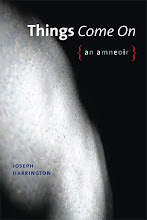
I have a book coming out early next year, called Things Come On. It covers the period from autumn of 1972 to summer of 1974, during which (a.) the Watergate scandal was “unfolding” and (b.) my mother was dying. That concurance provided a ready-made structure.

Now I’m writing the rest of my mother’s life and times – and there is no obvious narrative structure waiting for me. Instead, I have to pull one out of my – brain.

In part, this is because I’m dealing with 50 + years instead of 2. Also, I’m working on the part that covers her childhood and teens, during which not much extraordinary happened. I’m hoping that once I get her to Washington and onto Capitol Hill, the content will buoy me up and carry me along.

This is not to say that her childhood and teen years (1920-1939) are not interesting. I find them very interesting – not just b/c they involve people I knew later in life, but because, well, I’m a sucker for particularity. I can get immersed in the minutiae of anyone’s life, esp. if it’s new to me, esp. if it’s from a bygone era. And I think that the minutiae, the seemingly random and haphazard memories, quotations, and factoids, form a lot of what we take to be life.

But not everyone feels that way, alas. So, how to make it interesting to others? Isn’t that always the question?

Thursday, August 12, 2010

2 By Rachel Zolf

I’ve been meaning for some time to write something about Rachel Zolf’s book Masque (Mercury Press 2004), and now she’s come out with another one, Neighbour Procedure (Coach House 2010). The first is a “masked” memoir in the form of verse dialogue. The second deals with the Palestinian-Israeli conflict; it was occasioned by a trip to “Israel-Palestine” and contains “some of the journey’s mad affects.”

Masque is large – 10x8” pages – and the verse is spread out over the pages. It is “spoken” by various characters – The Media Man (who is also The Father, the egomaniacal reporter/TV personality, Benny Z-d); The Daughter; The Philosopher (who is mostly Marshall McLuhan); The Censor (who “redacts” certain words); The Whisper (which says things like “you fucking screaming idiot”), and so on. At first some of the voices occur on separate pages, then in consecutive dialogue. But finally, they mostly are all talking at the same time, by way of interlined stanzas; the names in the right and left margins alert the reader to the first line of the character’s speech, but the parts are written in alternating lines. Sometimes there are just a few short lines crouching in the upper left-hand corner of the page; sometimes there is one column of text that is left-justified, one that is right-justified, and one coming down the center. There are even drawings and extended etymologies. I’m not going to try to reproduce this method on Blogger. Suffice it to say that Zolf depicts a very complex set of relationships within and beyond a family in a few (colloquial) words. Much of the material is taken from Canadian Broadcasting Corporation footage, as well as newspapers which her father – who just happens to be a Media Man, too – wrote for.

Neighbour Procedure is rather different. The title refers to the practice by the Israeli army of using residents of Palestinian neighborhoods as de facto human shields. Again, much of the material comes from “found” sources: newscasts, web sites, commercials, the Qur’an, Judith Butler, etc. The first section reminds me of the ghazal form – that is, the juxtaposing of lines of verse that do not follow one from the other, but which have a lot to do with each other. (In this respect, it reminds me of Susan Tichy’s Gallowglass, except that there it is the American-Iraqui conflict that is the source). Other poems are lists of numbers and names, or a mosaic of the words “car [mule, belt, bike] bomb” with musical notations added. The middle section is composed of white-out poems from Ibn Barun’s 11th c. “Book of Comparisons” of Arabic and Hebrew words, as a method of glossing the Torah (mixed in with the poet-speaker’s own stutterings). The rest are various mash-ups and docupoems – one section is composed of “word maps.” And the notes at the end are well worth reading.

The barber

One soldier danced into the shop, 'Nice, nice'

Whose faces were painted certain images don't appear

Cutting in random lines the machine touched my scalp

Can you be gentle I'm not an expert open your mouth

A group of children stones his weapon on my shoulder

Intolerable eruption patting his chest, 'Now I'll tell you my name'

Sometimes staccato sometimes continuous

The soldier left the barbershop with the scissors

The soldier left the hair on my lips

Tuesday, August 3, 2010

Memory, History, Poetry, and the Nature of Nature

A couple of weeks ago, I heard Lawrence Buell, ecocritc extraordinaire, give a talk on what he calls “environmental memory” in literature. The argument is still developing (unlike some “big names,” he didn’t just read from an already-published book), and is sort of perspectival and descriptive, rather than anaylitical and critical. In any event, it seemed to me that “memory” was being used as a kind of ahistorical, psychologized category – an individualized version of history.

That’s a consummately American approach. Europeans can see history for the succession of tragedies that it is (b/c it has been more so, over there). Americans need to boil history down for their own personal use. If Europeans philosophize, Americans psychologize. This tendency is especially problematic for environmental discourse, as there is already a penchant for organicist tropes (and essentialist thinking).

I asked what to me was the obvious question: What is history? He was obviously quite tired (halfway through a two-week intensive graduate seminar), and the response kind of rambled, but I think he understood what I was getting at. I do hope that he thinks some more re: the relation of history to memory (and how each gets represented). That’s crucial.

I also hope that he branches out generically. “Literature” meant “novels.” This conflation is typical, esp. amongst Americanists. Moreover, he did not talk about the form or structure of novels – that is, how the shape and texture of the text might interact with the way it represents memory or the environment.

The grand theories of American literature from the 50s and 60s dealt with motifs in novels. Those were the days of structuralism and psychologistic readings. Nowadays, not many people presume to account for all of American lit – and increasingly, monographs limit themselves to one or two genres (in the titles, even). But Buell is the generation just after the Theories of American Literature (Novel) crowd, and while he has branched out in dramatically new directions, this basic assumption – and approach – remains in place. It is a criticism that takes “content” for granted.

It is a pivotal assumption, since, it seems to me, the nature of representations of nature is what is at stake – not simply the semantic, hypotactic meanings, but the syntactic, material nature of the text as well.

I recommend that Prof. Buell read poets who deal with memory and history: Susan Howe, Adrienne Rich, Charles Olson, Nathaniel Mackey, et al. They may or may not deal with the environment as well. But one needs to think about the medium in order to understand the message. And to do that, one cannot accept genres as natural phenomena. To do so means to misunderstand “nature.”

Thursday, July 29, 2010

Lost at Midnight

I still don't quite get what Susan Howe was doing in The Midnight. I mean, it hits on a lot of her major themes - legibility, lostness and discovery, textual mediation, margins v. center, etc. And there are the small, double-spaced poems in the middle of the page. But this book seems very different.

In many (most?) of Howe's books, we get a short prose introduction/explanation/narrative detailing what motivates the poems - and where some of the lines come from. This is a very useful and clever method, insofar as it preremps the "What's it about?" question. The prose bit gives you some notion of what the poems are alluding to, what the tone is to be, and what's prompting the feeling (and leaps of thought). In The Midnight by contrast, we get a series of poems, then a section of prose snippets, poems, prose, poems. The final set of poems, "Kidnapped," clearly pick up on themes and even texts that the prose parts introduce. But the relation between the other poems, "Bedhangings," which were originally collected as a chapbook of that name, and the prose sections that divide them, is rather cryptic.

Moreover, the relation of the prose pieces (each titled) to one another is often a bit mystifying. How does the early life of Frederic Law Olmstead relate to the origin of starching in fabrics relate to Howe's aunt and uncle? These sections are rendered in prose that is more-or-less linear and representational: it's clear how one person relates to another, or one object relates to those persons, and usually how one sentence relates to the next - which maybe leads me to expect more connections between the titled sections. One of the themes of the book is relationality - what's created when one thing is set next to another. That's OK until the relationality looks like that between the strands of spaghetti stuck to the wall. I mean, if I sent this to a publisher - even your friendly neighborhood avant publisher - they'd tell me to get lost. Granted, the writing wouldn't be as good, or the family stories as interesting. But even if they were, the form of the text offers so little purchase for the reader, that the reader has to be motivated already. You keep reading b/c it's by Susan Howe. 

So, I read Marjorie Perloff's article, which gave excellent close readings of individual sections, but not much sense of why all of these disparate elements are in the same book. Then I read John Palattella's review, which told me that "Howe catalogues details in an almost forensic way" and does so by "cracking the looking glass and making the incongruous appear even more so." Moreover, "The prose sections . . . . present a collage of brief narratives, with coincidence and synchronicity being the only means offered for aligning and organizing them." Reading these lines made me feel like I wasn't losing my mind after all. But in other books by Howe I always had a sense of how each section w/in a book hung together (loosely, anyway), and I saw the thematic filaments that led me from one to another and back.

Then I read Stephen Collis' review, and that helped. The "Bedhangings" poems relate text and textile, and the obssession w/the interleaves of books deals with another kind of "curtain," which in turn "is also the false front we present to the world," which Howe's actress-mother certainly did (when the curtain went up). "The curtain protects . . . but it also excludes." All of which rhymes with the account of trying to get into the Houghton Library at Harvard, and then trying to "get at" the books behind the "locked glass." Or how "while one voice excludes ('Go away') another includes."

That's really the issue: why these fragments? Why not that one - the one that was left out?

In any case, I had been suspecting what Collis says in as many words: that The Midnight is not so much about Howe's mother (as Palattella holds) as about Howe herself - or at least her work. It's almost like reading a "greatest hits," at least in terms of her intellectual concerns, tropes, forms: "she notes how 'you must turn Uncle John's books around and upside down to read the clippings and other insertions pasted and carerfully folded inside.' Again one is struck by the similarity between this and Howe's own books, where upside-down and off-kilter lines cause one to constantly turn her books about inthe midst of reading."

So, yes, noone but Howe could have published a book like this, but noone but Howe would have written it. And perhaps noone but Howe fans would be interested in reading it. If this were the first book of hers you read, it would be a disaster. But if you read it in the context of the rest of her oeuvre, you can see how one part of the book might "rhyme" with another. The family history/memoir is in a sense just another path into the woods - albeit a particularly treacherous and overgrown one.

All of which makes me wonder if one should read each of Howe's books as a chapter of a larger, yet-to-be-collected work.

All of which is, of course, my own anxieties about my writing projected onto Howe's book.