Literarisches Events (in and around Lawrence KS)

  • PATRICIA LOCKWOOD. Lawrence. Thursday, September 11, 7:00 p.m., Spooner Hall, KU Campus.
  • PATRICIA LOCKWOOD. Lawrence. Friday, September 19, 7:00 p.m. Lawrence Public Library. Sponsored by Raven Bookstore.
  • DENNIS ETZEL, JR. & RACHEL CROSS. Lawrence. Thursday, September 25, 7:00 p.m., Raven Bookstore, 6 E. 7th St.
  • TONY TRIGILIO. Lawrence. Thursday, Oct. 2, 4:00 p.m., English Room, Kansas Union, KU Campus. FREE.
  • CALEB PUCKETT & JUSTIN RUNGE. Lawrence. Thursday, October 16, 7:00 p.m., Raven Bookstore, 6 E. 7th St.
  • BEN LERNER. Kansas City, MO. Thursday, October 23, 7:00 p.m., Epperson Auditorium, Vanderslice Hall on the KCAI campus, 4415 Warwick Blvd.
  • KRISTIN LOCKRIDGE & ROBERT DAY. Lawrence. Thursday, December 4, 7:00 p.m., Raven Bookstore, 6 E. 7th St.

Monday, July 25, 2011

Kansas qua Oz

The early poems of Ronald Johnson have a lot of Kansas in them ("Sunflowers," "Indian Corn," "Quivera," "Of Circumstance, Of Circum Stances," "Letters to Walt Whitman") - they are post-Pound, Olson-influenced collages including some history (including Indigenous) and lots of geographical specificity. That part will die away later.

But the allusions to Kansas do not. It becomes a Kansas of the mind - as tho it and Oz were reversable. St. Jacob's Well, a natural spring near his hometown of Ashland, that was a beacon to travelers across the semi-arid western Kansas plain, becomes a mythical place for him -- as does Big Basin, a mile-wide hydrologic depression of the earth that becomes the caldera of a volcano in ARK 47. "The country was round, as if/ a man should imagine himself in a bowl, & could see sky/ at its edge" ("Quivera").

But the upshot is that Kansas really was El Dorado, tho Coronado didn't get it. For Johnson, however, there is always the compulsion to transmute the physical into metaphysical, via language:

'between a microscopic & a telescopic
world',

the twigged, brancy writing


of frost, spider & galactic cluster. That the syllables!

-- rock & flower & animal
alike --
among the words,


make Order.   ("Four Orphic Poems")

Or, the "common Kansas/ sunflower - / Helianthus,/ . . . it wheels like/ skies of a shaggy, & many-headed,/ sun" - which it does do and is like (Johnson's sunflower is so much more eloquent than Ginsberg's). "Mayse, my mother's/ family name/ & had it crest, Maize" later links to the Kanza, those "growers of maize" whose "crest was a human hand// & in the palm of it/ an eye:" (end of poem - "Of Circumstance"). Maybe it's that history and imagination, making and seeing are one for him:

But are these landscapes to be imagined,
or an actual
Kansas - the eternal, earthy, prosaic core of us?

. . .

All is Oz.
the dusty cottonwoods, by the creek
rustle an Emerald City.

And the mystic, immemorial city

is rooted in earth.

All is Oz & inextricable,

bound up in the unquenchable flames of double suns.

("Letters to Walt Whitman")

Friday, July 22, 2011

Then cam four grett wodyn/ with four grett clubes all in grene// & with skwybes/ borning -

It's not surprising, mind you, that I would dig Book of the Green Man. I'm a big fan of the Green Man, for one thing. For another, it's an archival poem, bringing together bits of various books, some famous, some obscure, some quoted in context, some not. "I lust after books with a . . . rich silt of bibliography, books which lead to other books," Johnson writes in the head-note. But it's also a Romantic poem, starting out at the Wordsworths' graves, and gradually getting more Blakean on us.

It's a cycle of the seasons, "something circular." It expresses a desire to "catch/ the labyrinthine wind,/ in words - " It is a circular shamanic journey. At the same time, it's very much a poem about gardens and a rather settled English countryside (it was written during a year he and his then-lover Jonathan Williams spent walking around England); the focus on topiary in "Winter" connects J's interest in the vegetative with his architectural design in ARK, "the interweavings/ of man with earth."

Lots of psychedelic muck.

As a leaf startles out
from an undifferentiated mass of foliage,
so the word did form a leaf
A Mirage Of the Delicate Polyglot
inventing itself as cipher.

Analogical, not totally organic, in other words - I sense that Johnson is the "delicate polyglot" here. Ways of seeing. He's really into the Goethean topos of the sun inventing the eye (cf. Allison Cobb in Green-Wood). The light "merges with the eye, with a wing of a sickle-shaped horn."

He uses the word "chryselephantine." To describe the sky (!).

Aside from wanting to read him b/c "I've heard so much about you, Mr. Johnson," and b/c of the geographic connection, I also thought it would be good for me to read a poet who wrote a long poem excluding history (or trying to, anyhow) - given that my own work is so taken up with and in the historical. Yet he manages to avoid the rampant Platonism of a Duncan - spirit really is immanent here - pre-Socratic, heraklitian.

The Oak of the Maze

Lichen.

Lion's shin, oak-limb, tomb:
all acquire
a hundred years'

skin,
a winter's pelt - bones

that 'being
striken one against
another

break out
like fire

& wax greene'.

Mistletoe. Its seeds
ripened
within birds -

out of the quickening gut,
it clings to oak.

An aerial
green,

white-berried.

Ivy. Springs out
of earth,
to cover it

with dark, shining leaves.

It is the mythic coat
of an oak -

made of a shining
& dark-
leaved thunder,

lightnings
& the owls

of its hollows.

There are connections in these

- between an earth, sentient with moles,
& the owl's
radiant eyes -

fine as a web drawn
by spiders,

close as the grain of oak

from earth to mistletoe, ivy & lichen, to owl's-
wing, to thunder to lightning, to earth - & back.

There are many ways

to look at an oak, & one, with its
own eyes:

the blunt, burning push

of acorns

in an earth full

of movements, slight rustlings, as a passage of night-birds,

& bones

that 'being striken one against another

break out like fire

& wax greene.'

Thursday, July 21, 2011

Ronald Johnson 'n' Me

One of my colleagues compares the academic summer to the weekend: up til Labor Day, it's Friday night. Then it's Saturday up til July 4 (say). Then it's Sunday, and August is Sunday Night. Time's up!

I've been trying to get people to read a book that just came out; and for the first part of the summer, was revising a manuscript I'd like to come out, too. A couple of other writing projects, a little administration, a few grad students to work with, and before you know it, your blog has languished for three weeks.

Well, it's about time I at least wrote about JUNE! One of the things occupying my time during that month was a reading group I organized to discuss the works of the American poet Ronald Johnson. RJ was born in Ashland, Kansas, and grew up there and in Topeka, where he also spent his final years. So we claim him as One of Ours - even tho he lived most of the rest of his life in New York, Colorado, and San Francisco, with interegna in other spots.

The occasion was the visit of the Canadian poet Sonnet L'Abbé, who is also a doctoral candidate in the English Dept. at the Univ. of British Columbia in Vancouver. If you don't know her poems, you should. Her recent stuff, in particular, is concerned with some of the same issues that brought her from her delightfully temperate home to the global-warming capital of North America (viz., aquí). Those issues have to do with the nature and implication of metaphors involving plant life.

Sonnet w/Ronald Johnson plaque at Ward-Meade Park, Topeka, where he used to work. 


Clearly, RJ was obsessed by our foliate friends, the plants. From Book of the Green Man to Shrubberies, they're all over the place (literally):

What the Earth Told Me

No surface is allowed to be bare,
& nothing to stand still. A man could forever study a pebble

& at last see dilations & expansions of the hills -
to pull the most slender stalk, is to jostle the stars,
& between the bearded grass
& man 'looking in the vegetable glass
of Nature', is a network of roots & suckers
fine as hairs.
I threw a stone upon a pond
& it bounded the surface, its circles interlacing

& radiating out to the most ephemeral edge.

Flint & Mica, Lichened Limestone, Shale & Sarcens, Sandstone, Soil.

I saw the wind moving on a meadow
& the meadows moving under wind
lifeting, & settling & accumulating.

Flint & Mica, Lichened Limestone,

Shale & Sarcens, Sandstone, Soil.

[from The Book of the Green Man, 1967]

If you hear Whitmanesque echoes here, you're meant to ("Letters to Walt Whitman" is well worth a read, too); this is a pastoral poem written in the English countryside - by an American.

Another occasion for the group was my desire to - finally - read Ron Johnson's work. I'd lived in his home state for 15 years w/o doing so. My net-net: Green Man is amazing. Radi Os was necessary, and it is what it is. The concrete poetry is extremely interesting. The middle section of ARK is amazing. Much of Shrubberies is extremely moving and well-wrought. Not bad, Ron.

[To Be Continued - it's late . . .]

Tuesday, July 19, 2011

On the Radio

It turns out something that I "wrote" was read on the radio in Asheville, NC on Sunday. Actually, Patricia Carrigan and Barak Obama wrote most of it - but hey, I edited. Carol Novak, editor of Mad Hatters Review reads selections from that publication. It's at Asheville FM's Word Play show w/Jeff Davis (yes, southerners, that's his real name) - go down to "Stream Link" and click "Listen." The talking begins after about 6 minutes of music; "my" piece, "Dwarf Reform," comes about 34 minutes into it.

Friday, July 1, 2011

NO SOAP in BathHouse

Well, if this were an actual bathhouse, they'd probably have plenty of soap. But I'm talking about my book manuscript, No Soap, part of which is in BathHouse 8.2, alongside luminaries such as Matthew Cooperman, Francesco Levato, Rachel Zucker, et alia. I've admired BH for quite a while and am tickled to be part of it.

Wednesday, June 15, 2011

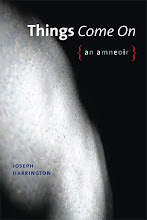
_Things Come On_ Reviewed in Alabama

Another review of Things Come On, this time in Alabama Writers Forum.  (I think I'm blushing.)

Tuesday, June 7, 2011

What Is Genre?

". . . I think that as soon as a genre is given a name, or once it's identified and becomes recursive or self-aware, once those things happen, it dies. . . . Encased in genre we become what's expected . . .

"We use the word [genre], I think, to refer to a certain familiarity, or pre-conceived set of expectations - something the reader brings to the text. What the writer does from there, how they manipulate those expectations, is the fun part."

- David Peak and Ben Spivey, editors of Blue Square Press, interviewed by Joyelle McSweeney at Montevidayo.

Friday, June 3, 2011

Positive Review of _Things Come On_ in The Washington Times (!)

Honest to god - check it out. When the publicist for Wesleyan told me they were reviewing it, I braced myself. But never a good idea to prejudge periodicals or people.

Martin Rubin, the reviewer, is very generous, but extremely eloquent, insightful, and specific. I am o'erwhelmed. I am very grateful for the attention, not to mention the kind words.

He does take me to task a bit (albeit politely) for the less-than-glowing portrayal of Richard M. Nixon. Fair enough. Everything in the book is working on two levels: the political/historical and the emotional/biographical. So sometimes a Nixon is more than a Nixon. "Nixon for us had always been the cancer, the cancerer," I wrote at one point. The "for us" (meaning my family) is crucial in that statement - I was pre-disposed to overdetermine him. The fact that the extent of his and his associates' malfeasance appeared during the worst period of my life did nothing to counter-act that predisposition.

The cover-up of Watergate and the cover-up of breast cancer is a much more telling analogy/homology for me than Dean's "cancer on the presidency" bit. And there's really something about Nixon's potty mouth, as revealed in the tapes, that jibes with the filth and indignity of dying from cancer in the early 70s (or before). As someone (I forget who) once put it - "he is the Id" (the RMN on the tapes, not the one in public). It's not just that he uses the F-bomb a lot, but that he uses it transitively to refer to his enemies. It was almost like someone's medula oblongata had its hand on the Button for at least a few months there.

Having said that, the Constitution's the Constitution, and I'm fer it. If you try to subvert it - whether you're using the CIA and IRS as your personal political secret police force, or you're trying to pack the Supreme Court with your cronies - I'm agin' it.

I also should say that I happen to agree with Rubin's negative assessment of much "experimental" writing, in the first paragraph - that it is stale and predictable. Which depresses me, since I like experimental writing in general - and much of it is fresh and surprising. I don't necessarily think that it's bad to innovate for the hell of it - to see what happens. If it doesn't work, move on (or maybe if it does work, move on - like Oulipo). But it's true that a lot of experimental writing isn't. It's simply hewing to a different convention than "mainstream" or "academic" or "confessional" poetry - a type of writing that I tend to find even more boring than the most precious and formulaic "experimental" work. Which is to say that familiarity breeds contempt in literature no less than other spheres of experience.

Fortunately, there are writers who are smart, know their theory, understand the ideological stakes, but who still let the radio signals through, no matter what they say. That's why god gave us revision - to give the left side of our brain something to do after the first draft.

Wednesday, June 1, 2011

Recently Received (or, Look How Behind I Am on My Reading!)

Aitkin, Adam. Tonto's Revenge. TinFish Retro Chaps #2.
Briante, Susan. Utopia Minus. Ahsahta.
Collis, Stephen. On the Material. Talonbooks.
Friedlander, Ben. The Missing Occasion of Saying Yes. Subpress.
Hawkey, Christian. Ventrakl. Ugly Duckling.
Johnson, Ronald. RADI OS. Flood.
-----------------. The Shrubberies. Flood.
-----------------. To Do As Adam Did. Talisman.
Lavender-Smith, Evan. From Old Notebooks. BlazeVox.
Osman, Jena. The Network. Fence.
Singer, Sean. Discography. Yale UP.

If I have omitted your book, please feel free to comp me  : )

Wednesday, May 25, 2011

On Goro Takano's _With One More Step Ahead_

Now that it is officially almost summer, I'm back at it - with my first "book description" of the new season. But how to describe With One More Step Ahead, by Goro Takano? It is certainly a charmingly weird book - a novel with a bibliography, which is addressed telepathically in English to a group of girls in Hawai'i by a Japanese woman or girl named Lulu who may have senile dementia or schizophrenia or may not, but who is under restraint of some kind, who purports to be "translating" the memoir of a paraplegic man from whom the girls in Hawai'i serve as amanuenses as he composes his musical scores by moving his eyeballs this way or that. With me so far? No? Me neither. But there's never a dull moment. "Mr. Onishi," the protagonist (?), is a sensationalist TV reporter turned English grad student (not unlike Takano himself) who becomes involved with a group called the Banyan Tree Society, which promotes world harmony via sexual intercourse. As the story unfolds, it appears there is more than one Lulu and multiple Onishi's - one Lulu will look to Onishi like his ex-wife, or vice-versa, for instance. Every so often, someone - Lulu? Onishi? Takano? An unnamed omniscient narrator? says:

    "Wait a minute.
     This is a goddamn lie. This should be a goddamn illusion.
     My life should not be like this.
     This should be somebody else's life.
     Somewhere, without my permission, somebody is revising my life. Rewriting my life. Translating my life into something else. Exchanging my life with somebody else's."

A lot of "edgy" novels these days aren't. But this is novel writing that hasn't forgotten John Barth, Thomas Pynchon, Alain Robbe-Grillet, et al. It's narrative as carnival - and Takano is the master of digressions within digressions and flashback within flash-forward. The novel includes legends, a story-board, an essay on Dostoyevski's The Idiot, poems, and travelogue. It is a satire, in the sense of satura lanx, full plate. The fare most often has to do with Japanese history and contemporary Japanese culture, but it's also about (post)modernity writ large - the nature of subjectivity in a digital for-profit environment.

Appropriately enough, the English prose here is peppered with instances of non-native-speaker-type usages - such as the recurrent use of "cocksure" to mean "to be very certain." Given that the author possesses a PhD in English, one suspects that these are more or less intentional, and they give the texture of the novel a strangely manic quality - like a poorly-dubbed samuai movie that turns into a psychological thriller/comedy.

OK - that's the best I can do. This book is proof positive of Croce's dictum that every work of art is a unique aesthetic phenomenon.