Literarisches Events (in and around Lawrence KS)

  • PATRICIA LOCKWOOD. Lawrence. Thursday, September 11, 7:00 p.m., Spooner Hall, KU Campus.
  • PATRICIA LOCKWOOD. Lawrence. Friday, September 19, 7:00 p.m. Lawrence Public Library. Sponsored by Raven Bookstore.
  • DENNIS ETZEL, JR. & RACHEL CROSS. Lawrence. Thursday, September 25, 7:00 p.m., Raven Bookstore, 6 E. 7th St.
  • TONY TRIGILIO. Lawrence. Thursday, Oct. 2, 4:00 p.m., English Room, Kansas Union, KU Campus. FREE.
  • CALEB PUCKETT & JUSTIN RUNGE. Lawrence. Thursday, October 16, 7:00 p.m., Raven Bookstore, 6 E. 7th St.
  • BEN LERNER. Kansas City, MO. Thursday, October 23, 7:00 p.m., Epperson Auditorium, Vanderslice Hall on the KCAI campus, 4415 Warwick Blvd.
  • KRISTIN LOCKRIDGE & ROBERT DAY. Lawrence. Thursday, December 4, 7:00 p.m., Raven Bookstore, 6 E. 7th St.

Thursday, November 4, 2010

Kansas, Mississippi

"Democratic processes could hardly help oppressed minorities who were barred by discriminatory election laws from even participating in the process. Those who did participate had a special interest in keeping the bar. Nor could those processes rectify the widespread and blatant violation of the constitutional requirement that election districts be realigned to conform to shifting demographic patterns, espcially the urbanization of the population. Those elected from the anachronistic rural districts had a compelling interest in maintaining their underpopulated fiefdoms."

- Richard M. Abrams, America Transformed: Sixty Years of Revolutionary Change, 1941-2001 (Cambridge UP, 2006)

This passage explains both what's the matter with Kansas politics, and the reason it will not change in the foreseeable future. The population is becoming more and more urban, but the legislative districts, esp. in the House, are lagging behind. The rural districts are overwhelmingly Republican (and right-wing), so that party, which controls both houses of the Leg, has no interest in redictricting. And there is no demand for same from beyond the Corn Curtain - there is no oppressed minority - no larger (galvanized) national constituency in more populous and richer states to demand attention and action. German-Americans are not being knocked over by firehoses and mauled by dogs. And there sure as shit ain't no mass movement. Result: an ever deeper shade of red (in the 21st c. sense).

All of which makes me wonder how many other states between the Rockies and Appalachians are in the same boat.

Wednesday, November 3, 2010

if this time next it sounds
a voice beyond the tomb,
Cassandra: "If only I -
It - hadn't been right" -

permaculture and guns:
The voice behind the tune.
Thank you.

the worst are full of passion-
less entropy the best
lack all cojones

So this is what it is like
to be poor, we will hear
us say - "us"? . . . Humnph -
quote your own self.

I will ascend this ex
crement of some sky, this
this. It butters
no parsnips. It batters
my heart and deep
fries it, sho.

Fact it: Time
to make your con-
cession speech.
Time to time
your each &
ev'ry act.

Monday, November 1, 2010

Khaled Mattawa's "Tocqueville"

Read a very interesting poem yesterday – “Tocqueville,” by Khaled Mattawa. I don’t know that it’s the Great Poem of the Era of Globalization, but it’s definitely a draft of part of that poem (which we are all writing, whether we leave a record of it or not). It is mostly a collage, drawn from materials as disparate as Franz Fanon, Robert Pinsky, and first-person accounts from Somali refugees. The work is composed of verse, found prose, and imagined dialogues. Mattawa manages to bring together the quotidian and the Big Events, the masses and the players, in a way that evokes the nature of neoliberal globalization – in particular, neo-colonialism and the global politics/psychology of race.

It also attempts to “get at” the psychology of the folks in the metropole – not least of all via Tocqueville himself:

“Such a government does not break men’s will, but softens, bends, and guides it; it seldom enjoins, but often inhibits action; it does not destroy anything, but prevents much from being born; it is not at all tyrannical but it hinders, restrains, enervates, stifles, and stultifies.”

It also puts into place tyrannical, destructive, will-breaking governments in subject territories. And sets those territories against each other. Just before the passage above:

“If you talk to the Chinese about cheap labor, they begin to complain about Vietnamese competitiveness.

“And who are the Vietnamese complaining about?

“Bangladesh. And the Bangladeshis are pissed at the Burmese.” (36)

A lot of the passages are deadpan accounts of unimaginable cynicism and cruelty, often recounted in an elliptical, allusive manner – along with the surreal, nightmarish mode one often finds in poetry dealing with the postcolonial condition:

“The wonder of it she’d sung,
the wonder she’s spring into the world singing,

and you say bless this goodness
wrung of amnesia, of the whips’ hieroglyphs,

this song rattling the creaking church,
this gale of cool air washing away the savannah’s moss.

Hearth in winter, Abel’s
blood streaming endless from your veins.” (40)

There are several voices, themes and sources that recur over the 25 pp. of the poem, which links the general and the particular, as well as different parts of the world to one another, via the principle of montage. To his credit, Mattawa doesn’t exempt those who live in seeming “safe havens” (like Ann Arbor, Michigan) from scrutiny. Then there is the rest of the eponymous book, in which Mattawa presents some fascinating and disconcerting experimental work.

“And these idiots still think we lost Vietnam.”

Friday, October 29, 2010

I'm reading at Wesleyan UP poetry reading panel at AWP

. . . on Friday (February 4, 2011), 12 noon-1:15 p.m., in the Delaware Suite, Lobby Level of the Marriott Wardman Park Hotel, with Elizabeth Willis, Evie Shockley, Ed Roberson, and Adrian Blevins. Book signing by me 2:30-3:30 that afternoon, tho I plan to go up to the WesPress booth right after the reading, and I expect that Elizabeth, Evie, and Ed will be there, too, and maybe Rae Armantrout.

Saturday, October 23, 2010

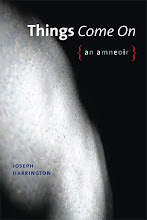
My Book (_Things Come On_) Has a Cover . . .

. . . which is suitably noir-ish and indeterminate, not unlike the contents (which see, right above).

If you click on the cover, it will take you to a description, blurbs, etc. You can also order the book then-and-there (unless you're going to AWP, where you can buy it at a discount - unless, of course, you want one less book in your suitcase, in which case, you should order it). I think that you will like it, in a pity-&-terror-cathartic sort of way.

In fact, if you think you're going to buy it anyway (and I do hope you do), then please go ahead and order it, so that Wesleyan will want to publish my next book, which is called No Soap (about my mother's life and times up to mid-1947). You can read the first chapter of that book here. If Wesleyan likes it, and publishes it, you will get to read the rest of it. So, if you like the first chapter of No Soap, and want to read the rest of it, please order Things Come On. Plus which, if you order it now, you will completely forget about it, and it will show up on your doorstep in February, when you undoubtedly will want a surprise of any sort.

Friday, October 15, 2010

Abayomi Animashaun Reading

A friend asked me about Abayomi Animashaun's poetry reading last night. I answered - and figured I might as well share it:

I think Abayo's book The Giving of Pears is much more interesting than your run-of-the-mill representational narrative verse. For one thing, he's keenly aware of sound - incl. cadences of sentences - and thinks about line-breaks. He read wonderfully (and slowly). Secondly, he uses his imagination. The poem rarely stays in one locale (or even in one apparent reality) for long. [indeed, many of his poems have a surrealist - or magical realist - aspect] Thirdly, I really like the way he handles the Nigeria/America thing - with a light touch - matter-of-fact, but again, taking it places you don't expect.

Thursday, October 14, 2010

Formal Indeterminacy as A Epistemology

"Grounded in situational practice: that is, there are no a priori determinations regarding specific use of style, technique, form, order. Importantly, this is not a lack of aesthetic theory. In a sense it is theory theorizing upon theory. The indeterminate is never, here, transcendentally indeterminate: rather it maintains a connection to the determinate of its being claimed in the first place. Just as the unknowable is only and merely something a person may come to know, this indeterminate is something that may very well be tethered to a forthcoming determination."

- Brent Cunningham, quoted in A Tonalist, by Laura Moriarty (Nightboat 2010).

Tuesday, October 12, 2010

It's one thing to not be aware that your literary friends are, in fact, a coterie. It's something different, however, to start self-consciously thinking of your literary friends as though they were a coterie. This latter procedure can produce some useful and principled results. See, for instance, the "coda" to A Tonalist, by Laura Moriarty, where she makes a good case for interpellating friends and strangers into a "movement" she's thought up - one that is especially a Bay-Area phenomenon. A Tonalist values the contingent (not nec. continent) and fictional nature of coteries, one gathers. I'd sign on, but I can't, and it would defeat the point anyway.

Monday, October 11, 2010

I'm zipping around trying to find books, clothes, etc. for my second day of teaching primary school math. I stop at my apartment. The dog is there, a pug. But somehow this is only half the dog. What happened to the other half? A black and tan miniature dachshund - really, really miniature - is submerged in the water dish. Suddenly I realize I haven't been home for days. I pour out some food and apologize to the pug. "I don't know how he died," the pug says, matter-of-factly, nonchalant. "I guess he fell in the water dish and drowned."

Saturday, October 9, 2010

Being "in" a coterie means not thinking of yourself as being in a coterie. You might be vaguely aware of it as a "community" or "group of friends," but it's the nature of coteries to be like the water to the fish. And wondering why all those people on the other side of the glass are excluding you from their coterie.

Then there are the fish in the next tank over - now there's a coterie. They're so exclusionary. Those are BAD FISH. Nobody would want to be in their tank.

When there is money (or jobs, publication opportunities, etc.) at stake, everything gets a little more intense. And when you start writing about your coterie's exciting adventures, recording their bons mots, and referring to them by their first names, you've started writing to your coterie - and only them. The people on the other side of the glass have gotten bored and gone home.