Literarisches Events (in and around Lawrence KS)

  • PATRICIA LOCKWOOD. Lawrence. Thursday, September 11, 7:00 p.m., Spooner Hall, KU Campus.
  • PATRICIA LOCKWOOD. Lawrence. Friday, September 19, 7:00 p.m. Lawrence Public Library. Sponsored by Raven Bookstore.
  • DENNIS ETZEL, JR. & RACHEL CROSS. Lawrence. Thursday, September 25, 7:00 p.m., Raven Bookstore, 6 E. 7th St.
  • TONY TRIGILIO. Lawrence. Thursday, Oct. 2, 4:00 p.m., English Room, Kansas Union, KU Campus. FREE.
  • CALEB PUCKETT & JUSTIN RUNGE. Lawrence. Thursday, October 16, 7:00 p.m., Raven Bookstore, 6 E. 7th St.
  • BEN LERNER. Kansas City, MO. Thursday, October 23, 7:00 p.m., Epperson Auditorium, Vanderslice Hall on the KCAI campus, 4415 Warwick Blvd.
  • KRISTIN LOCKRIDGE & ROBERT DAY. Lawrence. Thursday, December 4, 7:00 p.m., Raven Bookstore, 6 E. 7th St.

Monday, February 24, 2014

Keywords for _Animal Form_, by Kiki Anderson

Milwaukee's Mitzvah Chaps does it again, under the aegis of (KU MFA) Robert J. Baumann. Coming soon: Animal Forms, words by Kiki Anderson, art by Madeleine Leplae. Anderson's poems: emotionally charged moments; economically rendered; precise details (to do so); hypotactic sentences, paratactic pages. Gorgeous colloquial language sculptures. Europe, Africa, Southeast Asia. Leplae's etching plates (say that out loud) are equally amazing: familiar animal forms; antique-modern; 19th c. neolithic. Gorgeous (also). Production values: make you want to own. Bravo Mitzvah.

Monday, February 10, 2014

The Blog Tour: My Writing Process (such as it is)

-->
Many thanks to the fabulous David Lazar for inviting me to join this discussion re: writing as present-progressive verb. You really must read David's new book, Occasional Desire, which, unlike most "creative nonfiction," is composed of essays - indeed, essays that are entertaining! He is also editor of the indispensable journal Hotel Amerika and is a Professor of English at Columbia College Chicago. 


1.) What are you working on?

That’s a rather pointed question to pose to a writer. What the hell am I working on?

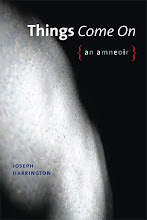
My “Big Project” is a trilogy of books about my mother’s life and times (and a lot of other things besides, like history in general, US in particular; time; gender; epistemology, etc etc). This is a follow up to my last book, Things Come On (an amneoir) [Wesleyan UP – now available in paperback! Woo-hoo!]

I’m also revising a poetry collection, working title: Extinction Canceling Button.

And I’m writing a book chapter about documentary poetry for a critical collection on 21st c. US political poetry.


2.)  How does your work differ from others of its genre?

Uh . . . it doesn’t have one? It doesn’t even establish one. I’m talking about this Big Project: it mixes and invents genres, uses whatever is ready to hand. One volume is inspired (loosely) by scrapbooks; another, by the archive; a third, by the newspaper. There’s verse, prose, dialogue, reproductions, headlines, photographs in each.

In terms of content, you could say it’s biograpahy/memoir/history. Indeed, the point is to think about those three genres as mutually constitutive: a small life as a tour through a big history, documentation merging with memory, all one text. The point is that you could write a trilogy of books about anybody’s life. My mom wasn’t famous – though she did work as Sen. Albert Gore’s secretary during the 1950s, which just makes her a famous-person enabler. But that’s an interesting perspective: from the wings. And doubly offstage, as a woman artist.

The poetry book is built around several voice-based serial poems, broadly on the theme of schizotheology, in a neo-necro-pastoral mode. I don’t think that’s ever been done before, do you?

The book chapter is, well, academic criticism. But it’s on a topic that hasn’t gotten much ink. And I think criticism/theory can and ought to be more interesting to read – more “creative” – and that’s what I’m moving towards.


3.)  Why do you write what you do?

Because I can’t help myself.


4.)  How does your writing process work?

And does it? Another pointed question!

As to the Big Project: bricolage. “FORM IS NEVER MORE THAN AN EXTENSION OF CONTENT,” to which Olson adds “this possible corollary, that right form, in any given poem, is the only and exclusively possible extension of content under hand.” To me, that corollary sounds like “There is only and exclusively one possible person for me, in all the whole wide world!” – a belief which has diverted billions of dollars of capital into the pockets of divorce lawyers.

I got yr corollary right here: throw it against the wall and see what sticks. But the writer has to do the throwing, even if she doesn’t use any of her own words in the text. One chooses one’s content, and the more moving parts, the more possible combinations.

If you’re working with existing texts, as I am, part of it has to do with which of those texts seem most compelling. In Things Come On, it turned out to be hearing transcripts and a medical chart – and those things largely suggested the structure of the book. Likewise, using scrapbooks, archives, and newspapers as research sources suggested broad structures for the others.

Then again, I’m revising the hell out of all of them. It’s not like Michelangelo “finding” the form in the marble. It’s more like a potter shaping something that’s in motion, in response to the shapes that are emerging in her hands. And then collapsing it all and doing it again. That sounds more organic than it is. But then all metaphors are.

As to the serial poems, I try to hew to Jack Spicer’s injunction to listen to “The Outside” – that is, to try not to find the perfect words to ex-press my inner truth, but rather to trust that I’m receiving something more important as words come into my head. And I collect phrases, sentences, etc. I have a “word collection” that I draw upon as the bricks for poemlets – then I put in new words to form the mortar. 

Anyway, here is a section of No Soap (v. 1 of the B.P., as free PDF) - a portion also appeared in Hotel Amerika; and here is a section of Griefing on Summit (v. 2). For poems, see earth day suite, published by the great Beard of Bees Press, also in Chicago, also as a free PDF.

[pause]

Is that it? Are we done? . . .

OK! Well, now that you’ve suffered through the warm-up act, here are the headliners for Feb. 17:

TONY TRIGILIO’s newest books are The Complete Dark Shadows (of My Childhood), Book 1 (BlazeVOX Books, 2014); White Noise (Apostrophe Books, 2013); and, as editor, Elise Cowen: Poems and Fragments (Ahsahta Press, 2014).  His other books include the poetry collections Historic Diary (BlazeVOX, 2011) and The Lama’s English Lessons (Three Candles Press, 2006); the chapbooks With the Memory, Which is Enormous (Main Street Rag Press, 2009) and Make a Joke and I Will Sigh and You Will Laugh and I Will Cry (Scantily Clad Press, 2008); and two books of criticism, Allen Ginsberg’s Buddhist Poetics (Southern Illinois University Press, 2012) and “Strange Prophecies Anew” (Fairleigh Dickinson University Press, 2000).  He is co-editor of the anthology Visions and Divisions: American Immigration Literature, 1870-1930 (Rutgers University Press, 2008).  He directs the program in Creative Writing/Poetry at Columbia College Chicago and is a co-founder and co-editor of Court Green. Tune in next Monday to Tony's website.

BEN CARTWRIGHT’s poetry and prose poetry have appeared in Sentence, The Stinging Fly, Parcel, and Midwestern Gothic.  He was awarded the Ana Damjanov Poetry Prize from the Academy of American Poets, and won third place in the 2012 Atty Award poetry contest, judged by Margaret Atwood.  Ben records poets reading their work for his Kansas Blotter poetry archive, and his recordings of the poets Kenneth Irby, Rachel Blau DuPlessis, and Fred Moten have been added to the PennSound archive.  Ben lives in Topeka, Kansas, and teaches creative writing and literature courses at the University of Kansas. Tune in next Monday to Ben’s Blog


LEA GRAHAM is the author of the poetry book, Hough & Helix & Where & Here & You, You, You (No Tell Books, 2011). Her poems, translations and reviews have been published in Notre Dame Review, Southern Humanities Review and Fifth Wednesday. She is a contributing editor for Atticus Review’s feature, “Boo’s Hollow,” which showcases poets writing on place.  She is an Associate Professor of English at Marist College in Poughkeepsie, New York. Her entry will appear on the Atticus Review web site (somewhere - stay tuned!).

Sunday, January 19, 2014

Questions & Observations for the Post-English-Major/Marketized-University Era in the Suburban Midwest


“The Customer’s always Right.”  - popular apothegm


College enrollments are declining, and those in the humanities, including English, are plummeting. This seems to me to be a result of the post-2008 economic collapse: fewer people can afford college, and those who can go into engineering and accounting, rather than literature. We have to do some serious sales to get people to be English majors. How to respond to this new reality?

- Do I need to be more entertaining in the classroom? How?
            - Should I start using PowerPoint all the time, showing more films, etc.?
            - Switch to large lectures and play up the performance aspect?
            - Do more in class w/computers (and let them check What’s App, porn, etc.?)
            - How do I “sell” my subject more effectively?
- How improve my effectiveness at teaching writing? What does the New Student positively respond to, in composition instruction? And does it really teach them to write?  

- How much can I realistically expect them to read (in a particular level)?
            - Teaching more lower-division courses means smaller assignments (?)
            - If I rely more on media produced by others, I can decrease the amount of   reading: since we
              won’t spend as much time talking, we won’t need as much to talk about.
            - If we want to attract English majors, we can’t go too hard on them. We want them to have a
              pleasant, relaxing experience.

- We’ve got to give the customer what they want. But we also have to sell it. (we’re beyond edutainment; this is edvertising)
So:
- Assign what I think that they should know about a given topic or what I think they will want to read/watch that’s related to that topic?
            - Any polling data of students on this issue?

The real problem is time. For instance, we don’t have enough time between when our course assignments come out and when our book orders are due to really think about and research how we might overhaul a particular course.

Moreover, we’re too busy teaching to radically alter our teaching. If we take time to learn new (or not-so-new) technologies, techniques, and pedagogical theories, it’s usually on break (or sabbatical, if we have them), which is also the only time to get any appreciable amount of research and writing done. So it’s back to research vs. teaching, esp. if teaching is not your area of research, or if your area of research is not one that students want to study (e.g., any type of poetry from any era).

There are, of course, good reasons why all this should be so: the students that are left in the university are working more hours to stay there. But then, on-line courses, which should theoretically be less time-consuming, have abysmal retention rates. The ultimate problem is that the ultimate "consumer" (i.e., employers) have a different set of desires than the immediate customer (i.e., the student). But if the ultimate consumer isn't satisfied, then the value to the immediate customer diminishes. If the student is the customer, and the customer's always right, then the student is always right. All I can say is that I'm glad my teachers didn't believe that.

Saturday, January 4, 2014

From "New Year's Eve," by Charles Lamb

"Of all the sound of all bells--(bells, the music nighest bordering upon heaven)--most solemn and touching is the peal which rings out the Old Year. I never hear it withoiut a gathering-up of my mind to a concentratio0n of all the images that have been diffused over the past twelvemonth; all I have done or suffered, performed or neglected--in that regretted time. I begin to know its worth, as wehn a person dies. It takes a personal colour; nor was it a poetical flight in a contemporary, when he exclaimed

           I saw the skirts of the departing Year."

Saturday, December 14, 2013

After the future, a lot of things don’t signify:

-->
grades, literature, publishing, networking, money, an individual’s inaccurate opinion of himself, another’s accurate opinion of me, politics, careers (remember those?), price-points, extinction of non-food species, credit ratings, deadlines, immaterial definitions of success and failure, deadlines, software compatibility issues, 401k’s (boy do those really not signify), trying to impress people, weather events that don’t knock the power out, “people with influence,” blogs, predictions, deferred gratification, losing sleep, prevention, resistance, engagement, participation, energy, the “news.”

Replacing the car’s wiper blades still signifies.

Friday, December 6, 2013

The Dying Elephant in the Middle of the Room

The one that no one really talks about: namely, that it's over. Democracy is over - has been for some time, in fact. The middle class is over, as is economic stability of any sort. Nature isn't over by a long shot, but it's changing a whole lot, very quickly, in ways that will disrupt everyone's life. People acknowledge that things are bad; but we keep behaving as though the future were going to be just a slightly worse version of the past. So people take on another job, looking forward to the day when things will start looking up; or they put money in their retirement accounts; they try to advance their careers; they try to raise their kids with essentially the same values and expectations they have. It's going to be more competitive to get a good job, but you will still be able to get a good job. A college degree will help you get there. If the Democrats can regain the House, then things will change in a big way!

But what if all that is self-delusion.

I recently read a couple of texts that take that premise seriously. The first, by Roy Scranton, "Learning How to Die in the Anthropocene," takes a rather philosophical approach - Stoic, even. He takes as a given that self-delusion is a bad thing; for him, there seems to be a certain nobility (or beauty?) in facing up to the facts.

The other, After the Future, by Autonomist theorist and activist Franco Berardi, posits that the future, understood as the possibility of progress, is at an end. There has been a "mutation," produced by finance capital, neoliberal politics, necroculture, and permanent natural changes, that prevents people from forming links of solidarity ("subjectivation") with one another. This is particularly true, according to Berardi, of the "cognitariat," those knowledge-workers in Palo Alto or Bangalore, who are ostensibly instantly and integrally interconnected. Instead, digital connections reinforce the culture of the cubicle.

Berardi does not end on a totally hopeless note. Rather, he believes that economic collapse will necessitate subjectivation, in the interests of survival. Moreover, the powerlessness of the individual may encourage the withdrawal of individuals from active participation in the economic and political systems that have led to this mess. The task now is to (a.) forget about the future as deferred gratification; pay attention to the present, and see what possibilities arise. Be willing to be surprised by new and unanticipated possibilities; and (b.) imagine what he (after Marx) calls the "general intellect" - that is, a self-consciousness of the collective intelligence of humanity.

There used to be these bumper stickers that said "I feel much better ever since I gave up hope," or something to that effect. Maybe hope is the problem, in fact.

Saturday, November 23, 2013

Don't Nobody With a Good Car NEED Redemption

From an e-mail exchange:

Q: I recently came across your interview with Kathleen Ossip online, and I really appreciated your comment that it is not necessary "to attach redemptive endings to stories that resist it" in talking about your writing and amneoir but I was curious as to why you referred to redemptive endings as an American desire?

A: Obviously, there are stories in all cultures that have redemptive endings (the Christian New Testament, for example). But not every culture insists on them all the time. There's something about US culture that values the story about victory despite the odds, recovery from serious _____, rags to riches, etc. Look at the memoirs on the New York Times Bestseller list, and you'll see what I mean. "I once was lost, but now am found" - the conversion narrative was the first American success story.

This is, of course, why a lot of modern writers write about the other side of things – the tragedies, the injustices, the more complicated and ambiguous stories. Some of them see the "American success story" as being ideology. That's why Theodore Dreiser titled his novel An American Tragedy. That's why Richard Wright wrote Native Son.

Saturday, October 12, 2013

If it has to be a pitcher's duel, best to have it end in 8 1/2 innings, rather than 13. As long as the Cards win.

Thursday, September 26, 2013

Criquettes

name-sayers
vainly hold
out for
summer's
coming again

when plants
exactly
keep time

Thursday, September 19, 2013

Poem for today (seemed appropriate)


The flags drop to half-mast
anytime anyone dies:
for the shooting in DC,
the one in Florida, the one
in Colorado, or any other state?
Or the ones 10 yrs ago today. Or
the ones that haven’t happened yet.

Not for the ones in Iraq,
I’m guessing.

The flags stay at half-mast
Half the whirlygigs shut
down at the wind farm

how now brown corn
cows browsing water
all along an irrigation arm:
mamma’s little animals
wanna live too.

there, there

where, where

Pappa’s little critters
say sauve qui peut