Literarisches Events (in and around Lawrence KS)

  • PATRICIA LOCKWOOD. Lawrence. Thursday, September 11, 7:00 p.m., Spooner Hall, KU Campus.
  • PATRICIA LOCKWOOD. Lawrence. Friday, September 19, 7:00 p.m. Lawrence Public Library. Sponsored by Raven Bookstore.
  • DENNIS ETZEL, JR. & RACHEL CROSS. Lawrence. Thursday, September 25, 7:00 p.m., Raven Bookstore, 6 E. 7th St.
  • TONY TRIGILIO. Lawrence. Thursday, Oct. 2, 4:00 p.m., English Room, Kansas Union, KU Campus. FREE.
  • CALEB PUCKETT & JUSTIN RUNGE. Lawrence. Thursday, October 16, 7:00 p.m., Raven Bookstore, 6 E. 7th St.
  • BEN LERNER. Kansas City, MO. Thursday, October 23, 7:00 p.m., Epperson Auditorium, Vanderslice Hall on the KCAI campus, 4415 Warwick Blvd.
  • KRISTIN LOCKRIDGE & ROBERT DAY. Lawrence. Thursday, December 4, 7:00 p.m., Raven Bookstore, 6 E. 7th St.

Thursday, July 5, 2012

O Bon O Boy!

Finally got and read O Bon, by Brandon Shimoda (Litmus 2011) - the poems have a combination of delicacy and creepiness that's hard to get over. I wish I could write poems that used syntactic disjunction and reversals to such precise effect/affect. I'm also very interested in the relation of narrative to lyric here - just enough of the former to generate the latter. It kind of reminds me of the m.o. of Susan Howe or Cecil Giscombe in that it's clear that the poems are "based in" or incited by research, but there's not too much of the actual research in the poems. They are more like an emotional or psychic distillate of the events. Which is why they have such force. You can get all of the narrative or sources that you need (or want -- or not) in the 5-page afterword.

The book is really an elegy for the poet's grandfather, a Japanese immigrant photographer, born in Hiroshima, interned during WWII. Japanese ritual and mythology provide much of the imagery and feeling-tone of the book -- for instance, the Corpse Eater, a former priest doomed to cannibalize the deceased (in Japan, this is folklore; in early modern Europe, it was real life). Shimoda is well aware of the Freudian link between cannibalism (symbolic) and melancholia: ". . . I have found myself, repeatedly and throughout O Bon, feasting off of what is resurrected, eating my grandfather's corpse, turning it over in my mouth, as the rest of my body burns out of the sound" (89). Like Genet in Funeral Rites, Shimoda in O Bon accepts, embraces, and explores the implications.

Now, in keeping with my practice of randomly selecting excerpts from books I am describing . . . from "In the Middle of Migration":

we find ourselves
turning --


recalcitrant in the ancient domain


masks simultaneously black
we know not
the sensible thing


sugar mammal, slit throat
thethered to the thickest spar
between home and adopted home


makes no difference in times like these
without bothering to unfold the map
or take it from its sleeve


climb the rungs of bone and limb
to pierce what version of skin or sky
the solvent leaks

(35)

I will admit to deliberately choosing left-justified lines for this passage -- which in fact characterize few of the poems -- in order to conform to the almighty Google formatting. But as the multiple spaces between stanzas suggest, these poems are composed of words and the spaces between the words. You should look at the book to get a sense of what Shimoda does with the space of the page. I can't replicate the indentations that "set off" this stanza (in more ways than one): "a visage / nettling the slack / foundation -- may I beg shelter for the night / misshapen where / shall I alight / the valley hymns in the crust" (23).

Want more? See Jerome Rothenberg's blog, where same can be found. Shimoda is interested in contemporary Japanese poetry (vide the poet's ANCIENTS project), from which he has undoubtedly drawn formal inspiration.


Friday, June 15, 2012

Tea and Gin, anyone?

Tea and Gin is a homophonic rendering of the name of the city of Tianjin, China. It is the title of Univ. of Kansas English PhD student Ben Cartwright's dissertation, and his Kickstarter project. He wishes to travel to China to conduct research for Tea and Gin, which is based on the history of foreign "concessions" in the city. Many of the poems are (being) written using procedural constraints of one type or another. It's quite a fascinating project - one that takes English-language "documentary poetry" in new directions (geographically, as well as formally).

Here is his site, w/a short introductory video, along with "testimonials" from William J. Harris and myself (under "Updates"). Even if you decide not to contribute, it's a very interesting project (and video), and a creative, forward-looking method of funding.

If you have an Amazon account, it's easy to make a pledge. And, as with all Kickstarter projects, if he doesn't make his goal by the deadline, you pay nothing.

Thank you for your consideration.

Thursday, June 14, 2012

F*in' "A"

This is my first time reading all of Louis Zukofsky's "A"; I'd read parts before (e.g., # 7 - the sawhorses), but never the whole. When I began, I was like, Oh - it's a leftist Cantos (which I guess is how some people think of it). Not a bad thing in itself. But as one gets farther into it, the more it becomes apparent that "A" is a much more formally (and thematically?) various text than the Cantos. One gets the sense of the poet (and person) changing over time, in response to changing circumstances (McCarthyism not least among them). And trying out different things. I find that a much more congenial approach than Uncle Ez, who thinks he has things figured out at the outset, and works deductively from there.

Preliminary conclusion after having read through movement 10: This is all about the potential harmonization of (seeming) opposites: Marx and Spinoza; general and particular; matter and spirit - - "tonus Contrarius" - the poem as fugue. I've started plowing through 12, and it's clear how things changed by the late 40s (as they did for so many writers).

The great thing about blogs is that you can write fresh impressions that probably recapitulate what somebody has already said, and it still has the charming naivite of the neophyte. And, since nobody makes any money from poetry, nobody really cares. Except maybe Paul Zukofsky. But that's another story.

Sunday, June 10, 2012

Trawkey/Hawkl

 I sometimes write authors to tell them I like what they wrote. Then it occurred to me that it might be nice to share those complimentary remarks with the rest of the world (after all, I've already bought the book, and who knows maybe you will, too). Is that gauche? OK.

So, to inaugurate this questionable practice, here is what I wrote Christian Hawkey about his book Ventrakl (Ugly Duckling 2010):

"I love the rhythm it establishes between the dialogic, ekphrastic, and lyric. Translation, yes, but also a certain amount of mediumship or necromancy - anyway, it gives the sense of bringing Trakl present (and maybe projecting Hawkey back). I love the way the materiality (and playfulness) of the poems intersperses the documentary passages"

I should give some back story. The premise of the book (on UDP's amazingly wonderful Dossier series, ed. by Anna Moschovakis) is that Hawkey is having a conversation with the German expressionist poet Georg Trakl. This project presents some difficulties, as (a.) Trakl is dead, and (b.) there's about 100 years between the two poets. The ventricle is the back-and-forth between these - via homophonic translations and staged dialogues between the two (both of these quite funny - sometimes the deeply sincere German of Trakl becomes brand names or pop culture references in 21st c. American English), was well as some relatively straightforward biographical speculating (which is rather more somber).  Also lots of photos accompanied by writing that sometimes takes a parallax relation towards them. And lists. And a mix of verse and prose. In short, the sort of book a Joe Harrington would be a sucker for. You might, too.

Saturday, June 9, 2012

I'm Finally on the Map

The "Map of Kansas Literature," that is - initiated by the dean of Kansasentrism studies, novelist Tom Averill. Apparently, you get a page if a student in his Kansas Literature class decides to make you one - which seems like an eminently sensible procedure. Check it out - you might be surprised at some of the names!

I should say that Tom, Sarah Smarsh, Eric McHenry, Dennis Etzel, Jr., and the other fine folks on the faculty at Washburn University take this sort of thing very seriously. I have not had a better campus visit than the one to WU, which is only 30 minutes from where I live - all of the folks named here were using my book in their class, the students were engaged and asked great questions, there were 60+ people at the reading (w/good - tough - questions afterward), and I signed at least as many books as I have anywhere else. And what a beautiful campus - which I'd never taken the time to wander around. The new dorm is second to none - complete w/a library (w/fireplace).

[Of course, the Univ. of Kansas isn't too shabby, either, IMO . . .]

I think this officially makes me a naturalized Kansan. (Now if we can just do something about Gov. Sam Brownshirt)

Thursday, June 7, 2012

We Love Events!!

Know of a reading or other public event involving quasi-experimental-post-avant-whatever writing w/in a 200-mile radius of Lawrence, KS? If so, let me know - as you can see, I try to maintain a calendar.

Wednesday, May 9, 2012

Wanna Hold Your Hand?

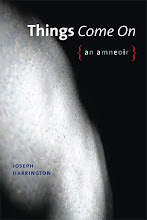
You may need a little hand-holding when approaching Things Come On (an amneoir). That's OK - in fact, it's why Wesleyan University Press has developed this "Reader's Companion" to the book. It should help you get your bearings - and maybe keep rhizoming out afterwards.

Wednesday, April 4, 2012

Conversing w/Kathy Ossip

Kathleen Ossip and I "were talking about death, Richard Nixon, Ezra Pound, growing up Catholic, and docu-poems... You might like to read our conversation over at Bookslut."

Friday, March 23, 2012

For the Coloradoans . . .

. . . or is it "Coloradans"? Or "Coloradians"? Well, if you're in that big square state to the west of Kansas (where the Kansas Panhandle used to be), do come join us for some swell readings next week:

- Danielle Pafunda, Tim Roberts, & I, at the hipster-biker Crankenstein in Fort Collins (215 N College Ave), as part of the Every Eye series, and

- Andrea Rexilius, Eric Baus, Richard Froude, and I, at Counterpath (613 22nd Street, near downtown) in Denver.

This is gonna be good!

Sunday, March 11, 2012

_Louise: Amended_ (and polished)

Just finished reading Louise: Amended, by Louise Krug (Black Balloon 2012). It is ostensibly about the author/protagonist's transformation from glamor girl to sadder, wiser neurological patient - due to the necessity to excise a "cavernous angioma" from the pons of her brain stem. But it's at least as much about all the other people in her life - the boyfriend, the parents, the step-parents, friends, brothers, etc. - about their reactions to having a loved one with a serious, debilitating illness, and what those reactions say about and do to their respective characters. By switching back and forth from first to (omniscient) third person, Krug can get inside their heads - and face what they were facing without (herself) flinching. This part is almost scarier than when she looks in the mirror with a half-paralyzed face. You might occasionally flinch, though, as a reader - the prose is spare, straightforward, colloquial, and doesn't pull any punches. Even her own thoughts at the time of her treatments are related in matter-of-fact style - perhaps the trace of having started a career in journalism in a previous life.

"When the bandages are unwound from my head it takes a long time to get to the end. The unwinding happens in circles, and it takes so long I worry that my face will come off, too."

This book feels like it has undergone multiple surgeries, too. Many of the chapters are composed of related, sutured-together vignettes, some of which switch point of view from one person to another. But I suspect it has also had a few "prose removal" operations; the writing is (to change the metaphor) sculptural, almost. Not many adjectives or scene-settings - and when there are, it's done via a single quirky detail in the periphery. And Krug uses the chapter as a unit of composition. Here, for instance, is Chapter Twelve:

"Warner and Janet email.

"The emails begin with 'Hi' and 'Dear.' They end with 'Best.'

"One thing about the trouble with their daughter: It has made them want to be kind."

End of chapter - with all the ambiguity of that last sentence left hanging for the next. Some chapters are longer, of course, but every single sentence is necessary, smart, and sometimes funny. Louise: Amended is a unique, kinetic, & finely-polished book that will be the envy of any of us who have ever tried to tell a life story.