Literarisches Events (in and around Lawrence KS)

  • PATRICIA LOCKWOOD. Lawrence. Thursday, September 11, 7:00 p.m., Spooner Hall, KU Campus.
  • PATRICIA LOCKWOOD. Lawrence. Friday, September 19, 7:00 p.m. Lawrence Public Library. Sponsored by Raven Bookstore.
  • DENNIS ETZEL, JR. & RACHEL CROSS. Lawrence. Thursday, September 25, 7:00 p.m., Raven Bookstore, 6 E. 7th St.
  • TONY TRIGILIO. Lawrence. Thursday, Oct. 2, 4:00 p.m., English Room, Kansas Union, KU Campus. FREE.
  • CALEB PUCKETT & JUSTIN RUNGE. Lawrence. Thursday, October 16, 7:00 p.m., Raven Bookstore, 6 E. 7th St.
  • BEN LERNER. Kansas City, MO. Thursday, October 23, 7:00 p.m., Epperson Auditorium, Vanderslice Hall on the KCAI campus, 4415 Warwick Blvd.
  • KRISTIN LOCKRIDGE & ROBERT DAY. Lawrence. Thursday, December 4, 7:00 p.m., Raven Bookstore, 6 E. 7th St.

Wednesday, November 17, 2010

Machines are taking over the world - I was being chased by a knife- throwing woman who said it was all done with mirrors - and she was working for some big-brother-type person - she said she had to do it, b/c they were holding her son hostage - very frustrating for me, b/c how you gonna defend against something like that? - something about needing to hide something in my suitcase (are they moving me to another prison?) - is part of this taking place in a motor court, or was that another dream?

Then a neighbor built a pavillion on the corner to cover up a hole in the ground.

Sunday, November 14, 2010

Something about children and wild cats - the snow is going to accumulate and accumulate and accumulate - packages of disassembled, shrink-wrapped houses that we thought were just already built little houses that we wanted to buy; some ovbviously are those houses, but they're old and they've just been disassembled.

Monday, November 8, 2010

LIMITED TIME OFFER - Me!

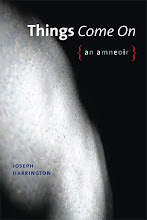
My mixed-genre book Things Come On (an amneoir) will be released by Wesleyan University Press' Wesleyan Poets series at the A.W.P. convention Feb. 2-5.

Between now and then, I will visit your town/institution to read/talk/teach, completely HONORARIUM FREE! - save for the price of a plane ticket, a place to crash, and some food here and there.

So please email me at jharrington [at] ku [dot] edu, let me know when you'd like for me to visit, and we'll sho nuff work something out! Thanks!
It's 20 years after the politically-motivated assassination of the Mexican woman, and I'm in the apartment of this Japanese graphic artist and designer. I talk to somebody else at this party who knew this woman. And there are pictures of her incorporated into some of the artist's works - like Marilyn Monroe in Andy Warhol's. It's clear that somebody there is hiding something, but I can't figure out what. George W. Bush's senatorial campaign is running ads on the TVs. There are daily explosions at the White House. I ("the hero") get a check from the World Bank for writing accounting software. I tear it up, b/c I wrote them a virus instead. I keep wanting to go back to the hangout of the killers of the Mexican woman, but people try to dissuade me. I then see on an adjacent rooftop a sailor setting up his sniper position - to "reenact" the killing.

Sunday, November 7, 2010

Some kind of slasher film - about Jack the Ripper - who's played by Tim Robbins. Some guy hands him a knife - asking him to "take care of it" or defend him or something. But he [Jack] realizes he can just hack the guy to death with it (duh), so he does.

Thursday, November 4, 2010

Kansas, Mississippi

"Democratic processes could hardly help oppressed minorities who were barred by discriminatory election laws from even participating in the process. Those who did participate had a special interest in keeping the bar. Nor could those processes rectify the widespread and blatant violation of the constitutional requirement that election districts be realigned to conform to shifting demographic patterns, espcially the urbanization of the population. Those elected from the anachronistic rural districts had a compelling interest in maintaining their underpopulated fiefdoms."

- Richard M. Abrams, America Transformed: Sixty Years of Revolutionary Change, 1941-2001 (Cambridge UP, 2006)

This passage explains both what's the matter with Kansas politics, and the reason it will not change in the foreseeable future. The population is becoming more and more urban, but the legislative districts, esp. in the House, are lagging behind. The rural districts are overwhelmingly Republican (and right-wing), so that party, which controls both houses of the Leg, has no interest in redictricting. And there is no demand for same from beyond the Corn Curtain - there is no oppressed minority - no larger (galvanized) national constituency in more populous and richer states to demand attention and action. German-Americans are not being knocked over by firehoses and mauled by dogs. And there sure as shit ain't no mass movement. Result: an ever deeper shade of red (in the 21st c. sense).

All of which makes me wonder how many other states between the Rockies and Appalachians are in the same boat.

Wednesday, November 3, 2010

if this time next it sounds
a voice beyond the tomb,
Cassandra: "If only I -
It - hadn't been right" -

permaculture and guns:
The voice behind the tune.
Thank you.

the worst are full of passion-
less entropy the best
lack all cojones

So this is what it is like
to be poor, we will hear
us say - "us"? . . . Humnph -
quote your own self.

I will ascend this ex
crement of some sky, this
this. It butters
no parsnips. It batters
my heart and deep
fries it, sho.

Fact it: Time
to make your con-
cession speech.
Time to time
your each &
ev'ry act.

Monday, November 1, 2010

Khaled Mattawa's "Tocqueville"

Read a very interesting poem yesterday – “Tocqueville,” by Khaled Mattawa. I don’t know that it’s the Great Poem of the Era of Globalization, but it’s definitely a draft of part of that poem (which we are all writing, whether we leave a record of it or not). It is mostly a collage, drawn from materials as disparate as Franz Fanon, Robert Pinsky, and first-person accounts from Somali refugees. The work is composed of verse, found prose, and imagined dialogues. Mattawa manages to bring together the quotidian and the Big Events, the masses and the players, in a way that evokes the nature of neoliberal globalization – in particular, neo-colonialism and the global politics/psychology of race.

It also attempts to “get at” the psychology of the folks in the metropole – not least of all via Tocqueville himself:

“Such a government does not break men’s will, but softens, bends, and guides it; it seldom enjoins, but often inhibits action; it does not destroy anything, but prevents much from being born; it is not at all tyrannical but it hinders, restrains, enervates, stifles, and stultifies.”

It also puts into place tyrannical, destructive, will-breaking governments in subject territories. And sets those territories against each other. Just before the passage above:

“If you talk to the Chinese about cheap labor, they begin to complain about Vietnamese competitiveness.

“And who are the Vietnamese complaining about?

“Bangladesh. And the Bangladeshis are pissed at the Burmese.” (36)

A lot of the passages are deadpan accounts of unimaginable cynicism and cruelty, often recounted in an elliptical, allusive manner – along with the surreal, nightmarish mode one often finds in poetry dealing with the postcolonial condition:

“The wonder of it she’d sung,
the wonder she’s spring into the world singing,

and you say bless this goodness
wrung of amnesia, of the whips’ hieroglyphs,

this song rattling the creaking church,
this gale of cool air washing away the savannah’s moss.

Hearth in winter, Abel’s
blood streaming endless from your veins.” (40)

There are several voices, themes and sources that recur over the 25 pp. of the poem, which links the general and the particular, as well as different parts of the world to one another, via the principle of montage. To his credit, Mattawa doesn’t exempt those who live in seeming “safe havens” (like Ann Arbor, Michigan) from scrutiny. Then there is the rest of the eponymous book, in which Mattawa presents some fascinating and disconcerting experimental work.

“And these idiots still think we lost Vietnam.”