Literarisches Events (in and around Lawrence KS)

  • PATRICIA LOCKWOOD. Lawrence. Thursday, September 11, 7:00 p.m., Spooner Hall, KU Campus.
  • PATRICIA LOCKWOOD. Lawrence. Friday, September 19, 7:00 p.m. Lawrence Public Library. Sponsored by Raven Bookstore.
  • DENNIS ETZEL, JR. & RACHEL CROSS. Lawrence. Thursday, September 25, 7:00 p.m., Raven Bookstore, 6 E. 7th St.
  • TONY TRIGILIO. Lawrence. Thursday, Oct. 2, 4:00 p.m., English Room, Kansas Union, KU Campus. FREE.
  • CALEB PUCKETT & JUSTIN RUNGE. Lawrence. Thursday, October 16, 7:00 p.m., Raven Bookstore, 6 E. 7th St.
  • BEN LERNER. Kansas City, MO. Thursday, October 23, 7:00 p.m., Epperson Auditorium, Vanderslice Hall on the KCAI campus, 4415 Warwick Blvd.
  • KRISTIN LOCKRIDGE & ROBERT DAY. Lawrence. Thursday, December 4, 7:00 p.m., Raven Bookstore, 6 E. 7th St.

Saturday, August 16, 2014

Cupid and Psyche for Beginners


1. Sex saves Soul

2. Sex awakens Soul

3. Beauty punishes Soul

4. Nature saves Soul (twice)

5. It’s about someone falling for someone they’re supposed to punish.

6. Sex disobeys Beauty

7. Sex is a winged serpent

8. Soul is forbidden to look upon Sex - but does so anyway, of course

9. Sex and Soul are married, for chrissakes!

10. They make love in darkness, not seeing each other.

11. Soul wounds Sex, not vice versa (and recriminations follow).

12. Soul is tormented by jealous sisters

13. Sex is locked up when Beauty whomps Soul

14. Nature assists again, in the form of animal helpers.

15. Beauty is mollified by the Soul’s apotheosis. Sex is still divine.

16. (In the Roman version, of course, Daddy has to throw the whole mess out.)

Wednesday, August 13, 2014

Variations on a Theme by Sandra Simonds


         and Joe said, “Everyone at this table

        has to write a poem with that line in it.”  

                                     - Tony Trigilio

“I only have eyeliner – 
do you have a pen?”

only you pen
do you have a do-liner?

have pen? eyeliner?
only do I know you?

a have have only eye;
I-liner I-liner!

a have I do I do I have
have pen? pen?

do only one pen?
have you pen-eye?

holy delighter
dew heave a pan

I travel with Einstein
do happen Oppen

You ought to die trying
sloppy as sin

The Bonn-ITM
eyeliner pen!

ever yodel aye –
pave no nylon hula hive

I only have geek-eye –
do you have a pen liner

“. . . all she wrote her
highbrow pencil broke”

“I am eyeliner.
There is a registry?”

I only have guideliners
have eyes for you (pen)

Have only you I do;
have eyeliner too –

and you have a pen –
I only have lines

Saturday, July 26, 2014

Just


children on the tops of trains
look like zombies to us
do they want to eat our brains
they do want to eat

our iron dome grows rusty
the world will get in
our steely guns are trusty
we’ll just kill it

doe-eyed fox on one-way street
alive for a wink of time
carrion creatures get the meat
the carcasses we create

Monday, July 21, 2014

Sitting

 
America, you have issues around death.
Take www.duckskulls.com -- home of
the Original Intimidator Duckskull --
it’s a way of saying You think you can
get away just by flying, motherfucker?  
Banks & bosses will break my bones, but
if it flies, it dies, so don’t even think.
[Affect incredulous, cocky, vaguely
threatening smirk.]
                                  It’s not even real,
this duckskull, all one word. It’s made
in USA of polymer resin, handpainted
to look like an angry dead bird skull  
w/eyes. Angry b/c it’s dead? Or angry on
yr account, like a guardian ghostcock?

If I had an animal skull on my rear view,
to remind me of the fractional life
I control, I’d think I’d died & gone
to heaven. I do have an animal skull, but
covered with flesh, not even dead, so
out of la mode, out of the loop, out of
necro-everything: the empty swamp,
the truck, the me . . .

Sunday, May 25, 2014

An Encouraging Word

Some months ago, there was a "chain e-mail" making the rounds that asked you to send an encouraging statement, poem, dictum, proverb, etc. to the sender, and then send the message to 20 friends (who would then send you such a message). You may have gotten one from me, who knows. Anyway, here are the responses I received:

*


"...thou canst not stir a flower without troubling of a star."

*

"When you really look into yourself you cannot say the body belongs to you. You are the result of two people and each parent had two parents and so on. All humanity is in you. You are what you absorb. You eat vegetables, fish, meat, and these are dependent on light, the sun, warmth… There is nothing personal in us. The body is in organic relationship with the universe… There is nothing personal in the heart, liver, kidneys, the eyes, ears or skin, nor in the elements which build patterns of behavior, thinking, reactions, anger, jealousy, competition, comparison, and so on."
                                                    - Jean Klein, Who Am I?

*

COLORED RAINBOWS

Dare to dream of colored rainbows
and fine "castles in the air" -
and a Sun that shines so brightly
making cloudy days seem rare!
When you aim to find a purpose
then your life becomes worthwhile.
You will dazzle those about you -
when you show your own true style!
Our dreams are not for keeping -
simply borrowed for a while;
to console us in adversity
and teach us how to smile!
Dream again of colored rainbows
and of bluebirds flying high.
You will overcome the obstacles
once you decide to try!

-unknown poet

*

ancient proverb, "be humble, for you are made of earth. be noble, for you are made if stars."

*

“Painting is easy when you don’t know how, but very difficult when you do.”

*

"I have decided to stick with love. Hate is too great a burden to bear."
                                                            —Martin Luther King, Jr.

*

It isn't what happens to you that is important, it is, to put it simply, your response.

Thursday, April 17, 2014

Extirpate Irony (??)

My response to this Salon article:

DFW Is Dead

We’re supposed to be unironic now; so I guess I better write about the neon-red tulip beds on a pastoral campus. From a distance, they look like a swath of red, and I’m glad the red isn’t blood. As far as I know: this isn’t on TV. Violets are supposed to be the drops of Attis’ blood, I heard. I’m staying unironic, talking about universal human values, like beauty, love, death, cash flow, not necessarily in that order. (Uh oh – watch it – I detect a hint of irony). Well, yes, but what created all this irony we’re swimming in in the first place? Bored teenagers? The seventh day? The seventh seal? Throw her a fish! (Come on, writer – this isn’t a joke. Help us change our lives without changing our income. Speak of the rigged markets, the artificial persons, the Heartbleed, but do so earnestly. Make your heart bleed. After all, there is no blood on your street) As though there were somewhere to go back to? As though sincerity hasn’t been commodified as well? “Being ignorant, comfortably,” dreaming of being apart from the Bourse. The Archaic Torso of Apollo lamp is set to medium-hi and says there is nowhere you are not observed. You must change your password. (OK – that’s it. I’m shutting this ^$*&*^%& poem down! Irony is so . . . 2008. We want something new, the next big thing, something that makes us keep wanting something new. We want to know what’s left in the bottom of the box).


Monday, March 24, 2014

Apologia Pro Suo Curriculum: What Do English Majors Need to Know?

Earlier this semester, my Chair recruited me to teach English 308, "Introduction to Literary Criticism & Theory." Here is the description: "Study of significant problems in literary interpretation and methodology, in which basic critical principles and approaches are systematically examined and applied. These approaches might include, but are not limited to, feminism, Marxism, deconstruction, psychoanalysis, and cultural studies. Prerequisite: Prior completion of the freshman-sophomore requirement or its equivalent." 

I expressed my reluctance to teach an intro to theory course. I taught such courses at UC Berkeley and in the Netherlands, both times with mixed results, from my perspective. And having an office opposite that of a teaching assistant who was teaching it, I couldn't help but overhear his 308 conferences, and they produced a rather dismal deja-vu for me.

The faculty voted in 2009 to make this a required course for all English majors and reaffirmed that decision informally in a "retreat" last August. (Unfortunately, few of them want to teach the required course - hence the recruitment effort). After consulting my colleagues who had taught the course before, and after long thought about the state of our actually-existing English majors' knowledge, it was clear to me that a survey of literary theory had not worked well, would be pointless to repeat, and would divert attention from addressing our students' needs. So here is the course description I came up with:

"This course will help you develop essential skills that will serve you in good stead in English studies, in your college career, and in your career beyond college. We will spend as much time as it takes for the class to master each subject or skill before moving to the next. In Part One, you will study the following elements of the language, as well as their changes over time: (1.) Words: spelling, vocabulary, usage, parts of speech, etymology; (2.) Sentences: diagramming sentences, grammar, syntax & punctuation, types of clauses, common errors; (3.) Paragraph construction in the expository essay: parts to whole, sequential (logical) progression, transitions. You then will be required to produce a piece of writing that seeks a response from someone beyond the classroom (an actual job letter, fellowship or award application, letter to the editor, etc.). Part Two will require you to develop the skill of “close reading,” or explication. We will apply what we’ve learned about words, sentences and paragraphs to (1.) explicating sentences in contracts; (2.) explicating paragraphs in literary essays; and (3.) explicating poems. In this part, you will be required to write a close reading of a poem (5-7 pp.) using the knowledge acquired thus far. Finally, in Part Three (if we get that far!), we will explicate poems in their historical context. This specialized form of close reading will form the topic of the third and final writing assignment, in which you will explicate a poem in light of your own historical research. In addition to the three major writing assignments (which I will expect to be error-free), there will be weekly quizzes on each of the topics above, along with a mid-term exam and final exam." 

~~~~~~~~~~~~~~~~~~~~~~~~~~~~~

Concern was expressed that this description, emphasizing as it does sentence and paragraph structure and mastering one level of knowledge before progressing to the next, might turn students off of the course, and, by extension of the major. This is not an imaginary fear: the number of our majors is down almost half (!) since 2008. 

Here is my reply to the Chair (and several other Dept. leaders):
"I can try to re-word the description, but I don’t want to give the students the false impression that we’re not going to work with spelling, vocabulary, etymology, grammar, syntax, and paragraph construction. Hopefully, this will just be three or four classes of review of things they already know how to do. But I can’t guarantee that. It depends on the skill level of the students in the class. I’ve become convinced, by talking with people who’ve taught the class before, that we have to start at a more basic level – not literary theory, but close reading skills. And close reading skills presuppose reading skills.

"I realize that we’re all in the business of marketing, under the present regime. And in the short term, our market is the current students, and the product is the course schedule for next semester – esp. in our current sped-up, crisis-driven culture. Our assumption has been that we can attract students for the next semester – and maybe even majors – by offering courses with more popular subject matter under sexier titles, and perhaps that’s true. (If it is, we even might want to re-think requiring all majors to take a course titled “Intro to Literary Criticism” . . .)

"But long-term, there is a secondary market, which is the employer. I have to think that one of the reasons that fewer people are majoring in English is that they feel it puts them at a disadvantage on the job market. And maybe it does. But why would that be, at a time when many employers are asking for trainable people who possess basic skills? Surely people who can read and write better than their compeers would make competitive job candidates.

"From my experience – and from speaking with students and colleagues – I’ve come to the reluctant conclusion that it is precisely because our graduates can’t read and write better than others. In many cases, the reverse may be true. Sure, there are the award-winning students, but then there are the other papers in the stack. Indeed, my freshman engineers this semester are better writers than my senior English majors. One of the smartest among the latter recently complained that she was about to graduate from college with an English major, but no one had ever taught her grammar. Judging from her most recent close-reading paper, I believe it. (She said she’s taking 308 next semester; I said we’ll be studying grammar; she said “GOOD!”)

"I don’t know how we’ve gotten to this pass. I guess grammar isn’t taught in grade school or high school. And then perhaps most majors “test out” of 100 and 200 level English courses (which means they’ve skipped a crucial stage in learning writing and reading – composition - one that the engineers are getting). But it’s my impression that it’s long been part of academic culture to accept as a fact of life that most graduating seniors, even English majors, will not be able to spell, use words correctly, or construct grammatical sentences. I’m no longer willing to accept that. In fact, I think they should be able to do those things much better than the average of the student population. And this is the one English course they’re all going to take (ideally before they take others), maybe the last one they take that focuses on skills.

"Moreover, from the point of view of teaching literary criticism & theory – or literary anything – I think it is essential that people have a very good feel for the elements of language, in particular the one they are studying. There’s no point trying to teach people about Viktor Shklovsky if they don’t know the difference between syntax and semantics (let alone how they work or don’t). Gertrude Stein loved diagramming sentences because it revealed to her the inner workings of language (and probably led her to her conclusion that sentences are not emotional, but paragraphs are).

"My take-away from my experiences trying to teach theory, as well as my correspondence and talks with colleagues who have taught 308, is that literary theory presumes and requires a level of knowledge of the basics of language that most undergraduates don't possess. Moreover, it seems to me that learning more about (the) language - grammar and syntax, for instance - is an excellent preface to beginning to think about theory. I doubt that Saussure, Jakobson, Derrida, et al. would have meant much to me, had I not had a good grounding in grammar and usage (I also was fortunate enough to have studied Nietzsche, Marx, Freud, Hegel and others before I studied lit theory, which not all undergrads are). Grammar, etymology, usage, spelling - that's what (post-)structuralism & continental philosophy are all about, and I can't imagine approaching literary theory without talking about all that.

"But even to do an old-fashioned new-critical close reading, you have to be alive to all those elements of language. I would contend that, unless you understand those workings, you’re not going to be able to make a convincing case about a Robert Frost poem or a Hemingway novel, let alone Stein or Henry James. Let alone be able to articulate that case persuasively. Indeed, I think it is helpful to know the history of these basics. I’m planning on having them read The Adventure of English, a recent history of the language aimed at a general audience, as well as Eats, Shoots, and Leaves, which is largely about the history of punctuation (and, hence, of grammar and style).

"So instead of following my (our) usual procedure, i.e., starting at the level of argument, then organization, using evidence, and (time permitting) style, I decided it could be productive to reverse this procedure, to begin with letters, words, then clauses and sentences, then paragraphs. At the same time, this approach will help students better understand the literary texts they read and then enable them to develop meaningful arguments about those texts.

"I wouldn’t be too quick to assume that no students are going to be interested in this subject matter or approach, or that they won’t understand the case I’m making here. They must be interested in language to be majoring in one. And I think a lot of them feel that their knowledge of the English language is not as advanced as they might wish (or they’re just interested in learning more). And this will definitely be a fresh approach for most of them."


~~~~~~~~~~~~~~~~~~~~~~~~~~~~~

It's entirely possible that I'm totally full of shit. What do you think?

Monday, February 24, 2014

Keywords for _Animal Form_, by Kiki Anderson

Milwaukee's Mitzvah Chaps does it again, under the aegis of (KU MFA) Robert J. Baumann. Coming soon: Animal Forms, words by Kiki Anderson, art by Madeleine Leplae. Anderson's poems: emotionally charged moments; economically rendered; precise details (to do so); hypotactic sentences, paratactic pages. Gorgeous colloquial language sculptures. Europe, Africa, Southeast Asia. Leplae's etching plates (say that out loud) are equally amazing: familiar animal forms; antique-modern; 19th c. neolithic. Gorgeous (also). Production values: make you want to own. Bravo Mitzvah.

Monday, February 10, 2014

The Blog Tour: My Writing Process (such as it is)

-->
Many thanks to the fabulous David Lazar for inviting me to join this discussion re: writing as present-progressive verb. You really must read David's new book, Occasional Desire, which, unlike most "creative nonfiction," is composed of essays - indeed, essays that are entertaining! He is also editor of the indispensable journal Hotel Amerika and is a Professor of English at Columbia College Chicago. 


1.) What are you working on?

That’s a rather pointed question to pose to a writer. What the hell am I working on?

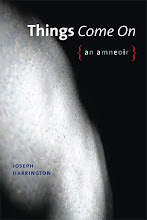
My “Big Project” is a trilogy of books about my mother’s life and times (and a lot of other things besides, like history in general, US in particular; time; gender; epistemology, etc etc). This is a follow up to my last book, Things Come On (an amneoir) [Wesleyan UP – now available in paperback! Woo-hoo!]

I’m also revising a poetry collection, working title: Extinction Canceling Button.

And I’m writing a book chapter about documentary poetry for a critical collection on 21st c. US political poetry.


2.)  How does your work differ from others of its genre?

Uh . . . it doesn’t have one? It doesn’t even establish one. I’m talking about this Big Project: it mixes and invents genres, uses whatever is ready to hand. One volume is inspired (loosely) by scrapbooks; another, by the archive; a third, by the newspaper. There’s verse, prose, dialogue, reproductions, headlines, photographs in each.

In terms of content, you could say it’s biograpahy/memoir/history. Indeed, the point is to think about those three genres as mutually constitutive: a small life as a tour through a big history, documentation merging with memory, all one text. The point is that you could write a trilogy of books about anybody’s life. My mom wasn’t famous – though she did work as Sen. Albert Gore’s secretary during the 1950s, which just makes her a famous-person enabler. But that’s an interesting perspective: from the wings. And doubly offstage, as a woman artist.

The poetry book is built around several voice-based serial poems, broadly on the theme of schizotheology, in a neo-necro-pastoral mode. I don’t think that’s ever been done before, do you?

The book chapter is, well, academic criticism. But it’s on a topic that hasn’t gotten much ink. And I think criticism/theory can and ought to be more interesting to read – more “creative” – and that’s what I’m moving towards.


3.)  Why do you write what you do?

Because I can’t help myself.


4.)  How does your writing process work?

And does it? Another pointed question!

As to the Big Project: bricolage. “FORM IS NEVER MORE THAN AN EXTENSION OF CONTENT,” to which Olson adds “this possible corollary, that right form, in any given poem, is the only and exclusively possible extension of content under hand.” To me, that corollary sounds like “There is only and exclusively one possible person for me, in all the whole wide world!” – a belief which has diverted billions of dollars of capital into the pockets of divorce lawyers.

I got yr corollary right here: throw it against the wall and see what sticks. But the writer has to do the throwing, even if she doesn’t use any of her own words in the text. One chooses one’s content, and the more moving parts, the more possible combinations.

If you’re working with existing texts, as I am, part of it has to do with which of those texts seem most compelling. In Things Come On, it turned out to be hearing transcripts and a medical chart – and those things largely suggested the structure of the book. Likewise, using scrapbooks, archives, and newspapers as research sources suggested broad structures for the others.

Then again, I’m revising the hell out of all of them. It’s not like Michelangelo “finding” the form in the marble. It’s more like a potter shaping something that’s in motion, in response to the shapes that are emerging in her hands. And then collapsing it all and doing it again. That sounds more organic than it is. But then all metaphors are.

As to the serial poems, I try to hew to Jack Spicer’s injunction to listen to “The Outside” – that is, to try not to find the perfect words to ex-press my inner truth, but rather to trust that I’m receiving something more important as words come into my head. And I collect phrases, sentences, etc. I have a “word collection” that I draw upon as the bricks for poemlets – then I put in new words to form the mortar. 

Anyway, here is a section of No Soap (v. 1 of the B.P., as free PDF) - a portion also appeared in Hotel Amerika; and here is a section of Griefing on Summit (v. 2). For poems, see earth day suite, published by the great Beard of Bees Press, also in Chicago, also as a free PDF.

[pause]

Is that it? Are we done? . . .

OK! Well, now that you’ve suffered through the warm-up act, here are the headliners for Feb. 17:

TONY TRIGILIO’s newest books are The Complete Dark Shadows (of My Childhood), Book 1 (BlazeVOX Books, 2014); White Noise (Apostrophe Books, 2013); and, as editor, Elise Cowen: Poems and Fragments (Ahsahta Press, 2014).  His other books include the poetry collections Historic Diary (BlazeVOX, 2011) and The Lama’s English Lessons (Three Candles Press, 2006); the chapbooks With the Memory, Which is Enormous (Main Street Rag Press, 2009) and Make a Joke and I Will Sigh and You Will Laugh and I Will Cry (Scantily Clad Press, 2008); and two books of criticism, Allen Ginsberg’s Buddhist Poetics (Southern Illinois University Press, 2012) and “Strange Prophecies Anew” (Fairleigh Dickinson University Press, 2000).  He is co-editor of the anthology Visions and Divisions: American Immigration Literature, 1870-1930 (Rutgers University Press, 2008).  He directs the program in Creative Writing/Poetry at Columbia College Chicago and is a co-founder and co-editor of Court Green. Tune in next Monday to Tony's website.

BEN CARTWRIGHT’s poetry and prose poetry have appeared in Sentence, The Stinging Fly, Parcel, and Midwestern Gothic.  He was awarded the Ana Damjanov Poetry Prize from the Academy of American Poets, and won third place in the 2012 Atty Award poetry contest, judged by Margaret Atwood.  Ben records poets reading their work for his Kansas Blotter poetry archive, and his recordings of the poets Kenneth Irby, Rachel Blau DuPlessis, and Fred Moten have been added to the PennSound archive.  Ben lives in Topeka, Kansas, and teaches creative writing and literature courses at the University of Kansas. Tune in next Monday to Ben’s Blog


LEA GRAHAM is the author of the poetry book, Hough & Helix & Where & Here & You, You, You (No Tell Books, 2011). Her poems, translations and reviews have been published in Notre Dame Review, Southern Humanities Review and Fifth Wednesday. She is a contributing editor for Atticus Review’s feature, “Boo’s Hollow,” which showcases poets writing on place.  She is an Associate Professor of English at Marist College in Poughkeepsie, New York. Her entry will appear on the Atticus Review web site (somewhere - stay tuned!).

Sunday, January 19, 2014

Questions & Observations for the Post-English-Major/Marketized-University Era in the Suburban Midwest


“The Customer’s always Right.”  - popular apothegm


College enrollments are declining, and those in the humanities, including English, are plummeting. This seems to me to be a result of the post-2008 economic collapse: fewer people can afford college, and those who can go into engineering and accounting, rather than literature. We have to do some serious sales to get people to be English majors. How to respond to this new reality?

- Do I need to be more entertaining in the classroom? How?
            - Should I start using PowerPoint all the time, showing more films, etc.?
            - Switch to large lectures and play up the performance aspect?
            - Do more in class w/computers (and let them check What’s App, porn, etc.?)
            - How do I “sell” my subject more effectively?
- How improve my effectiveness at teaching writing? What does the New Student positively respond to, in composition instruction? And does it really teach them to write?  

- How much can I realistically expect them to read (in a particular level)?
            - Teaching more lower-division courses means smaller assignments (?)
            - If I rely more on media produced by others, I can decrease the amount of   reading: since we
              won’t spend as much time talking, we won’t need as much to talk about.
            - If we want to attract English majors, we can’t go too hard on them. We want them to have a
              pleasant, relaxing experience.

- We’ve got to give the customer what they want. But we also have to sell it. (we’re beyond edutainment; this is edvertising)
So:
- Assign what I think that they should know about a given topic or what I think they will want to read/watch that’s related to that topic?
            - Any polling data of students on this issue?

The real problem is time. For instance, we don’t have enough time between when our course assignments come out and when our book orders are due to really think about and research how we might overhaul a particular course.

Moreover, we’re too busy teaching to radically alter our teaching. If we take time to learn new (or not-so-new) technologies, techniques, and pedagogical theories, it’s usually on break (or sabbatical, if we have them), which is also the only time to get any appreciable amount of research and writing done. So it’s back to research vs. teaching, esp. if teaching is not your area of research, or if your area of research is not one that students want to study (e.g., any type of poetry from any era).

There are, of course, good reasons why all this should be so: the students that are left in the university are working more hours to stay there. But then, on-line courses, which should theoretically be less time-consuming, have abysmal retention rates. The ultimate problem is that the ultimate "consumer" (i.e., employers) have a different set of desires than the immediate customer (i.e., the student). But if the ultimate consumer isn't satisfied, then the value to the immediate customer diminishes. If the student is the customer, and the customer's always right, then the student is always right. All I can say is that I'm glad my teachers didn't believe that.

Saturday, January 4, 2014

From "New Year's Eve," by Charles Lamb

"Of all the sound of all bells--(bells, the music nighest bordering upon heaven)--most solemn and touching is the peal which rings out the Old Year. I never hear it withoiut a gathering-up of my mind to a concentratio0n of all the images that have been diffused over the past twelvemonth; all I have done or suffered, performed or neglected--in that regretted time. I begin to know its worth, as wehn a person dies. It takes a personal colour; nor was it a poetical flight in a contemporary, when he exclaimed

           I saw the skirts of the departing Year."

Saturday, December 14, 2013

After the future, a lot of things don’t signify:

-->
grades, literature, publishing, networking, money, an individual’s inaccurate opinion of himself, another’s accurate opinion of me, politics, careers (remember those?), price-points, extinction of non-food species, credit ratings, deadlines, immaterial definitions of success and failure, deadlines, software compatibility issues, 401k’s (boy do those really not signify), trying to impress people, weather events that don’t knock the power out, “people with influence,” blogs, predictions, deferred gratification, losing sleep, prevention, resistance, engagement, participation, energy, the “news.”

Replacing the car’s wiper blades still signifies.

Friday, December 6, 2013

The Dying Elephant in the Middle of the Room

The one that no one really talks about: namely, that it's over. Democracy is over - has been for some time, in fact. The middle class is over, as is economic stability of any sort. Nature isn't over by a long shot, but it's changing a whole lot, very quickly, in ways that will disrupt everyone's life. People acknowledge that things are bad; but we keep behaving as though the future were going to be just a slightly worse version of the past. So people take on another job, looking forward to the day when things will start looking up; or they put money in their retirement accounts; they try to advance their careers; they try to raise their kids with essentially the same values and expectations they have. It's going to be more competitive to get a good job, but you will still be able to get a good job. A college degree will help you get there. If the Democrats can regain the House, then things will change in a big way!

But what if all that is self-delusion.

I recently read a couple of texts that take that premise seriously. The first, by Roy Scranton, "Learning How to Die in the Anthropocene," takes a rather philosophical approach - Stoic, even. He takes as a given that self-delusion is a bad thing; for him, there seems to be a certain nobility (or beauty?) in facing up to the facts.

The other, After the Future, by Autonomist theorist and activist Franco Berardi, posits that the future, understood as the possibility of progress, is at an end. There has been a "mutation," produced by finance capital, neoliberal politics, necroculture, and permanent natural changes, that prevents people from forming links of solidarity ("subjectivation") with one another. This is particularly true, according to Berardi, of the "cognitariat," those knowledge-workers in Palo Alto or Bangalore, who are ostensibly instantly and integrally interconnected. Instead, digital connections reinforce the culture of the cubicle.

Berardi does not end on a totally hopeless note. Rather, he believes that economic collapse will necessitate subjectivation, in the interests of survival. Moreover, the powerlessness of the individual may encourage the withdrawal of individuals from active participation in the economic and political systems that have led to this mess. The task now is to (a.) forget about the future as deferred gratification; pay attention to the present, and see what possibilities arise. Be willing to be surprised by new and unanticipated possibilities; and (b.) imagine what he (after Marx) calls the "general intellect" - that is, a self-consciousness of the collective intelligence of humanity.

There used to be these bumper stickers that said "I feel much better ever since I gave up hope," or something to that effect. Maybe hope is the problem, in fact.

Saturday, November 23, 2013

Don't Nobody With a Good Car NEED Redemption

From an e-mail exchange:

Q: I recently came across your interview with Kathleen Ossip online, and I really appreciated your comment that it is not necessary "to attach redemptive endings to stories that resist it" in talking about your writing and amneoir but I was curious as to why you referred to redemptive endings as an American desire?

A: Obviously, there are stories in all cultures that have redemptive endings (the Christian New Testament, for example). But not every culture insists on them all the time. There's something about US culture that values the story about victory despite the odds, recovery from serious _____, rags to riches, etc. Look at the memoirs on the New York Times Bestseller list, and you'll see what I mean. "I once was lost, but now am found" - the conversion narrative was the first American success story.

This is, of course, why a lot of modern writers write about the other side of things – the tragedies, the injustices, the more complicated and ambiguous stories. Some of them see the "American success story" as being ideology. That's why Theodore Dreiser titled his novel An American Tragedy. That's why Richard Wright wrote Native Son.

Saturday, October 12, 2013

If it has to be a pitcher's duel, best to have it end in 8 1/2 innings, rather than 13. As long as the Cards win.

Thursday, September 26, 2013

Criquettes

name-sayers
vainly hold
out for
summer's
coming again

when plants
exactly
keep time

Thursday, September 19, 2013

Poem for today (seemed appropriate)


The flags drop to half-mast
anytime anyone dies:
for the shooting in DC,
the one in Florida, the one
in Colorado, or any other state?
Or the ones 10 yrs ago today. Or
the ones that haven’t happened yet.

Not for the ones in Iraq,
I’m guessing.

The flags stay at half-mast
Half the whirlygigs shut
down at the wind farm

how now brown corn
cows browsing water
all along an irrigation arm:
mamma’s little animals
wanna live too.

there, there

where, where

Pappa’s little critters
say sauve qui peut

Monday, September 2, 2013

On _Occasional Desire: Essays_, by David Lazar

Reading David Lazar’s new book, Occasional Desire (U of Nebraska Press), is like eating the richest, most decadent and delicious flourless chocolate torte with raspberry coulis that you have ever had in your life, except it’s essays. This sensation is caused, in all likelihood, by the epigrammatic density and detectability of the writing. To wit:
Men in run-down, anachronistic businesses in New York in the 1960s always seemed to have the air of a Borscht Belt comedian who had gotten tired of telling jokes. They always seemed on the verge of saying something, before saying nothing.
For Lazar, the terms of my analogy (torte and retorte?) are not so far removed. For him (and his readers) the essay is a pleasure; it may or may not have nutritional value, but it will remind you that you are alive. Of course, by the same token, this particular torte may contain more than the allowable p.p.m. of gall. There’s a lot of rather unpleasant topics (like, uh, death, divorce, decay, dating). The thing is, his discussion of them transforms them into something - not necessarily palatable by themselves, but undeniable, when this writer serves them up.

Lazar’s guiding lights are Montaigne and Lamb, and one could do worse for guiding lights. He is an unrelenting proponent of the Essay - not “creative nonfiction,” i.e., the realist short story that happens to be derived from “real-life” material (though you wouldn’t know it if you were not told, so similar is the form to mainstream fiction). The essay is different from “autobiographical excursions that insist on epiphany” (too common in poetry, as well - in 2013 even - one might add). This is a crucial distinction, and you should buy the book simply to encourage someone who is willing to make it publicly and vociferously:
The best essay’s sheets are rumpled, askew; it sits on the corner of the bed with one eyebrow raised. Memoir, too often, stands at the window in white linen; it gazes out wistfully, not admitting it wants a large greasy breakfast.
Ouch. And right on. And funny, even to the point of near-Wildean zingers: “She had the laugh of someone who has had too much therapy, and needs much more.” “Meeting the dog” has already become a cross between a punch-line and a come-on in my home. Or more sober, but no less memorable: “A good run of bad luck strains our sense of the probable, turning it into the absurd. At such moments we see ourselves as fictional.” Narrative in the essay is OK - “Anecdotes are like essay candy” - but a whole book of candy? No thanks. Lazar deploys anecdotes, memoiristic or not, judiciously, as a saucy saucier should do.

The essay “Queering the Essay” makes a strong case that it is that genre (not, say, “Poetry”) that is the true and proper medium of trans-genre or genre queer (not unrelated to gender queer for Lazar) literature. Sure, he uses the materia poetica of his life - a lot of it, in fact. But it’s always in service to something that you can care about even if you don’t happen to be David Lazar: the frisson of a ringing pay phone (remember them?); taking a taxi in one’s (former) home town; death; mentorship; sex; the presentation of the self; death.

But the biggest pleasure (for this reader) of Lazar’s essays are his sentences:
But the fluid, indefinable masculinity of Astaire, the otherworldly trances of the great dances with Rogers (I clung tenaciously to the tow of them as the necessary pair) had been important to me ever since I started watching them on four o’clock movies - my gateway to so much ideological twaddle and necessity, so many images of charming impossibility, tuxes and gowns, beauty and wit, bandstands and banter, art deco and décolletage.
(this in an essay about death, mind you) For instance again: the sentence on page 12, beginning with “after” and ending with “tongue” would not be as funny as it is were not the penultimate and antepenultimate clauses as long as they are, in comparison to the last. (Really, you don’t have to think this way to enjoy the book - you can enjoy a boat ride w/o thinking about displacement and buoyancy. But civil engineers are different; you’ll still get to the other side, even if you aren’t one). Those of us who love the sentence as a unit of composition, its deepening level of clause subordination, even to the point of intricacy (not to mention those of us who cannot, even in the simplest sentence, resist the parenthetical aside), its workings, both mechanistic and organic, will be delighted by Lazar’s.

For him, the essay is not about linearity. Sure, you want the papers in freshman comp to be coherent; you want your instruction manual to stay on topic. Those are not essays in the Lazarian sense. “[I]n its classic form, the essay doesn’t quite know where the hell it’s going to go from the outset.” Lazar’s essays, like Emerson’s or Montaigne’s, are like listening to a particularly intelligent, sensitive, and creative friend captivate a dinner party after the plates are taken away; only in Lazar’s case, he has foregone the cognac for a triple espresso. To switch metaphors: his sentences are meandering paths into the woods: at first lovely, green, and sylvan, then darker and rather unsettling, and there may be a witch or mama grizzly (or MFK Fisher) at the end. But that’s what you get if you walk in the woods, and Lazar is the pied piper or sylph or whoever it is that draws you deeper in, until you realize your soul and body are where they really are anyway: lost. In addition to being formally inventive and delightful, the essays in Occasional Desire use humor and brio to get at the rather dark and tacky recesses of life. Here is his reading of the iconic airplane/cornfield scene in “North By Northwest”:
It’s a dream so large it could fill a childhood. The dreamer in this scene is a man on the ground, a man with a camera, a man watching the screen from the safety of his chair. But anyone awake in the dark or asleep in the day senses that the dreamer has an X on his back; he can only run hard in that timeless space and flat time, when the dark wings pick up speed and descend at midday, zeroing in on us, like a toy holocaust whose remote control is shattered.
Or overhearing a couple on a train and ruthlessly dissecting the moment:
SHE: What are you thinking about? 
HE:  I was wondering what you were thinking about.
SHE: Me too.
Understood by the eavesdropper: The couple is on a cusp, being prodded to jump onto the tracks of metalove by the little amourvore on their shoulders, the grim reaper who tells them their emerging self-consciousness is charming and knows, to boot, that no one will risk saying what’s really on his or her mind. The safest response can lead to romantic carnage.
I should say that my upscale culinary metaphor is chosen advisedly. As you might imagine, there is more of Freud than of Marx in this book: this essayist sees the world in terms of individuals and their relationships. If you’re looking for political critique that is just as incisive in its sphere, we should talk. But it has been my experience that political movements are composed of individuals and their (dysfunctional) relationships, and this book provides quite a bit of insight in that department. Indeed, much of Lazar’s charm comes from “a kind of adaptable interest in the world and seeing [him]self in it” - "himself" being a character as fallible and self-protective as any of us. Knowing your Freud doesn’t mean you can cure thyself, any more than knowing your Marx makes you a political organizer. But in both cases, auto-critique can go a long way.

But it’s the pleasure principle that keeps one engaged in Occasional Desire - even when reading about a preternaturally awkward date or about Francis Bacon’s sometimes ghoulish portraiture. No wonder I devoured it as fast as I’ve devoured any collection of essays. And it didn’t spoil my appetite for more!

Monday, August 19, 2013

Please Write One of Each of the Following . . .

A “motion” poem
A spoiler poem
A giddyup poem
A natal poem
A stereo poem
A theriomorphic poem
An orthoscopic poem
A steroidal poem
An e-motion poem
A contested poem
A pledged poem
A poem in thyrsids
A poem in crenelated stanzas
A poem in frosted couplets
A poem in a namby-pamby register
A wombly poem
A poem containing empids
A poem in “stacked” stanzas
A septiva
An ocharina
A “peasant” mandalay
A choirette
A bivouaced poem
A lost poem
A “boomerang” poem
A cavernous poem
A poem generated via a Madurzial operation
A baronial snivella
A shackled sonnet
A list poem
A stop poem

Saturday, August 10, 2013

Note on Notes on Notes on Conceptualisms

The central tenet of conceptual art is that the concept - the idea behind the art work - is more important than the work itself. If you have the idea that gave rise to the work, you don't need to see or read the result to "get" it.

Ergo, now that I know the concept behind conceptual art and writing pet se, it means that I don't have to read or see any conceptual art, or think about any conceptual writers or artists, or their critics, ever.

QED. . . . And what a relief!